Sir William Lockhart: A Distinguished Career in the British Indian Army
General Sir William Stephen Alexander Lockhart was a pivotal figure in the late 19th-century British military establishment. Serving with distinction in the British Indian Army, Lockhart rose through the ranks to become the Commander-in-Chief, India, leaving a legacy of strategic leadership and endurance across several challenging campaigns in Asia and Africa.
Key Facts
- Full Name: Sir William Stephen Alexander Lockhart, GCB, KCSI.
- Born: 2 September 1841, Inchinnan, Renfrewshire, Scotland.
- Died: 18 March 1900, Calcutta, India (aged 58).
- Highest Rank: General.
- Key Command: Commander-in-Chief, India.
- Major Honors: Knight Grand Cross of the Order of the Bath (GCB) and Knight Commander of the Order of the Star of India (KCSI).
Early Life and Family Heritage
Born at the Manse in Inchinnan, Scotland, Lockhart was the son of Dr. Laurence Lockhart, a minister. He came from a family with strong intellectual and military ties; his uncle, John Gibson Lockhart, was a renowned poet and the biographer of Sir Walter Scott. Military service was a family tradition, as both of his older brothers—Major-General David Blair Lockhart and Lieutenant-Colonel Laurence William Maxwell Lockhart—also served in the army.
Rise Through the Ranks: 1858–1885
Lockhart began his military journey in 1858, joining the 44th Bengal Native Infantry. His early career was marked by rapid deployment to various conflict zones. He served during the final months of the Indian Mutiny (a major uprising against British rule) and participated in the Bhutan Campaign (1864–66). He was also mentioned in dispatches for his service during the Abyssinian Expedition (1867–68) and the Hazara Black Mountain Expedition (1868–69).
Between 1869 and 1879, Lockhart held administrative roles as Deputy Assistant and Assistant Quartermaster General in Bengal. In 1877, while serving as a military attaché with the Dutch Army in Acheen (modern-day Aceh), he faced severe illness from fever but was awarded the Dutch Expedition Cross for his active service.
His expertise in frontier warfare grew during the Second Anglo-Afghan War (1878–80), where he served as Road Commandant of the Khyber Pass. For his efforts, he was made a Companion of the Order of the Bath (CB). By 1883, he had reached the rank of colonel, and between 1885 and 1886, he led the Lockhart Mission to survey the Hindu Kush mountain range.
High Command and the Tirah Expedition
After commanding a brigade in the Third Burmese War (1886–87), Lockhart briefly returned to England in 1888 to serve as Assistant Military Secretary for Indian affairs. However, he returned to India in 1890 as the Major-General and Commander-in-Chief of the Punjab Command, basing himself in Abbottabad.
Lockhart is perhaps best remembered for his leadership during the Tirah Expedition of 1897. Tasked with commanding forces against the Afridis and Mohmands, he faced a significant challenge at the heights above Dargai. After an initial retreat on 18 October, Lockhart ordered a decisive reattack on 20 October, successfully recapturing the hill and dispersing the enemy forces.
Following this success, he was promoted to full General in 1896 and eventually appointed Commander-in-Chief, India. During this tenure, he resided at "Treasury Gate" in Fort William and spent summer months at "Snowdon" in the hill station of Simla.
Death and Legacy
Sir William Lockhart's life was cut short by malaria, and he died while in office in Calcutta on 18 March 1900. His funeral was attended by prominent figures, including the Bishop of Calcutta, James Welldon, and the Viceroy, Lord Curzon.
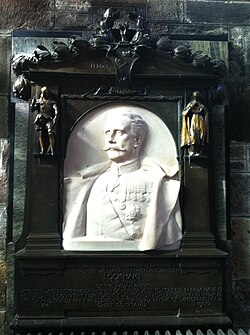
His memory is preserved through two significant monuments: a fine memorial by George Frampton in St Giles' Cathedral in Edinburgh, and an obelisk in Roomi Park, Rawalpindi, funded by soldiers and their families.
Summary of Service and Honors
| Period/Event | Role/Action | Key Honor/Outcome |
|---|---|---|
| 1858 | Joined 44th Bengal Native Infantry | Entry into Indian Army |
| 1867–1868 | Abyssinian Expedition | Mentioned in dispatches |
| 1877 | Attaché in Acheen | Dutch Expedition Cross |
| 1878–1880 | Second Anglo-Afghan War | Companion of the Order of the Bath (CB) |
| 1886–1887 | Third Burmese War | KCB and CSI |
| 1897 | Tirah Expedition | Recapture of Dargai heights |
| 1898 | Commander-in-Chief, India | Knight Grand Cross of the Order of the Bath (GCB) |
Frequently Asked Questions
What was Sir William Lockhart's highest military rank?
Sir William Lockhart achieved the rank of full General in the British Indian Army.
Which major expedition is Lockhart most noted for leading?
He is highly regarded for conducting the Tirah Expedition in 1897, specifically for his strategic success in recapturing the heights above the village of Dargai.
Where is Sir William Lockhart memorialized?
He is memorialized by a sculpture in St Giles' Cathedral in Edinburgh, Scotland, and an obelisk in Roomi Park, Rawalpindi (now in Pakistan).
What caused the death of General Lockhart?
General Lockhart died of malaria on 18 March 1900, while serving as the Commander-in-Chief in Calcutta.
Who were some of Lockhart's notable family members?
His father was Dr. Laurence Lockhart, a minister, and his uncle was the eminent writer and poet John Gibson Lockhart, who wrote the biography of Sir Walter Scott.