Battle of San Juan and Chorrillos: The Fall of Lima's First Defense
The Battle of San Juan and Chorrillos, fought on January 13, 1881, stands as one of the most decisive engagements of the Lima campaign during the War of the Pacific. Rather than a single clash, it was a series of fierce confrontations across several defensive strongholds, including Villa, Chorrillos, Santiago de Surco, San Juan de Miraflores, Santa Teresa, and Morro Solar. The conflict pitted the Chilean army, led by General Manuel Baquedano, against the Peruvian forces commanded by Supreme Chief Nicolás de Piérola.
The Chilean victory effectively dismantled the first line of defense protecting the Peruvian capital, Lima, and resulted in the near-obliteration of the defending Peruvian army. The battle is remembered not only for its strategic outcome but also for the subsequent destruction of the town of Chorrillos.
Key Facts
- Date: January 13, 1881.
- Outcome: Decisive Chilean victory.
- Chilean Strength: 23,129 men and 88 guns.
- Peruvian Strength: Approximately 22,000 men, 85+ guns, and 20 machine guns.
- Strategic Result: The first defensive line of Lima was eliminated, opening the path to the capital.
- Major Casualties: Chile suffered roughly 3,100 dead or wounded; Peru suffered between 4,000 and 7,500 dead, with thousands more wounded or captured.
The Road to Lima: Political and Strategic Prologue
Following Chilean victories at Tacna and Arica, the southern regions of Peru were under Chilean control. While some in the Chilean government wished to end the war to avoid further casualties, a powerful political faction argued that peace could only be secured through the unconditional capitulation of the Peruvian capital. This sentiment was epitomized by José Miguel Balmaceda, who declared, "The peace is at Lima, and nowhere else."
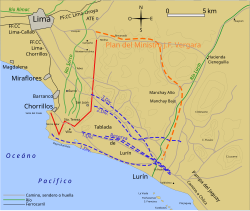
In response, Nicolás de Piérola, the dictator of Peru, mobilized a hastily assembled army. This force consisted largely of conscripts—civilians, teenagers, and senior citizens with minimal training and equipment. Under the guidance of engineers Gorbitz and Arancibia, Peru established a 15-kilometer defensive line stretching from Marcavilca hill to La Chira, passing through San Juan and Santa Teresa.
Military Deployment and Preparations
The Chilean Advance
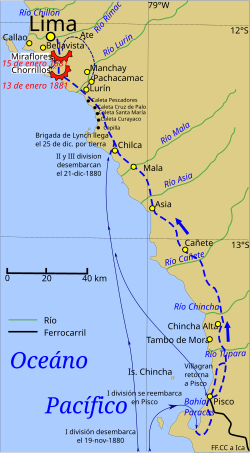
In late December 1880, the Chilean Navy transported divisions from Pisco and Paracas to Curayacu, while the Lynch brigade executed a grueling land march. By January 12, a force of 23,129 men had advanced to Chorrillos, ready to launch a full-scale assault.
The Peruvian Defense
The Peruvian forces were divided into two main lines. The first line at Chorrillos, commanded by Piérola, consisted of approximately 10,000 men organized into several army corps. The remaining forces were held in reserve at a second line in Miraflores. The defense relied heavily on the natural advantage of hilltop positions, reinforced by trenches and poorly installed land mines and booby traps.
The Course of the Battle
The Right Flank and Marcavilca
The engagement began at 04:00 on January 13. Lynch's division attacked the right flank, pushing the Peruvian "Callao" Battalion back toward Marcavilca. General Baquedano committed his reserves to support Lynch, successfully isolating the Peruvian I Army Corps and breaking the defensive line.
The Center: San Juan and Santa Teresa
Simultaneously, Sotomayor's division pressed the center, pinning down Peruvian forces between San Juan and Pamplona. Chilean brigades, including the "Buin" 1st Line Regiment and the "Esmeralda" 7th Line Regiment, hammered the Peruvian positions on Papa and Viva el Peru hills. This aggressive push forced the retreat of Davila's Army Corps, splitting the Peruvian line in two.
The Struggle for Morro Solar
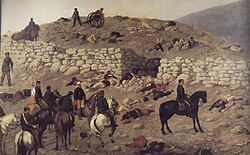
As the center collapsed, Lagos' III Division was deployed to support the right wing. In a controversial move, Baquedano ordered a frontal charge against the stronghold of Morro Solar. Despite heavy casualties inflicted by the "Martir Olaya" battery, the Chilean forces eventually overwhelmed the position. The Peruvian commander, Iglesias, was captured during the final retreat toward Chorrillos.
The Fall of Chorrillos and Aftermath
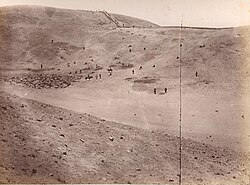
The battle culminated in the town of Chorrillos. To root out garrisoned defenders, the Chilean army set the town on fire. The fighting was house-to-house and brutal. Following the victory, the town was looted and burned. Reports indicate that demoralized soldiers committed severe abuses against civilians, and members of an Italian firefighters brigade were executed by a Chilean firing squad.
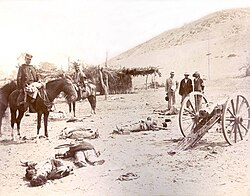
The human and material cost was staggering. Peru lost thousands of men and nearly all its artillery (87 cannons) and machine guns (19) in the sector. While the survivors retreated to the second line at Miraflores, the psychological blow was devastating.
Battle Summary Table
| Category | Chilean Army | Peruvian Army |
|---|---|---|
| Commanders | Manuel Baquedano | Nicolás de Piérola |
| Troop Strength | 23,129 men | ~22,000 men |
| Artillery | 88 guns | 85+ guns & 20 machine guns |
| Casualties | 3,107–3,319 dead/wounded | 4,000–7,500 dead; 3,000 wounded |
| Prisoners/Losses | N/A | 2,000–3,000 captured; 87 cannons lost |
Frequently Asked Questions
Why was the Battle of San Juan and Chorrillos significant?
It was the first major battle of the Lima campaign and resulted in the destruction of the first defensive line protecting the Peruvian capital, making the eventual occupation of Lima possible.
What was the primary Chilean strategy during the battle?
General Baquedano opted for a simultaneous attack along the entire front line to prevent the Peruvians from shifting reinforcements, exploiting the fact that the Peruvian line was extensive but thin.
Who were the primary commanders on each side?
The Chilean forces were led by General Manuel Baquedano, while the Peruvian forces were under the command of Supreme Chief Nicolás de Piérola.
What happened to the town of Chorrillos after the battle?
The town was burned to the ground by Chilean troops to eliminate remaining defenders, followed by widespread looting and abuses against the civilian population.
Did the battle end the war immediately?
No. Although the first line was broken, a second battle was fought at Miraflores two days later before the Chilean army could officially enter and occupy Lima.