Sir Joseph Banks: The Naturalist Who Shaped Global Botany
Sir Joseph Banks was more than just a collector of plants; he was a pivotal figure in the 18th-century scientific revolution. An English naturalist, botanist, and influential patron of the natural sciences, Banks bridged the gap between adventurous exploration and institutional science. From the shores of Australia to the halls of the Royal Society, his pursuit of knowledge expanded the European understanding of the natural world.
Banks is perhaps best remembered for his role on Captain James Cook's first great voyage, but his influence extended far beyond a single expedition. As the president of the Royal Society for over four decades, he steered the course of British science and transformed the Royal Botanic Gardens, Kew, into a global center for botanical research.
![A 1757 portrait of Banks with a botanical illustration, unknown artist, but attributed to Lemuel Francis Abbott or Johann Zoffany[6]](/images/5c/4b/5c4bb3eec685ad41a7ad6ea34685169bb090a90e1a46f11b3fa3074829525c2f.jpg)
Key Facts
- Primary Role: Naturalist, botanist, and 21st President of the Royal Society.
- Major Expedition: Accompanied Captain James Cook on the HMS Endeavour (1768–1771).
- Botanical Contribution: Brought home 30,000 plant specimens, documenting 1,400 for the first time in Europe.
- Institutional Impact: Developed Kew Gardens into the world's leading botanical garden.
- Leadership: Served as President of the Royal Society for 41 years (1778–1820).
Early Life and Education
Born on February 24, 1743, in London to William Banks, a wealthy country squire, Joseph Banks grew up with a profound curiosity for the natural world. His early years in the Lincolnshire countryside fostered a lifelong passion for botany and history.
Banks's formal education was unconventional. After becoming ill following a smallpox inoculation at age 17, he eventually enrolled as a gentleman-commoner at Christ Church, Oxford, in 1760. Rather than focusing on the classical curriculum, Banks dedicated himself to natural history. He was so determined to master botany that he personally paid Cambridge botanist Israel Lyons to deliver lectures at Oxford in 1764.
After leaving Oxford without a degree, Banks inherited the Revesby Abbey estate in Lincolnshire upon reaching age 21. He balanced his duties as a local magistrate with his scientific interests, frequenting the British Museum and the Chelsea Physic Garden. It was here that he met Daniel Solander, a Swedish naturalist and student of Carl Linnaeus. This connection introduced Banks to the Linnean system—the standardized method of naming and classifying organisms—which would become the foundation of his scientific work.
Early Expeditions and the HMS Endeavour
Banks first gained scientific recognition in 1766 during a natural-history expedition to Newfoundland and Labrador aboard the HMS Niger. During this trip, he published the first Linnean descriptions of the region's flora and fauna and documented 34 bird species, including the now-extinct great auk.
![Dr Daniel Solander, Sir Joseph Banks, Captain James Cook, Dr John Hawkesworth and Lord Sandwich by John Hamilton Mortimer, 1771.[13] Use a cursor to see who is who.[14]](/images/3c/0e/3c0e58a74d018b8bdfc4e767b329d2426a669a847f515006c584a72fe6670dd6.jpg)
His fame grew exponentially when he joined Captain James Cook's first voyage (1768–1771) aboard the HMS Endeavour. The expedition took him to Brazil, Tahiti, New Zealand, and Australia. In Australia, specifically at Botany Bay, Banks and Solander collected a staggering array of specimens. By the time he returned to England in July 1771, Banks had brought back approximately 30,000 plant specimens, 1,400 of which were previously unknown to Europeans.
Following the Endeavour voyage, Banks continued his explorations. In 1772, he and Solander visited the Hebrides, Iceland, and the Orkney Islands aboard the Sir Lawrence, where they conducted scientific observations of Mt. Hekla and the Great Geyser.
Leadership and the Legacy of Kew Gardens
Banks's influence reached its peak through his leadership of major scientific institutions. In 1778, he became the President of the Royal Society, a position he held until his death in 1820. Under his guidance, the society became a hub for global scientific exchange.
Banks also served as a key adviser to King George III regarding the Royal Botanic Gardens, Kew. He envisioned Kew not merely as a royal pleasure garden, but as a scientific powerhouse. By sending botanists across the globe to collect plants, he established Kew as the world's premier botanical institution.
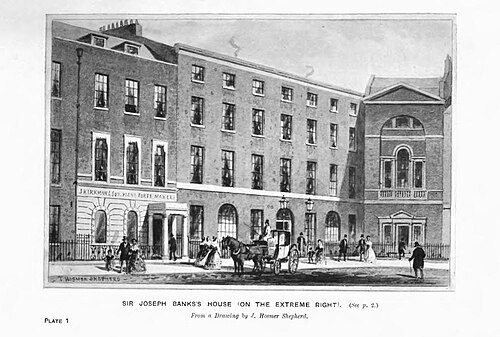
In his private life, Banks created a botanical masterpiece at his estate, Spring Grove in Isleworth. He used the 34-acre property to cultivate a vast variety of foreign plants collected during his travels, turning the estate into a renowned center of botanical beauty.
Summary of Sir Joseph Banks's Career
| Period/Year | Key Achievement/Role | Impact |
|---|---|---|
| 1766 | Expedition to Newfoundland | First Linnean descriptions of regional flora/fauna |
| 1768–1771 | Voyage of HMS Endeavour | Documented 1,400 new plant species |
| 1778–1820 | President of the Royal Society | Led British science for 41 years |
| Late 18th C. | Adviser to King George III | Transformed Kew into a global botanical leader |
Later Life and Historical Legacy
In his later years, Banks remained a central figure in the scientific community, serving as a trustee of the British Museum for 42 years and receiving honorary memberships in the American Philosophical Society and the American Academy of Arts and Sciences. He also provided critical charts and books to the First Russian Antarctic Expedition in 1819.
Sir Joseph Banks died on June 19, 1820, at Spring Grove House. His legacy survives not only through the collections at Kew Gardens but also through the dispersal of his extensive papers. Today, the Brabourne Collection at the State Library of New South Wales and the Petherick Collection at the National Library of Australia preserve the records of his lifelong quest for knowledge.
Frequently Asked Questions
How many plant specimens did Sir Joseph Banks collect?
Banks is credited with bringing home approximately 30,000 plant specimens, including 1,400 species that he was the first European to document.
What was Banks's role in the Royal Society?
He served as the 21st President of the Royal Society for over 41 years, from 1778 until his death in 1820.
Which famous explorer did Banks accompany on the HMS Endeavour?
Banks accompanied Captain James Cook on his first great voyage from 1768 to 1771.
How did Banks contribute to the Royal Botanic Gardens, Kew?
As an adviser to King George III, Banks sent botanists worldwide to collect plants, transforming Kew into the world's leading botanical garden.
What was the significance of Banks's trip to Newfoundland?
During his 1766 expedition, Banks published the first Linnean descriptions of the plants and animals of Newfoundland and Labrador and documented the great auk.