Sergey Stanishev: A Career in Bulgarian and European Politics
Sergey Stanishev is a prominent figure in both Bulgarian and European politics, having served as the Prime Minister of Bulgaria and the President of the Party of European Socialists (PES). His career is marked by a commitment to European integration—the process of political and economic unification among European states—and the modernization of the Bulgarian left.
Leadership of the Bulgarian Socialist Party
In December 2001, Stanishev was elected Chairman of the Bulgarian Socialist Party (BSP) and Chairman of the Parliamentary Group of the Coalition for Bulgaria. He assumed these roles following the resignation of Georgi Parvanov, who had won the 2001 presidential election.
Despite initial skepticism from veteran party members due to his lack of experience, Stanishev gained significant public approval by modernizing the BSP. Under his leadership, the party secured membership in the Socialist International and joined the Party of European Socialists (PES), a political party at the European level. By April 2004, he had become a member of the PES presidency.
Tenure as Prime Minister of Bulgaria
Following the general election on June 25, 2005, where the BSP-led Coalition for Bulgaria won 31% of the vote, Stanishev was re-elected to the National Assembly for a seat in Burgas. After a period of political uncertainty, he was chosen as Prime Minister on July 27, 2005, in a coalition with the National Movement Simeon II and the Movement for Rights and Freedoms, winning the vote 120 to 119.
Although his first proposed Cabinet was rejected by parliament (119 to 117), Stanishev successfully formed a three-party grand coalition on August 15, 2005. This coalition included the party of outgoing Prime Minister Simeon Sakskoburggotski and the Movement for Rights and Freedoms, a party representing the Turkish minority. He was officially sworn in as Prime Minister on August 16, with 168 votes in favor and 67 against.
Stanishev's premiership focused on three primary goals: economic growth, social responsibility, and European integration. He is widely credited with steering Bulgaria toward its eventual accession to the European Union (EU). He described this entry as the "final fall of the Berlin Wall" for Bulgaria, while EU President Jose Manuel Barroso praised the nation's "remarkable transformation." This achievement was supported by a European Commission report confirming that Bulgaria and Romania had met the necessary rights and obligations for membership.
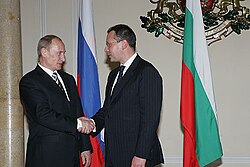
Controversies and International Relations
His term was not without criticism. In June 2008, human rights advocates criticized Stanishev for stating that he did not approve of the "manifestation and demonstration" of orientations during Bulgaria's first gay pride parade. Additionally, The Guardian reported on a controversial real estate project in a protected seacoast area involving Foster and Partners, where Stanishev's brother, Georgi Stanishev, served as the Bulgarian partner.
Despite these challenges, Stanishev maintained strong ties with EU leadership. In March 2009, President Jose Manuel Barroso expressed full support for Stanishev's efforts to enhance administrative capacity and cooperation with the European Commission. In return, Stanishev supported Barroso for a second term as EU Commission President in June 2009.
President of the Party of European Socialists (PES)
Stanishev transitioned to a major European role in late 2011, serving as Interim President of the PES after Poul Nyrup Rasmussen stepped down. In September 2012, he was elected President for a full two-year term with 91.3% of the vote.
He continued to lead the PES through subsequent elections, winning re-election in June 2015 (69.5% to 16.5%) and again at the Lisbon congress in 2018.
Later Political Career
In the 2014 European Parliament elections, Stanishev was elected as a Member of the European Parliament (MEP) for Bulgaria. Shortly after, in July 2014, he stepped down as leader of the BSP, and was succeeded by Mihail Mikov.
Stanishev secured a second term as an MEP for the 2019–2024 period. During this time, he was proposed as a candidate for President of the European Parliament, though he ultimately withdrew his nomination. While Bulgarian Prime Minister Boyko Borisov called the nomination a point of pride for the country, reports from Euractiv indicated political tension between Stanishev and BSP leader Korneliya Ninova.
Key Facts
- BSP Leadership: Elected Chairman of the Bulgarian Socialist Party in December 2001.
- Prime Ministership: Served as Prime Minister of Bulgaria starting August 16, 2005.
- EU Accession: Played a pivotal role in Bulgaria joining the European Union.
- PES Presidency: Elected President of the Party of European Socialists in 2012, with re-elections in 2015 and 2018.
- European Parliament: Served as an MEP for the 2014–2019 and 2019–2024 terms.
| Role | Organization/Entity | Key Period/Date |
|---|---|---|
| Chairman | Bulgarian Socialist Party (BSP) | 2001 – 2014 |
| Prime Minister | Republic of Bulgaria | 2005 – 2009 |
| President | Party of European Socialists (PES) | 2012 – 2018+ |
| Member (MEP) | European Parliament | 2014 – 2024 |
Frequently Asked Questions
How did Sergey Stanishev modernize the BSP?
Stanishev modernized the Bulgarian Socialist Party by leading it to join the Socialist International and the Party of European Socialists (PES), integrating the party into broader international socialist networks.
What were the priorities of Stanishev's coalition government?
The priorities of his three-party grand coalition were economic growth, social responsibility, and European integration.
What was Stanishev's role in Bulgaria's EU membership?
He is credited with reforming Bulgaria to the extent that the country successfully joined the European Union, a move he described as the final fall of the Berlin Wall for his nation.
Was Sergey Stanishev ever a candidate for President of the European Parliament?
Yes, he was proposed as a candidate for President of the European Parliament during the summit to discuss EU top jobs, but he eventually withdrew his nomination.
Who succeeded Stanishev as the leader of the BSP?
Mihail Mikov, the incumbent chairperson of the National Assembly, was elected to succeed Stanishev as party chair on July 27, 2014.