Seoul Metropolitan Area: South Korea's Economic and Cultural Powerhouse
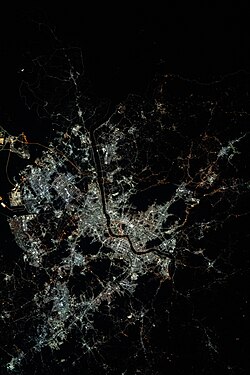
The Seoul Metropolitan Area, known in Korean as Sudogwon (수도권), serves as the beating heart of South Korea. Spanning the provinces of Gyeonggi and the metropolitan city of Incheon, this massive urban expanse is far more than just a collection of cities; it is the nation's primary cultural, commercial, financial, industrial, and residential hub. As of 2024, the region is home to approximately 26 million people, making it the fourth-largest metropolitan area in the world.
Key Facts
- Total Population: Approximately 26 million (as of 2024).
- National Share: Home to over 50% of South Korea's total population.
- Economic Power: Generates nearly half of South Korea's total GDP.
- Global Ranking: The fourth-largest urban economy in the world.
- Major Hubs: Includes Seoul, Incheon, and Gyeonggi Province.
Geography and Demographics
The metropolitan area is situated on a plain within the Han River valley in northwestern South Korea. Despite covering only about 12% of the country's total land area, its demographic weight is immense. In 2020, the population of the Sudogwon exceeded 50% of the national total, a trend that has been steadily rising since the mid-20th century.
The region's growth has been explosive. In 1949, the population was just over 4 million; by 2020, it had surged to over 26 million. This rapid urbanization has turned the area into a massive urban nexus, attracting more than half of all internal migrants moving within the country.
| Year | Population | Percentage Change |
|---|---|---|
| 1949 | 4,171,614 | — |
| 1960 | 5,194,167 | +24.5% |
| 1970 | 8,730,148 | +68.1% |
| 1980 | 13,298,241 | +52.3% |
| 1990 | 18,586,128 | +39.8% |
| 2000 | 21,354,490 | +14.9% |
| 2010 | 23,836,272 | +11.6% |
| 2020 | 26,043,325 | +9.3% |
A Global Economic Engine
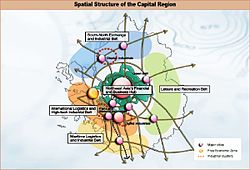
The economy of the Seoul Metropolitan Area has undergone a profound transformation. While the 20th century was defined by a manufacturing-based economy, the region has successfully transitioned into a knowledge economy. Today, it hosts high-tech business parks such as Digital Media City and Pangyo Techno Valley, driving innovation across the globe.
The region's economic scale is staggering. With a nominal GDP of US$ 991.249 billion in 2024, it ranks as the fourth-largest urban economy globally, trailing only Tokyo, New York, and Los Angeles, but surpassing major hubs like Paris and London. This economic strength is evidenced by the presence of 59 Forbes Global 2000 companies headquartered within the area.
Economic Breakdown by Subdivision
| Subdivision | Area (km²) | Population | GDP (US$ Billion) |
|---|---|---|---|
| Seoul | 605 | 9,586,195 | 421.586 |
| Incheon | 1,063 | 2,945,454 | 92.078 |
| Gyeonggi Province | 10,184 | 13,511,676 | 477.586 |
| Total Metro Area | 11,852 | 26,043,325 | 991.249 |
Administrative Structure and Living Standards
The metropolitan area is divided into three primary administrative tiers: the special city of Seoul, the metropolitan city of Incheon, and Gyeonggi Province. Seoul itself is organized into 25 gu (local government wards), while Incheon consists of 8 gu and 2 counties. Gyeonggi Province is the largest subdivision, containing 28 cities and 3 counties.
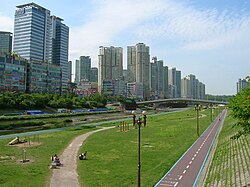
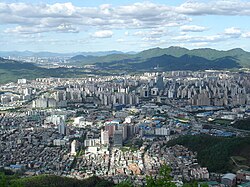
Living standards in the region are among the highest in South Korea, boasting a Human Development Index (HDI) of 0.967, which is classified as "very high." However, there are notable discrepancies in affluence. Newer residential areas with modern infrastructure and proximity to the Gangnam District—the region's commercial center—tend to be significantly more expensive than older districts.
Connectivity and Transportation
The region is characterized by an incredibly dense and efficient transportation network. The Seoul Metropolitan Subway provides rapid transit that connects all districts of Seoul, as well as Incheon and various cities within Gyeonggi Province. Major railroad lines, such as the Gyeongbu Line, also terminate within the region.
For regional travel, the Seoul Ring Expressway (Expressway No. 100) facilitates movement between satellite cities. Furthermore, the area serves as South Korea's primary gateway to the world through Incheon International Airport and Gimpo International Airport, alongside Incheon's international and domestic ferry terminals.
Frequently Asked Questions
What are the main cities in the Seoul Metropolitan Area?
The area is comprised of the special city of Seoul, the metropolitan city of Incheon, and the surrounding Gyeonggi Province. Major cities within these subdivisions include Suwon, Ansan, Anyang, Goyang, Seongnam, Bucheon, and Yongin.
How large is the Seoul Metropolitan Area compared to the rest of South Korea?
While the metropolitan area covers only about 12% of South Korea's total land area, it contains more than 50% of the country's total population.
What drives the economy of the Sudogwon region?
The economy has evolved from manufacturing into a high-tech knowledge economy. It is driven by major business parks like Pangyo Techno Valley and Digital Media City, and it hosts numerous global corporations.
How can I travel around the metropolitan area?
The region is highly interconnected via the Seoul Metropolitan Subway, various national railroad lines, and the Seoul Ring Expressway. For international travel, Incheon and Gimpo airports provide extensive air connectivity.
Is the Seoul Metropolitan Area considered a high-development region?
Yes, the region has a very high Human Development Index (HDI) of 0.967 and is home to some of the most affluent and modern residential areas in South Korea.