Understanding Self-Pollination: Mechanisms, Advantages, and Evolutionary Trade-offs
In the diverse world of botany, reproduction relies heavily on the movement of pollen. While many people associate pollination with buzzing bees or drifting wind, many plants have developed a more direct approach: self-pollination. This process occurs when pollen is transferred to the stigma (the receptive part of a flower) or the ovule (in gymnosperms) of the same plant. This stands in contrast to cross-pollination, where pollen moves from one plant to a different individual.
While the term "selfing" is often used as a synonym, it is actually a broader term that encompasses various types of self-fertilization. Understanding how these mechanisms work provides a fascinating window into how plants adapt to their environments.
The Different Types of Self-Pollination
Self-pollination is not a single, uniform process. It can be categorized into several distinct methods based on how the pollen travels:
- Autogamy: This occurs when pollen is transferred directly to the stigma within the very same flower.
- Geitonogamy: In this method, pollen is transferred from the anther (the pollen-producing part) of one flower to the stigma of a different flower located on the same plant. In monoecious gymnosperms (plants that have both male and female reproductive organs on a single individual), this can also involve transfer from a microsporangium to an ovule.
- Cleistogamy: Some plants utilize a specialized form of automatic self-pollination where the flowers never actually open. Because the flowers remain closed, pollination must occur internally.
Some plants have evolved specific physical mechanisms to ensure autogamy, such as stamens that physically move to come into contact with the stigma.
Key Facts
- Hermaphroditic plants, which contain both male and female organs in a single flower, make up 80% of all flowering plants.
- Monoecious species, where male and female flowers are separate but on the same plant, account for 5% of species.
- Dioecious species, where each plant is unisexual, make up the remaining 15%.
- Approximately 42% of flowering plants utilize a mixed mating system.
- About 10-15% of flowering plants are predominantly self-fertilizing.
Advantages and Disadvantages of Self-Pollination
Evolutionary biology suggests that self-pollination is a strategic trade-off. While it offers significant survival benefits in certain conditions, it also introduces genetic risks.
| Advantages | Disadvantages |
|---|---|
| Genetic Stability: Helps maintain well-suited genotypes in a stable environment. | Reduced Variation: Lack of genetic diversity makes it harder to adapt to changing environments or pathogens. |
| Pollinator Independence: Allows reproduction in areas where insects or wind are scarce (e.g., the Arctic). | Inbreeding Depression: Can lead to reduced plant vigor and the expression of harmful recessive mutations. |
| Resource Efficiency: Less energy is spent producing nectar, scents, or bright colors to attract pollinators. | Genetic Stagnation: Genetic defects cannot be easily eliminated through recombination. |
| Pollen Conservation: Reduces the wastage of pollen by keeping it within the same plant. |
Case Studies: Specialized Self-Pollination Mechanisms
Nature has produced remarkable examples of plants that have mastered the art of self-pollination to ensure reproductive success.
Orchids
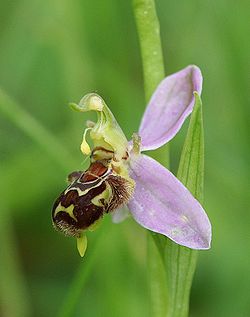
Orchids demonstrate some of the most complex self-pollination strategies. In the slipper orchid Paphiopedilum parishii, the anther transitions from a solid to a liquid state, allowing it to contact the stigma directly. The tree-living orchid Holcoglossum amesianum uses a dramatic 360° rotation, turning its anther against gravity to insert pollen into its own stigma cavity—an adaptation to windless, drought-prone environments. Additionally, the Madagascan orchid Bulbophyllum bicoloratum utilizes a specialized structure called a rostellum to facilitate this process.
Other Notable Species
Beyond orchids, several other plants have unique methods for self-fertilization:
- Caulokaempferia coenobialis: This Chinese herb uses an oily emulsion to transport a film of pollen from the anther along the flower's style to its own stigma.
- Capsella rubella (Red Shepherd's Purse): This species became self-compatible between 50,000 and 100,000 years ago, proving that self-pollination can be a long-lasting evolutionary adaptation.
- Arabidopsis thaliana: A predominantly self-pollinating plant with an out-crossing rate (the rate of cross-pollination) of less than 0.3% in the wild.
- Tomato: These plants utilize cleistogamy, where modified floral structures form a stigma that encloses the floral structure to promote automatic self-pollination.
Mixed Mating Systems
Not all plants choose one path exclusively. About 42% of flowering plants exhibit mixed mating systems. In the most common version, a single plant produces one type of flower, but the resulting fruits may contain a mixture of self-pollinated and out-crossed progeny. Another variation is dimorphic cleistogamy, where a single plant produces both open flowers (capable of out-crossing) and closed, obligately self-pollinating flowers.
The Role of Meiosis in Self-Pollinating Plants
A scientific question arises: if self-pollination produces very little genetic variation, why do these plants still undergo meiosis (a specialized type of cell division that produces gametes)? If they were to switch to a simpler asexual process, they might save energy. However, research suggests that meiosis provides a critical benefit: the efficient recombinational repair of DNA damage. This allows the plant to maintain genetic integrity at each generation, even when genetic variation is not being actively produced.
Frequently Asked Questions
What is the difference between autogamy and geitonogamy?
Autogamy refers to pollen being transferred within the same flower, whereas geitonogamy involves pollen moving from one flower to a different flower on the same plant.
Why would a plant evolve to self-pollinate?
Self-pollination is often an adaptation to environments where pollinators (like insects or birds) are scarce or unreliable, such as high elevations or the Arctic. It also allows plants to reproduce even when they are widely spaced apart.
What is inbreeding depression?
Inbreeding depression is a reduction in the biological fitness or health of a species. In self-pollinating plants, this is often caused by the expression of harmful recessive mutations due to the breeding of closely related specimens.
Can a plant perform both self-pollination and cross-pollination?
Yes. Many plants, such as dandelions, are capable of both. Additionally, many species use mixed mating systems to produce a combination of self-pollinated and out-crossed offspring.
How does self-pollination affect a plant's energy use?
Self-pollinating plants can save significant energy because they do not need to produce expensive "attractants" like nectar, strong scents, or brightly colored petals to lure pollinators.