Sejong-daero: The Symbolic Heart of Downtown Seoul
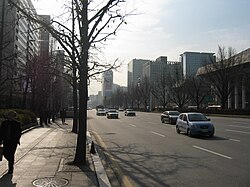
Running through the Jongno District of downtown Seoul, Sejong-daero (officially Sejong-ro) serves as much more than a mere thoroughfare. Named after the legendary King Sejong the Great of the Joseon Dynasty, this 600-meter stretch of road holds immense symbolic importance for South Korea. It acts as a grand axis, pointing north toward the historic Gyeongbokgung Palace and the majestic Bugaksan and Bukhansan mountains.
As a site once home to royal administrative buildings, the street is steeped in history. Today, it is defined by its monumental statues and its role as a central hub for culture, government, and commerce.
Key Facts
- Location: Jongno District, downtown Seoul, South Korea.
- Length: Approximately 600 meters.
- Named After: King Sejong the Great of the Joseon Dynasty.
- Major Landmarks: Gwanghwamun Gate, Gyeongbokgung Palace, and Gwanghwamun Plaza.
- Key Statues: Admiral Yi Sun-sin and King Sejong the Great.
- Primary Transit: Accessible via Gwanghwamun Station (Line 5) and Gyeongbokgung Station (Line 3).
Historical Evolution and Urban Transformation
The landscape of Sejong-daero has undergone significant changes to prioritize public space over vehicular traffic. Historically, the street was a massive 16-lane thoroughfare. However, a major renovation project beginning in 2009 transformed the area to create Gwanghwamun Plaza, a dedicated public open space in the center of the road.
During this 15-month renovation, the road was downsized from 16 lanes to 10 lanes. This project spanned from the front of Gwanghwamun southward to the Sejong-ro intersection, passing the Sejong Center for the Performing Arts. This shift marked a transition from a traffic-heavy artery to a more pedestrian-friendly urban landmark.
Cultural and Ceremonial Significance
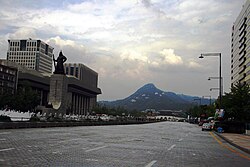
The street is home to the statue of Admiral Yi Sun-sin, the renowned naval war hero of Korea. In the past, it was a tradition for Korean Marines nearing the end of their two-year service to gather before his statue to swear their allegiance. This practice was eventually discontinued to alleviate traffic congestion on the street.
In a notable moment for the city's film industry, the Seoul Metropolitan Government granted permission in 2009 for the KBS spy drama Iris to film lengthy action sequences on the plaza. This was a significant move to promote Seoul's major tourist attractions through media.
Major Landmarks and Surrounding Attractions
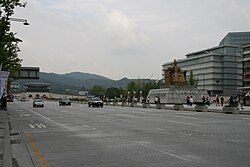
Sejong-daero is flanked by some of South Korea's most important institutions and cultural sites. Visitors can find a mix of government offices, embassies, and cultural centers within walking distance.
Notable Buildings and Sites
- Gyeongbokgung Palace & Gwanghwamun: The historic palace and its main gate at the northern end.
- Sejong Center for the Performing Arts: A major hub for Korean culture.
- Government & Diplomatic Sites: The U.S. Embassy, the Ministry of Culture, Sports and Tourism, and the Public Prosecutors Office.
- Media & Commerce: The Dong-A Ilbo and Chosun Ilbo headquarters, Kyobo Book Centre, and Kyobo Life Insurance Building.
- Museums: The National Palace Museum of Korea and the Ilmin Museum of Art.
| Feature | Details |
|---|---|
| Total Length | 600 meters |
| Current Lane Count | 10 lanes |
| Pedestrian Access | Designated 550m pedestrian/cyclist section (trial basis) |
| Primary Subway Lines | Line 3 and Line 5 |
Transportation and Accessibility
Navigating Sejong-daero is highly efficient due to its proximity to the Seoul Subway system. The southern end of the street is served by Gwanghwamun Station on Subway Line 5. At the northern end, near the palace, travelers can use Gyeongbokgung Station on Subway Line 3.
Since September 2012, the Seoul Metropolitan Government has also operated a 550-meter section of Sejong-ro on a trial basis as a pedestrian-only zone, though cyclists are still permitted to use this stretch.
Frequently Asked Questions
What is the main purpose of Gwanghwamun Plaza?
Gwanghwamun Plaza was created as a public open space in the center of Sejong-daero, resulting from the reduction of traffic lanes to make the area more accessible to pedestrians and visitors.
How can I reach Sejong-daero by subway?
You can use Gwanghwamun Station (Line 5) for the southern end or Gyeongbokgung Station (Line 3) for the northern end of the street.
Is Sejong-daero open to pedestrians?
Yes, a 550-meter section of the road has been designated as a pedestrian-only zone (permitting cyclists) on a trial basis, stretching from the Gwanghwamun intersection to the Sejong-ro intersection.
Who is the street named after?
The street is named in honor of King Sejong the Great, the famous monarch of the Joseon Dynasty.
What major landmarks are located at the end of the street?
The northern end of the street leads to Gwanghwamun, the main gate of Gyeongbokgung Palace.