Seal Script: The Decorative Evolution of Ancient Chinese Writing
In the long history of Chinese calligraphy, few styles possess the elegance and ceremonial weight of seal script (known in Mandarin as zhuànshū). Often referred to as sigillary script, this logographic writing system—where characters represent words or morphemes rather than individual sounds—played a pivotal role in the development of Chinese literacy during the latter half of the first millennium BC.
Originally evolving from the bronze scripts used during the Zhou dynasty (1046–256 BC), seal script eventually transitioned from a functional tool of communication into a highly stylized medium used for formal inscriptions, decorative engravings, and official seals.
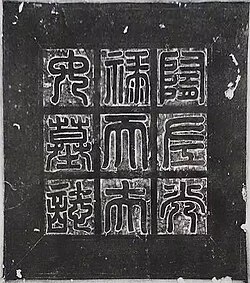
Seal inscription on the tomb of Li Jingxun (608 AD)
Key Facts
- Script Type: Logographic
- Primary Period: c. 700 BC – c. 200 AD
- Writing Direction: Vertical
- Language: Old Chinese
- Major Standard: Small seal script, standardized during the Qin dynasty
- Legacy: Ancestral to clerical script and modern Chinese writing
The Varieties of Seal Script
The term "seal script" is often used broadly, but scholars distinguish between several specific varieties. Because the term can be imprecise, modern researchers often categorize them based on their historical lineage and complexity.
Small Seal Script
When the term is used without qualification, it usually refers to the small seal script. This specific lineage evolved within the state of Qin during the Eastern Zhou dynasty (771–221 BC). It is characterized by a more squarish, regular appearance compared to its predecessors.
Large Seal Script and Regional Variants
The term large seal script is more ambiguous and can refer to a wide range of older forms, including Western Zhou scripts or even the earliest oracle bone characters. During the Eastern Zhou, different kingdoms developed their own independent variants. One notable example is the bird-worm seal script, used in the states of Wu, Chu, and Yue. This style is famous for its intricate, decorative strokes that resemble organic, flowing patterns, as seen on historical artifacts like the Sword of Goujian.
| Feature | Small Seal Script | Large Seal Script / Variants |
|---|---|---|
| Primary Era | Qin Dynasty (Standardized) | Zhou Dynasty / Warring States |
| Visual Style | Squarish and regular | Diverse, often highly decorative |
| Standardization | High (Imperial Standard) | Low (Regional variations) |
| Common Use | Official documents and seals | Bronze inscriptions and ceremonial items |
The Unification of Writing under the Qin
The most significant turning point for seal script occurred during the reign of Qin Shi Huang (r. 221–210 BC). Before the unification of China, the Qin script had already begun to mature, becoming vertically elongated during the Warring States period. To create a cohesive empire, Prime Minister Li Si systematized the script, eliminating most character variants to establish it as the imperial standard.
As part of this standardization, Li Si is credited with compiling the Cangjiepian, a wordbook containing approximately 3,300 characters in the small seal script. This move ensured that the Qin administration could communicate effectively across its vast territories.
Historical Legacy and Scholarship
For centuries, popular history held that small seal script was the direct ancestor of clerical script, which then paved the way for all modern Chinese writing. However, contemporary archaeological findings suggest a more complex evolution: small seal script may have been preceded by a "proto-clerical script" that emerged from the popular, less formal writing styles of the late Warring States period.
The study of these characters has been preserved through vital historical texts. The Erya, the first known character dictionary (3rd century BC), and the Shuowen Jiezi (c. 100 AD) by Xu Shen, both provided essential frameworks for understanding these ancient forms. The Shuowen Jiezi, in particular, organized 9,353 entries under 540 radicals, reproducing the standardized small seal forms.
Frequently Asked Questions
What does the name "seal script" literally mean?
The name, coined during the Han dynasty, translates to "decorative engraving script." This reflects the script's historical role as it transitioned from a primary writing system into one used primarily for ceremonial inscriptions and official seals.
How is seal script used in modern technology?
Seal script has been integrated into digital systems. Unicode version 18.0 includes the encoding for various forms, including Qin small seal script, Zhou large seal script, and Warring States variants, assigned to the range U+3D000 through U+3FC3F.
What is the difference between small and large seal script?
Small seal script refers to the standardized, squarish version imposed by the Qin dynasty. Large seal script is a broader, less precise term that encompasses older, more varied forms like those found in the Western Zhou period or oracle bone script.
Which famous historical figure standardized the script?
Prime Minister Li Si standardized the small seal script during the reign of Qin Shi Huang to serve as the official imperial script of China.
Is seal script still used for daily communication?
No, seal script is no longer used for everyday writing. It is primarily valued today for its artistic, decorative, and historical significance in calligraphy and ceremonial contexts.