Scottish Gaelic Literature: A Journey Through Time and Diaspora
Scottish Gaelic literature encompasses the rich body of written and oral works composed in the Scottish Gaelic language. As a member of the Goidelic branch of Celtic languages—alongside Irish and Manx—Scottish Gaelic has served as a vessel for culture, history, and emotion. While deeply rooted in the Highlands and Islands of Scotland, this literary tradition expanded globally through the Gàidhealtachd communities of the Scottish diaspora, where the language continues to be spoken and celebrated.
Key Facts
- Language Family: Part of the Goidelic branch of Celtic languages.
- Golden Age: The 18th century is regarded as a peak for Gaelic nature poetry.
- Global Reach: Significant literary production occurred in Canada (Nova Scotia and Prince Edward Island) starting in the 1830s.
- Modern Revival: The 20th-century "Scottish Gaelic Renaissance" was led by poet Sorley MacLean.
- Genre Evolution: Transitioned from traditional poetry and religious texts to modern novels and hard science fiction.
The 18th Century: Nature and Conflict
The 18th century marked a pivotal era for Gaelic poetry, blending political turmoil with a profound appreciation for the natural world. One of the most iconic figures of this period was Sìleas, whose work captured the spirit of the Jacobite Uprisings. Her song-poem Alistair à Gleanna Garadh eulogized Alasdair Dubh, the 11th Chief of Clan MacDonald of Glengarry, who famously rallied his warriors at the Battle of Sherrifmuir with the cry, "Blows today, mourning tomorrow!"
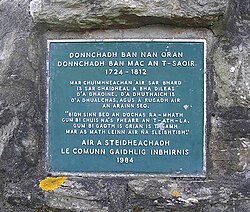
Parallel to the political poets was Duncan Ban MacIntyre (1724–1812). Despite being a monoglot Gaelic speaker who was illiterate in his own language, MacIntyre is celebrated as a master of nature poetry. His work, most notably Moladh Beinn Dòbhrain ("Praise of Ben Doran"), represents the zenith of the genre. His poetry also reflects the social complexities of the time; having served in the Campbell of Argyll Militia, his later works express the disillusionment of Highlanders who felt betrayed by the government they aided.
The Global Diaspora and the Spread of Print
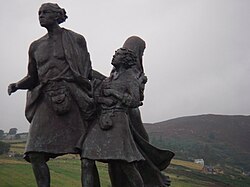
As thousands of Gaels left Scotland, their literature traveled with them. The 19th century saw the establishment of Gaelic printing presses in North America. By 1832, Presbyterian religious books were being published in Pictou, Nova Scotia, and Charlottetown, Prince Edward Island. This was followed by publications in Toronto and Montreal between 1835 and 1836, with Catholic religious texts appearing in Pictou by 1836.
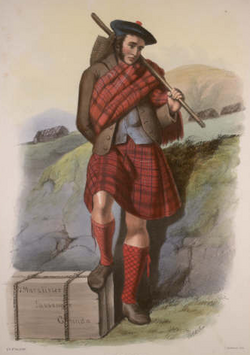
The experience of exile became a recurring theme in Gaelic writing. In the interwar period, poets like Iain Eairdsidh MacAsgaill (the "Bard of Bernera") emigrated to Western Australia. His poems and songs, written while farming near Lake Varley, are poignant expressions of homesickness and regret, remaining vital contributions to the Gaelic literary canon.
The 20th Century: Renaissance and War
The 20th century witnessed a revitalization known as the Scottish Gaelic Renaissance, driven largely by Sorley MacLean (1911–1996). A former member of the Free Presbyterian Church who later became a Communist sympathizer, MacLean brought a modern sensibility to the language. His experiences as a soldier in the Royal Corps of Signals during the Western Desert campaign and his wounding at the Second Battle of El Alamein in 1941 deeply informed his war poetry.
Other poets of this era reflected the geopolitical tensions of the time. Calum MacNeacail, who served in the Royal Air Force, wrote Cùmhnantan Sìthe Pharis (1946), a poem that praised the atomic bombings of Hiroshima and Nagasaki while warning Joseph Stalin and Vyacheslav Molotov.
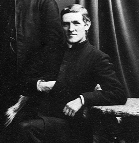
The legacy of this period also includes the work of Fr. Allan MacDonald of Eriskay. Though his research into folklore and folksong was often plagiarized during his life, modern scholars like Ronald Black have hailed him as a huge literary talent, noting that his prophetic poem Ceum nam Mìltean is a primary work of First World War poetry.
Modern Developments and the 21st Century
The influence of MacLean inspired a new generation of poets—including Deòrsa Mac Iain Dheòrsa, Ruaraidh MacThòmais, and Iain Mac a' Ghobhainn—who focused on bi-culturalism and the fate of the Gaelic language. Later, Aonghas MacNeacail introduced influences from American poetry, specifically the Black Mountain School.
In the 21st century, the focus has expanded into prose and diverse genres. Angus Peter Campbell has been a prolific force, publishing three poetry collections and five novels between 2003 and 2011. The landscape of Gaelic fiction now includes a wide array of writers such as Alasdair and Tormod Caimbeul, and Catrìona Lexy Chaimbeul. A landmark moment occurred in 2013 with the publication of Air Cuan Dubh Drilseach by Tim Armstrong, the first hard science fiction novel written in Scottish Gaelic.
| Figure | Period | Key Contribution/Work | Primary Theme |
|---|---|---|---|
| Duncan Ban MacIntyre | 18th Century | Moladh Beinn Dòbhrain | Nature and Landscape |
| Iain Eairdsidh MacAsgaill | Interwar Period | Songs of Exile | Homesickness and Diaspora |
| Sorley MacLean | 20th Century | Dàin do Eimhir | War, Politics, and Renaissance |
| Angus Peter Campbell | 21st Century | Multiple Novels (e.g., Tilleadh Dhachaigh) | Modern Fiction |
| Tim Armstrong | 21st Century | Air Cuan Dubh Drilseach | Hard Science Fiction |
Frequently Asked Questions
What is the Goidelic branch of Celtic languages?
The Goidelic branch consists of the Gaelic languages, specifically Scottish Gaelic, Irish, and Manx.
Who is considered the most influential figure of the Scottish Gaelic Renaissance?
Sorley MacLean is widely credited with leading the 20th-century revitalization of Gaelic poetry, blending traditional language with modern political and personal themes.
How did the Scottish diaspora affect Gaelic literature?
The diaspora expanded the reach of the language, leading to the establishment of printing presses in Canada and the creation of a distinct body of literature focused on exile, homesickness, and the preservation of culture in new lands.
Is there modern fiction written in Scottish Gaelic?
Yes, there is a thriving scene of modern fiction, including novels by Angus Peter Campbell and the first-ever hard science fiction novel, Air Cuan Dubh Drilseach, published in 2013.
Was Duncan Ban MacIntyre formally educated in writing?
No, Duncan Ban MacIntyre was a monoglot Gaelic speaker who was illiterate in his own language, yet he is regarded as one of the most renowned poets of the 18th century.