Scottish Episcopal Church
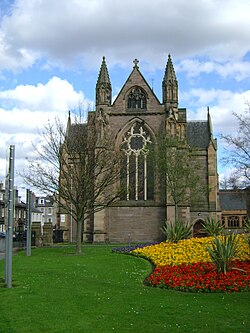
The Scottish Episcopal Church is a Protestant denomination in Scotland with an Anglican orientation. Defined by its slogan, "Evangelical Truth and Apostolic Order," the church operates under an episcopal polity—a system of church governance led by bishops. While it is a member of the global Anglican Communion and the Porvoo Communion, it maintains a distinct identity rooted in the complex religious history of Scotland.
Today, the church is headquartered at Forbes House in Edinburgh. Although it represents a small fraction of the Scottish population—constituting under 1% of the population—it continues to play a role in the nation's spiritual and social landscape.
Key Facts
- Orientation: Anglican / Protestant.
- Leadership: Led by the Primus (currently Mark Strange).
- Membership: 22,990 members as of 2024.
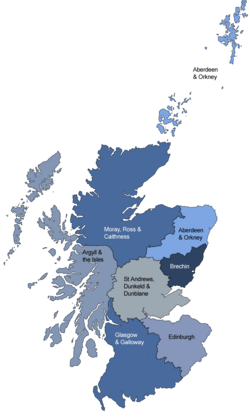
- Structure: Divided into seven dioceses.
- Headquarters: Edinburgh, Scotland.
- Key Affiliations: World Council of Churches and the Anglican Communion.
Historical Development
The Reformation and Stuart Influence
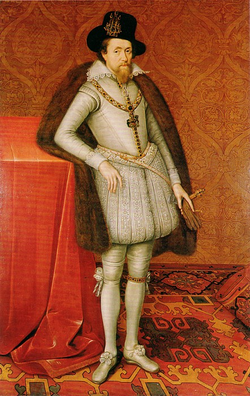
The roots of the church are tied to the broader Scottish Reformation and the subsequent attempts by the Stuart monarchs to impose episcopal government (governance by bishops) on the Church of Scotland. In 1584, James VI pushed through the Black Acts to bring the church under direct royal control, a move that faced fierce opposition from Calvinists who preferred a less ceremonious liturgy.
After James VI ascended to the English throne in 1603, he further increased the number of bishops and attempted to standardize practices. In 1618, a General Assembly in Perth adopted the Five Articles of Episcopalian practices, though many congregations responded with boycotts.
The Union and Legal Recognition
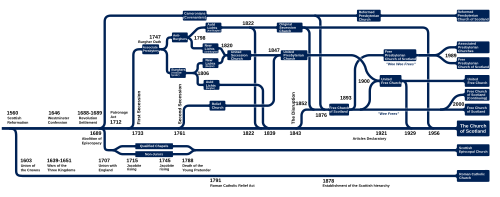
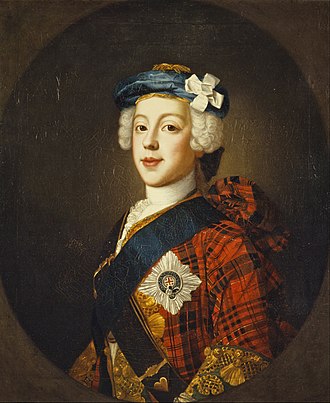
Following the merger of Scotland and England into the Kingdom of Great Britain in 1707, the Scottish Episcopalians Act 1711 provided essential legal protection for the church, effectively establishing it as a distinct society. The 18th century was marked by political turbulence, particularly the Jacobite risings of 1715 and 1745. Non-jurors (those who refused to swear allegiance to the Hanoverian monarchs) faced state repression, while new Hanoverian congregations emerged using the English Prayer Book.
Growth and Institutionalization
The 19th century saw the formalization of clergy training with the founding of the Theological College in 1810, which later merged with Trinity College, Glenalmond. By 1900, the church had reached a peak of 356 congregations and over 124,000 members. However, growth stagnated in the following decades.
Modern Era and 21st Century Challenges
Mission and Outreach
In 1995, the church launched Mission 21, an initiative designed to revitalize congregations and reach new populations. This included the "Making Your Church More Inviting" program, aimed at modernizing the church's approach to community engagement.
Membership Trends
The church has faced a steady decline in membership since the 1920s. Census data shows a drop from 103,017 people identifying as Anglican/Episcopalian in 2011 to 72,359 in 2022. By 2024, official membership stood at 22,990. Some modeling suggests that if these trends continue, the denomination could face extinction by 2045, though a small number of vibrant congregations may ensure its survival.
Social Doctrine and Global Relations
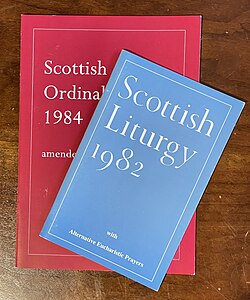
The Scottish Episcopal Church has been active in civic life, including participating in the Scottish Constitutional Convention that led to the 1999 devolved Scottish Parliament. In 2016, the General Synod voted to allow same-sex marriage, a decision formally approved in 2017. This led to a three-year suspension from "decision making on any issues of doctrine or polity" within the Anglican Communion primates' meeting.
This doctrinal shift also led to the departure of several congregations, including Christ Church, Harris and St Silas, Glasgow, which aligned themselves with the Anglican realignment movement.
Church Structure and Governance
The church is organized into seven dioceses, each led by a bishop. The Primus serves as the presiding bishop, chairing the General Synod and the Episcopal Synod.
| Diocese | Congregations | Membership | Communicants | Total Attendance |
|---|---|---|---|---|
| Aberdeen and Orkney | 36 | 2,206 | 1,577 | 752 |
| Argyll and The Isles | 22 | 843 | 608 | 325 |
| Brechin | 24 | 1,366 | 1,036 | 517 |
| Edinburgh | 53 | 8,459 | 5,599 | 3,452 |
| Glasgow and Galloway | 53 | 3,823 | 3,012 | 1,633 |
| Moray, Ross and Caithness | 40 | 2,977 | 1,929 | 644 |
| St Andrews, Dunkeld and Dunblane | 47 | 3,316 | 2,363 | 1,387 |
| TOTAL | 275 | 22,990 | 16,124 | 8,710 |
Frequently Asked Questions
What is the difference between the Scottish Episcopal Church and the Church of Scotland?
The Scottish Episcopal Church follows an Anglican orientation and is governed by bishops (episcopal polity), whereas the Church of Scotland is Presbyterian, meaning it is governed by elders and does not have a hierarchy of bishops.
Who is the current leader of the Scottish Episcopal Church?
The church is led by the Primus, currently the Right Reverend Mark Strange.
How does the church view same-sex marriage?
Following a vote by the General Synod in 2016 and formal approval in 2017, the Scottish Episcopal Church changed its canon of marriage to include same-sex couples.
What happened to the church's membership in recent years?
The church has seen a decline in membership, dropping from 30,909 in 2017 to 22,990 in 2024, with a corresponding decrease in Sunday worship attendance.
What is the role of the Primus?
The Primus presides over all Provincial Liturgical Functions, meetings of the General Synod and the Episcopal Synod, and carries out resolutions as specified in the church's Canons.