Scansoriopterygids: The Gliding Dinosaurs of the Jurassic
In the lush forests of the Middle to Late Jurassic, a group of small, enigmatic dinosaurs carved out a unique niche in the canopy. The Scansoriopterygidae (meaning "climbing wings") were maniraptoran theropods that defied the typical dinosaurian mold, evolving specialized adaptations for an arboreal—or tree-dwelling—lifestyle. Unlike their larger cousins, these creatures were masters of the heights, utilizing a combination of climbing claws and, in some species, bat-like membranes to navigate their environment.
Most of what we know about these animals comes from five well-preserved fossils found in the Tiaojishan Formation of Liaoning and Hebei, China. These specimens represent four distinct species that lived approximately 165 to 156 million years ago.
Key Facts
- Temporal Range: Middle to Late Jurassic (165–156 Ma).
- Location: Tiaojishan Formation, China.
- Defining Feature: Extremely long third fingers, unlike other theropods where the second finger is longest.
- Locomotion: Adapted for climbing and gliding.
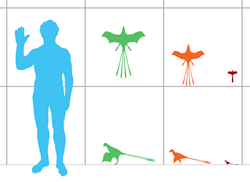
- Size: Ranged from house sparrow size (16 cm) to pigeon size (25 cm).
- Wing Structure: Some species possessed a "styliform" wrist bone to support a skin membrane.
Anatomy and Physical Characteristics
Scansoriopterygids are among the smallest non-avian dinosaurs ever discovered. Their size varied by age and species; for instance, juvenile Scansoriopteryx were roughly 16 cm long, while subadult Epidexipteryx reached about 25 cm (excluding tail feathers).
The Specialized Hand
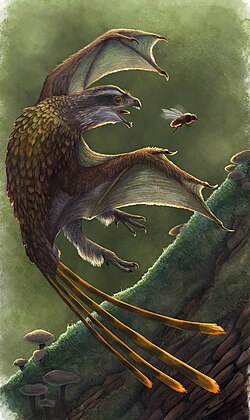
The most striking anatomical departure from other theropods is the hand. In almost all other theropod dinosaurs, the second finger is the longest. In scansoriopterygids, the third finger was exceptionally elongated. In the genera Yi and Ambopteryx, a unique "styliform" bone extended from the wrist. Together with the long third finger, this bone supported a membranous wing, similar to that of a bat, used for gliding.
Skull and Body Structure
These dinosaurs featured short, high skulls with downturned lower jaws and prominent front teeth. While they all possessed long arms, their tails varied wildly. Epidexipteryx had a short tail (70% of its torso length) adorned with long feathers, whereas Scansoriopteryx possessed a tail over three times the length of its torso, ending in a small spray of feathers.
Paleobiology: Life in the Canopy
Climbing Adaptations
Evidence suggests that scansoriopterygids were the first non-avian dinosaurs with clear adaptations for an arboreal lifestyle. Their strongly curved claws and elongated hands were ideal for grasping branches. Furthermore, the foot structure of Scansoriopteryx closely resembles that of primitive perching birds, though it lacked the reversed hallux (backward-facing toe) seen in modern birds.
Feathers and Plumage
All described specimens show evidence of feathers, though the types varied:
- Scansoriopteryx: Simple, down-like feathers around the arms and hands.
- Epidexipteryx: Simple body feathers and long, ribbon-like tail feathers used for display.
- Yi: "Paintbrush-like" feathers with long quill bases and thin filaments covering the body, head, and neck.
Additionally, they possessed a semilunate carpal—a half-moon shaped wrist bone—which allowed them to fold their hands in a bird-like motion, likely aiding maneuverability when leaping between trees.
Classification and Evolution
The taxonomic placement of Scansoriopterygidae has been a subject of significant scientific debate. Established as a family in 2002 by Stephen Czerkas and Yuan Chongxi, the group was initially monotypic (containing only Scansoriopteryx heilmanni). As more species like Epidexipteryx and Yi were discovered, the family definition expanded.
Researchers have struggled to place them on the dinosaur family tree. Some analyses suggest they are basal members of Paraves (the group including birds and dromaeosaurs), while others place them as basal Oviraptorosauria. More recent theories, such as those by Sorkin (2021), suggest that scansoriopterygids provide evidence that all pennaraptorans may have evolved from gliding, tree-climbing ancestors.
| Genus | Key Feature | Estimated Size/Stage |
|---|---|---|
| Scansoriopteryx | Very long tail; climbing adaptations | Juvenile (~16 cm) |
| Epidexipteryx | Ribbon-like tail feathers; short tail | Subadult (~25 cm) |
| Yi | Styliform bone; membranous gliding wings | Adult |
| Ambopteryx | Membranous wings for gliding | Unknown |
Paleoecology
These dinosaurs shared their environment in the Tiaojishan Formation with a diverse array of creatures. Their neighbors included the aquatic mammal Castorocauda, the gliding mammal Volaticotherium, and various rhamphorhynchoid pterosaurs like Jeholopterus. This ecosystem was rich in insects, such as beetles and mayflies, as well as various salamander species, providing ample food for these small predators.
Frequently Asked Questions
Were scansoriopterygids actual birds?
No, they were non-avian maniraptoran dinosaurs. While they shared some features with birds, such as feathers and a semilunate carpal, they are classified as theropod dinosaurs.
How did their wings differ from bird wings?
Unlike birds, which use feathers to create a wing surface, species like Yi used a skin membrane supported by an elongated third finger and a unique wrist bone, making their wings more similar to those of bats or pterosaurs.
Could they fly like modern birds?
Evidence suggests they were gliders rather than powered flyers. Their anatomy was suited for leaping and gliding from tree to tree rather than sustained, flapping flight.
Where were these fossils discovered?
The fossils were unearthed in the Tiaojishan Formation of northeastern China, specifically within the Liaoning and Hebei provinces.
What did they eat?
While their exact diet isn't explicitly detailed, their environment was filled with insects (mayflies, beetles) and small amphibians (salamanders), which were likely primary food sources for such small theropods.