Eosinopteryx: The Small Feathered Dinosaur of the Late Jurassic
In the diverse landscape of the Late Jurassic, a small but significant creature roamed the regions of what is now China. Eosinopteryx is an extinct genus of theropod dinosaur that provides critical insights into the evolution of feathers and the complex origins of flight. Known from a single, remarkably preserved specimen, this dinosaur challenges simple linear narratives about how birds evolved from their reptilian ancestors.
The genus contains only one recognized species, Eosinopteryx brevipenna. Its discovery has sparked ongoing scientific debate regarding its classification and its relationship to other early feathered dinosaurs, such as Anchiornis.
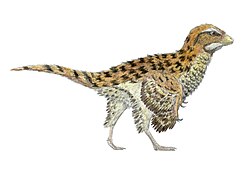
Key Facts
- Temporal Range: Late Jurassic epoch, approximately 160 million years ago.
- Location: Recovered from the Tiaojishan Formation in western Liaoning Province, China.
- Size: A very small non-avialan dinosaur, measuring about 30 centimeters (12 inches) in length.
- Distinctive Feature: Possessed reduced plumage and an unusual wing bone arrangement that likely prevented flapping.
- Classification: Currently identified as an anchiornithid, though some researchers consider it a synonym of Anchiornis.
Discovery and Etymology
The type specimen of E. brevipenna (cataloged as YFGP-T5197) was discovered in the Tiaojishan Formation of western Liaoning Province, China. This site is renowned for its exceptional preservation of fossils from the Oxfordian age of the Late Jurassic.
The naming of the dinosaur is a blend of three languages. The genus name Eosinopteryx is derived from the Greek eos ("daybreak" or "dawn"), the Latin Sinae ("Chinese"), and the Greek pteryx ("feather"). Its specific name, brevipenna, comes from the Latin brevis ("short") and penna ("feather"), referring to the reduced plumage found on the specimen.
Physical Characteristics
The fossil represents a nearly complete skeleton of either a subadult or an adult individual. Compared to other theropods, Eosinopteryx was diminutive, reaching only 30 centimeters in length. Its skull featured a very short snout, which was shorter than the diameter of its eye socket—a trait that distinguishes it from most troodontids.
Wings and Flight Ability
While Eosinopteryx possessed wings similar in size to those of Anchiornis huxleyi, with primary feathers longer than the humerus (upper arm bone), it was likely unable to fly. An unusual arrangement of the wing bones would have prevented the flapping motion necessary for powered flight. This suggests that the path to avian flight was more complex and non-linear than previously assumed.
Plumage and Anatomy
The dinosaur's plumage was notably reduced. Unlike many of its relatives, the tail lacked complex vaned feathers known as rectrices. Furthermore, the lower tarsals (ankle bones) and feet appeared to be featherless, lacking the "hind wings" commonly seen in related species. Its feet and toes were slender and lacked the highly curved claws typically used by dromaeosaurids or troodontids for climbing or predation.
Classification and Scientific Debate
The taxonomic placement of Eosinopteryx has shifted as more data became available. Initially classified as a troodontid, subsequent comprehensive analyses suggested it was either a primitive paravian (a clade including birds and their closest dinosaur relatives) or an avialan (the clade containing birds and their immediate ancestors).
By 2017, a re-evaluation of the Haarlem Archaeopteryx specimen led researchers to classify Eosinopteryx as an anchiornithid. However, some paleontologists argue that Eosinopteryx is a junior synonym of Anchiornis. This is because the primary distinction between the two—the length of the tail—is based on an incomplete tail in the Eosinopteryx specimen, making the distinction scientifically invalid to some.
| Feature | Detail |
|---|---|
| Period | Late Jurassic (160 Ma) |
| Region | Liaoning Province, China |
| Body Length | ~30 cm |
| Key Anatomy | Short snout, slender toes, reduced plumage |
| Flight Status | Non-flapping (likely flightless) |
| Family | Anchiornithidae |
Frequently Asked Questions
What does the name Eosinopteryx mean?
The name is a combination of Greek and Latin terms meaning "Chinese dawn feather," while the species name brevipenna means "short feather."
Could Eosinopteryx fly?
Evidence suggests it could not fly via flapping. The arrangement of its wing bones would have prevented the flapping motion, indicating that the origin of flight in dinosaurs was more complex than a simple progression.
How does Eosinopteryx differ from Anchiornis?
The main proposed difference is the length of the tail. However, because the Eosinopteryx tail is incomplete, many researchers believe it is actually the same genus as Anchiornis.
Where was Eosinopteryx discovered?
It was discovered in the Tiaojishan Formation of western Liaoning Province, China.
What makes its anatomy unusual compared to other troodontids?
It had a significantly shorter snout than most troodontids, a shorter tail, and lacked the curved claws and leg feathers (hind wings) common in related groups.