Satinbirds: The Vibrant Mountain Dwellers of New Guinea
The satinbirds, members of the family Cnemophilidae, are a group of four stunning passerine bird species endemic to the mountain forests of New Guinea. Named for their lustrous, silky plumage, these birds were once mistaken for members of the birds-of-paradise family (Paradisaeidae). However, modern genetic research has revealed they are distinct, with current evidence suggesting their closest relatives are the cuckoo-shrikes (Campephagidae).
The name Cnemophilidae is derived from the Ancient Greek words knemós (meaning "mountain/slope") and phílos (meaning "lover"), a fitting tribute to their preference for high-altitude habitats.
Key Facts
- Habitat: Found exclusively in the mountain forests of New Guinea.
- Diet: Strictly frugivorous, feeding exclusively on fruit from a young age.
- Nesting: Unlike birds-of-paradise, satinbirds build domed nests.
- Parenting: Females raise a single egg alone without assistance from the male.
- Classification: Now placed in the family Cnemophilidae, separate from birds-of-paradise.
Physical Characteristics and Species
Satinbirds are characterized by compact bodies, rounded wings, and wide gapes (the opening of the mouth). They possess an unossified nasal region and weak, non-manipulative feet. While females across the family generally share a muted olive-brown or rufous coloration, the males are renowned for their brilliant, species-specific colors.
The Genus Cnemophilus
This genus contains three distinct species, each with striking visual markers:
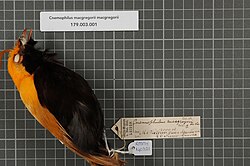
- Red Satinbird: Males feature rich reddish-orange to flame-red upperparts, black underparts, and a purplish erectile sagittal crest (a crest running along the midline of the crown).
- Yellow Satinbird: Males possess brilliant, silky flame-yellow upperparts contrasted by a black throat, chin, belly, and rump, topped with glistening golden crest plumes.
- Loria's Satinbird: The most iridescent of the group, males are primarily black with metallic purple sheens, light blue secondary wing and tail feathers, and a greenish-aqua patch extending from the bill to above the eyes.
The Genus Loboparadisea
The Yellow-breasted Satinbird is the sole member of this genus and differs significantly from its cousins. Males have reddish-olive upperparts with a golden-yellow upper rump and golden-yellow underparts from the chin to the breast. Most uniquely, they possess pale sky-blue bulbous wattles (fleshy lobes) on top of the bill.
Distribution and Habitat
Satinbirds are distributed across the rugged terrain of New Guinea, often occupying specific ecological niches:
| Species | Primary Range | Typical Altitude/Habitat |
|---|---|---|
| Loria's Satinbird | Central Highlands | 2,000–4,000 m |
| Red Satinbird | High mountain forests | Forests and shrubbery |
| Yellow Satinbird | Southeast New Guinea | "Bird's Tail" region |
| Yellow-breasted Satinbird | Central ranges to Huon Peninsula | Scarce, localized patches |
Behavior and Ecology
Satinbirds exhibit a specialized lifestyle tailored to the New Guinea highlands. Their diet is exclusively fruit-based, a trait that persists from the time they are chicks. Their nesting habits further distinguish them from the birds-of-paradise; they construct domed nests to protect their offspring.
The reproductive cycle is characterized by a lack of paternal care. The female is solely responsible for incubating the single egg and raising the chick, managing all parental duties independently.
Frequently Asked Questions
Are satinbirds related to birds-of-paradise?
While they were originally classified as birds-of-paradise due to their appearance, genetic research has proven they are not closely related. They are now placed in their own family, Cnemophilidae, and may be more closely related to cuckoo-shrikes.
What do satinbirds eat?
Satinbirds are strictly frugivorous, meaning they feed exclusively on fruit throughout all stages of their lives.
How do the males and females differ in appearance?
Males are typically brightly colored with iridescent or vivid plumage and crests to attract mates. Females are generally more camouflaged, appearing in shades of olive-brown, brownish-rufous, or olive-green.
Where can satinbirds be found in the wild?
They are endemic to the mountain forests of New Guinea, with different species occupying specific regions such as the Central Highlands and the "Bird's Tail" region of the southeast.
What is unique about the Yellow-breasted Satinbird?
Unlike other satinbirds, the male Yellow-breasted Satinbird possesses pale sky-blue bulbous wattles located on the top of its bill.