San Ignacio Miní: The Legacy of the Jesuit Guaraní Missions
Deep in the Misiones Province of Argentina lies San Ignacio Miní, a profound testament to the spiritual and cultural intersection of European Jesuits and the indigenous Guaraní people. Once a thriving center of community and art, these ruins now stand as a UNESCO World Heritage Site, offering a window into the complex colonial history of the Americas.
Founded in 1610, San Ignacio Miní was part of a network of reducciones—mission settlements designed to gather indigenous populations into organized communities. Located approximately 60 kilometers north of Posadas, the site is renowned for its architectural beauty and its survival against the elements and conflict.
Key Facts
- Founded: 1610 by Jesuit priests José Cataldino and Simón Maceta.
- Location: San Ignacio, Misiones Province, Argentina.
- UNESCO Status: Designated as a World Heritage Site in 1984.
- Architectural Style: Guaraní baroque, utilizing local red sandstone.
- Peak Population: Approximately 3,000 people during the 18th century.
- Church Dimensions: 74 meters in length and 24 meters in width.
A Turbulent History of Migration and Conflict
The journey of San Ignacio Miní was marked by instability. The original mission was established around 1610 in a region known as Guayrá (by the natives) or La Pinería (by the Spanish) in present-day Brazil. However, constant attacks by Bandeirantes—colonial slave hunters from Brazil—forced the mission to relocate in 1632. It finally settled in its current location in 1696.
The name "Miní" means "minor" in the Guaraní language, a designation used to distinguish this settlement from the larger mission, San Ignacio Guazú, located in Paraguay.
By the 18th century, the mission had evolved into a bustling community of 3,000 residents. The indigenous population produced high-quality handicrafts and cultural goods, which the Spanish traded via the nearby Paraná River. This era of prosperity ended abruptly in 1767 with the Suppression of the Society of Jesus, leading to the departure of the Jesuits a year later. The site suffered further devastation in 1817 when Luso-Brazilian forces destroyed the mission during wars against the independent movement in the Banda Oriental.
Architectural Grandeur and the Guaraní Baroque
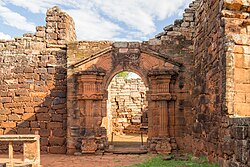
The ruins of San Ignacio Miní are among the best-preserved of the Jesuit missions in the region. The site was designed around a main square that housed a monastery, a cemetery, a cabildo (town hall), several houses, and the centerpiece: the church.
Designed by the Italian priest Juan Brasanelli, the church was constructed from local red sandstone. Despite the fragile nature of the stone, the walls—which are approximately 2 meters thick—have allowed the structure to remain standing for over two centuries. The aesthetic is known as Guaraní baroque, a unique fusion of European Baroque architecture and indigenous artistic sensibilities.
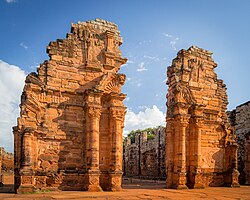
After being reclaimed by dense vegetation for years, the ruins were rediscovered in 1897. Public interest surged following a 1903 expedition by the poet Leopoldo Lugones, though formal government restoration did not begin until 1940.
Preservation and Modern Recognition
In 1984, UNESCO recognized San Ignacio Miní, along with Santa Ana, Nuestra Señora de Loreto, and Santa Maria Mayor, as World Heritage Sites. To further protect the site, it was included in the 1996 World Monuments Watch. Thanks to funding from American Express, the eastern lateral portal was restored, followed by the restoration of the main portal and the creation of an interpretation center and the Museo Jesuítico de San Ignacio Miní.
| Feature | Details |
|---|---|
| Primary Material | Local Red Sandstone |
| Architect | Juan Brasanelli |
| UNESCO Inscription | 1983 (Extended 1984) |
| Associated Sites | Santa Ana, Santa María La Mayor, Nuestra Señora de Loreto |
| Coordinates | 27°15′S 55°31′W |
Frequently Asked Questions
Why is it called San Ignacio Miní?
The term "Miní" means "minor" in the Guaraní language. This name was used to differentiate it from the larger mission, San Ignacio Guazú ("great"), located in Paraguay.
What is Guaraní baroque?
Guaraní baroque is the architectural style found in the Jesuit missions, blending European Baroque elements with the artistic influence and craftsmanship of the indigenous Guaraní people.
Who designed the main church?
The church was designed by Juan Brasanelli, an Italian priest, and built using local red sandstone with walls approximately 2 meters thick.
Why did the mission move multiple times?
The mission was forced to move from its original location in 1632 due to constant attacks by the Bandeirantes, eventually settling in its current location in 1696.
When was the site recognized by UNESCO?
San Ignacio Miní was designated as a World Heritage Site in 1984 as part of a group of Jesuit Missions of the Guaranis.