S-Class Submarines: Design and Evolution of the US Navy's Interwar Fleet
Between 1914 and 1916, intelligence reports revealed a stark reality for the United States Navy: the German U-boats operating off Great Britain far surpassed the capabilities of the existing H, K, L, and N class submarines. The USN realized that if Great Britain were to fall, its current fleet would be unable to cross the Atlantic and engage in effective combat. This strategic gap drove the rigorous requirements for a new generation of vessels: the S-class submarines.
The Navy's specifications demanded a boat of 800 long tons (813 t) capable of speeds between 11 and 14 knots (20–26 km/h) and a range of 3,400 to 5,400 nautical miles. To ensure these goals were met, the Navy sought designs from traditional builders—the Electric Boat Company (EB) and Lake Torpedo Boat Company—while simultaneously developing its own internal design to foster competition and diversify the acquisition process.
Key Facts
- Purpose: Developed to match the capabilities of German U-boats for Atlantic operations.
- Armament: Standardized with four 21-inch (533 mm) torpedo tubes and a 4-inch/50 caliber deck gun.
- Design Diversity: Divided into four primary groups based on three different prototype designs.
- Innovation: Experimented with aircraft integration and served as the foundation for the McCann Rescue Chamber.
- Legacy: The challenging engineering of these boats influenced future Admiral Hyman G. Rickover's pursuit of high engineering standards.
The Three Prototype Designs
The Navy authorized three prototypes in Fiscal Year 1918, each representing a different engineering philosophy. While all followed the same basic specifications, the resulting boats were vastly different.
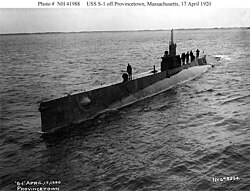
The Electric Boat Design (S-1)
The S-1 utilized a single-hull design, meaning all ballast tanks were contained within the pressure hull. Featuring a rounded spindle shape and a rudder placed aft of the twin screws, this design was an enlarged version of previous EB models. Compared to the earlier R-boats, the Group I S-boats were 33 feet longer and had 60% greater displacement, allowing for larger engines, higher speeds, and increased torpedo reloads.
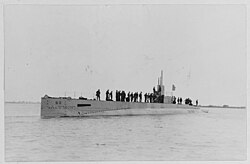
The Lake Torpedo Boat Design (S-2)
The S-2 employed a modified double-hull type, where ballast tanks wrapped around the inner pressure hull. It featured a flat "shovel" shaped stern for buoyancy and a partially watertight superstructure. However, sea trials revealed the bow tended to "burrow" into waves, requiring the addition of a buoyancy tank that gave the boat a humped appearance. Due to poor maneuverability and unreliability, the Navy rejected this design for mass production.
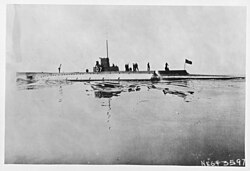
The Navy Design (S-3)
Developed by the Bureau of Construction and Repair (BuC&R), the S-3 was a full double-hull type. It was longer and wider than the other prototypes, with a sleek appearance created by a large battery compartment forward of the control room. While it featured a sharp vertical "chisel" stern, it suffered from slow diving speeds because the upper main ballast tanks would not fill until the boat was already submerged.
Production Groups and Classifications
The S-class was eventually subdivided into four distinct groups based on these designs:
| Group | Design Type | Boats | Primary Builder(s) |
|---|---|---|---|
| Group I | Holland (S-1) | S-1, S-18 to S-41 | Bethlehem Steel (for EB) |
| Group II | Navy (S-3) | S-3 to S-17 | Portsmouth Navy Yard / Lake |
| Group III | Modified Holland | S-42 to S-47 | Electric Boat Company |
| Group IV | Modified Navy | S-48 to S-51 | Lake Torpedo Boat Company |
Evolution and Technical Improvements
Post-World War I analysis led to several critical upgrades. After observing German U-boats, the Navy added a single stern torpedo tube to the final boats of Group II and all of Group IV. The armament was also upgraded to a 4-inch/50 caliber deck gun, a significant jump from the 3-inch guns of previous classes, reflecting the German tendency to use deck guns frequently.
Another major change was the conning tower fairwater (the structure atop the hull). Experience in the North Atlantic showed that crews spent significant time on the surface and needed better protection. Consequently, S-boats were built or refitted with larger fairwaters and permanent grab rails to protect bridge watchstanders.
Experimental Ventures and Legacy
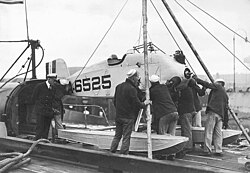
In 1923, the USS S-1 became a testbed for naval aviation, attempting to carry a Martin MS-1 scouting seaplane in a cylindrical hangar on the after deck. While the aviation experiment was deemed unworkable, the hangar structure was later repurposed as the prototype for the McCann Rescue Chamber, a vital diving bell used to rescue sailors from sunken submarines.
The S-class also left a mark on naval leadership. Future Admiral Hyman G. Rickover served on the S-48; he later claimed that the "faulty, sooty, dangerous and repellent engineering" of these boats drove his lifelong obsession with exacting engineering standards.
Frequently Asked Questions
Why was the S-class developed?
The S-class was developed because intelligence reports from 1914–1916 showed that German U-boats were far superior to the US Navy's H, K, L, and N classes, particularly regarding their ability to operate across the Atlantic.
What was the main difference between the S-1 and S-3 designs?
The S-1 (Electric Boat) used a single-hull design with ballast tanks inside the pressure hull, while the S-3 (Navy) used a full double-hull design. The S-3 was longer and wider but suffered from slower diving times.
Why was the Lake Torpedo Boat design (S-2) not mass-produced?
The S-2 was considered overcomplicated, unreliable, and suffered from poor maneuverability. It also had stability issues where the bow tended to burrow into waves, making it unpopular with its crew.
How did the S-class improve upon previous US submarines?
The S-class featured larger displacements for greater range and speed, a more powerful 4-inch/50 caliber deck gun, and improved conning tower fairwaters for better crew protection on the surface.
What happened to the seaplane experiment on the USS S-1?
The attempt to carry a Martin MS-1 seaplane was found to be unworkable and the equipment was removed. However, the hangar used for the plane was later rebuilt into the prototype for the McCann Rescue Chamber.