V-22 Osprey: The Versatile Tiltrotor Transport
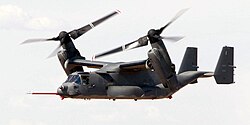
The V-22 Osprey represents a paradigm shift in military aviation, blending the vertical agility of a helicopter with the speed and range of a fixed-wing aircraft. As a tiltrotor military transport, it allows operators to take off and land vertically (VTOL) while cruising at high speeds to reach distant objectives quickly.
Developed through a partnership between Bell Helicopter and Boeing Defense, Space & Security, the Osprey was designed to overcome the inherent speed limitations of traditional rotorcraft, providing a more efficient means of transporting troops and cargo across diverse environments.
Key Facts
- Type: Tiltrotor military transport aircraft.
- Manufacturers: Bell Helicopter and Boeing Defense, Space & Security.
- First Flight: March 19, 1989.
- Introduction Date: June 13, 2007.
- Primary Users: US Marine Corps, US Air Force, US Navy, and Japan Ground Self-Defense Force.
- Production: Approximately 400 units built as of 2020.
Development and Design
Origins and Evolution
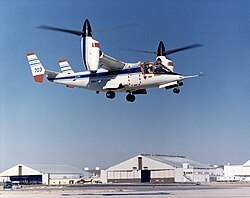
The V-22 was developed from the Bell XV-15, an experimental tiltrotor that proved the viability of the concept. The transition from experimental design to a production-ready military asset involved extensive flight testing and design modifications to ensure stability and safety during the critical transition phase when the engine nacelles tilt from vertical to horizontal.
Propulsion and Mechanics
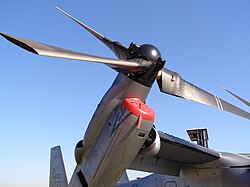
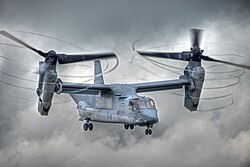
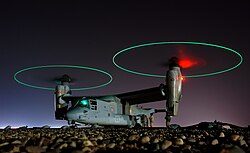
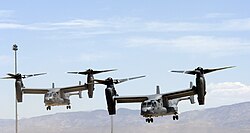
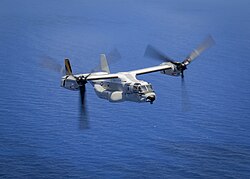
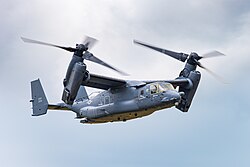
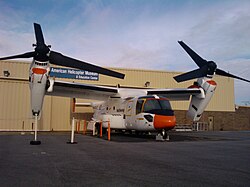
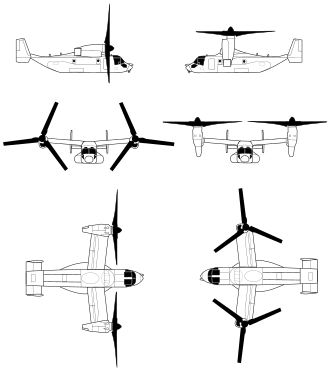
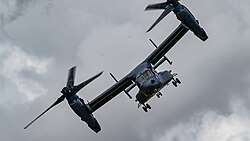
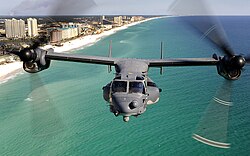
The core of the Osprey's versatility is its propulsion system. It utilizes two large rotors mounted on tilting nacelles. In vertical mode, these act as propellers for takeoff and landing; in horizontal mode, they function as propellers for high-speed forward flight. This allows the aircraft to achieve a maximum speed of 275 knots (316 mph), increasing to 305 knots at 15,000 feet.
Avionics and Armament
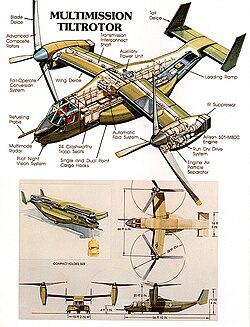
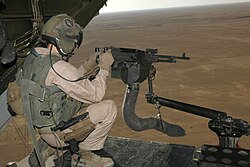
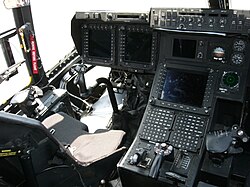
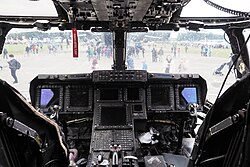
To support complex missions, the V-22 is equipped with advanced avionics, including the APQ-168 Multifunction radar, AN/AAR-47 Missile Approach Warning System, and Directional Infrared Counter Measures (DIRCM) for self-defense. For offensive and defensive capabilities, the aircraft can be fitted with a removable 7.62 mm M240 or a .50 in M2 Browning machine gun mounted on the loading ramp.
Operational Variants and Users
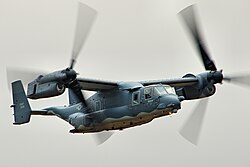
The Osprey has been adapted into several specialized variants to meet the needs of different military branches:
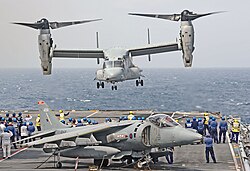
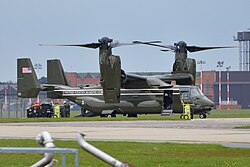
- MV-22B: The primary transport variant used by the U.S. Marine Corps for assault support.
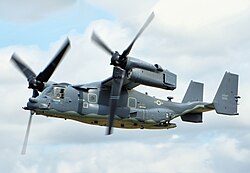
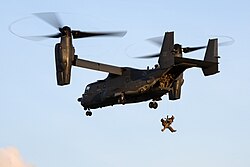
- CV-22B: A specialized version used by the U.S. Air Force for special operations.
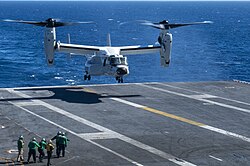
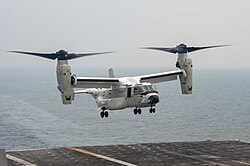
- CMV-22B: A long-range variant used by the U.S. Navy for Carrier Onboard Delivery (COD).
Global Deployment
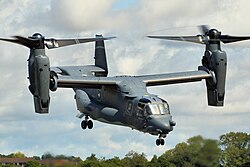
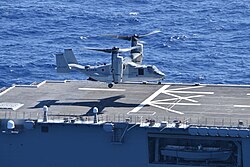
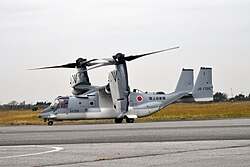
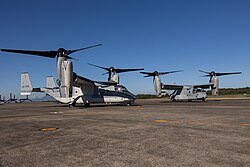
While primarily a U.S. asset, the Japan Ground Self-Defense Force has also integrated the V-22 into its fleet, with 14 delivered and more on order as of late 2023. The aircraft's ability to operate from ships and austere landing zones makes it invaluable for amphibious operations and rapid response.
Technical Specifications (MV-22B)
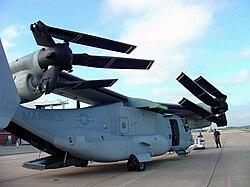
The MV-22B is designed for high-capacity transport, capable of carrying 24 seated troops or up to 20,000 pounds of internal cargo. Its unique folding design allows it to be stored in compact configurations on ships.
| Characteristic | Specification |
|---|---|
| Crew | 3–4 |
| Max Take-off Weight (VTOL) | 52,600 lb (23,859 kg) |
| Max Speed | 275 kn (316 mph) |
| Ferry Range | 2,230 nmi (2,570 mi) |
| Service Ceiling | 25,000 ft (7,600 m) |
| Internal Cargo Capacity | 20,000 lb (9,100 kg) |
Operational Capabilities
Refueling and Range
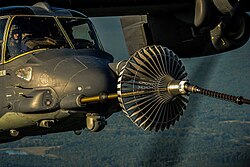
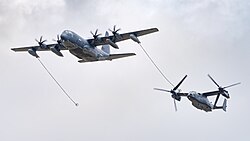
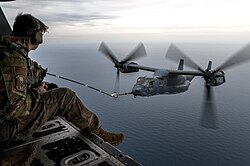
One of the Osprey's most critical features is its aerial refueling capability. By connecting to a refueling probe, the CV-22 and MV-22 can significantly extend their operational reach, allowing for long-distance insertions and extractions without landing.
Deployment Scenarios
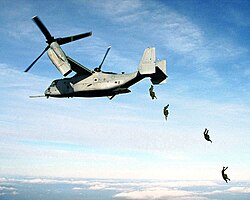
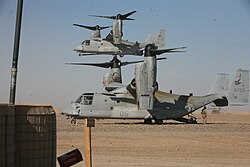
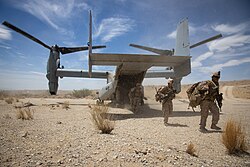
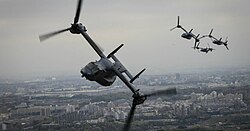
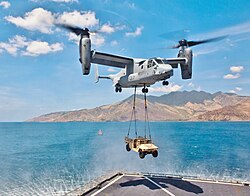
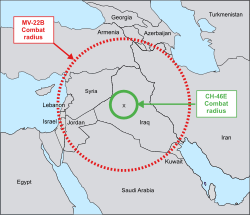
The V-22 has seen extensive use in Iraq and Afghanistan, where its combat radius provided a significant advantage over older aircraft like the CH-46E. Whether delivering Humvees to support ships or conducting casualty evacuations (CASEVAC), the Osprey's speed reduces the time troops spend in high-risk transit zones.
Frequently Asked Questions
What is a tiltrotor aircraft?
A tiltrotor is a hybrid aircraft that uses rotors that can tilt between a vertical position for takeoff and landing (like a helicopter) and a horizontal position for forward flight (like a traditional airplane).
How many troops can an MV-22B carry?
The MV-22B can carry 24 troops in seated positions or up to 32 troops if they are floor-loaded.
Which countries operate the V-22 Osprey?
The V-22 is operated by the United States (Marine Corps, Air Force, and Navy) and Japan (Japan Ground Self-Defense Force).
What is the difference between the MV-22 and the CV-22?
The MV-22 is the Marine Corps' assault transport version, while the CV-22 is the Air Force's specialized version tailored for special operations missions.
Can the V-22 land on aircraft carriers?
Yes, the V-22 is designed for shipboard operations, and the CMV-22B variant specifically serves the U.S. Navy for carrier-based logistics.