Russian State Library: A History of Moscow's Premier Literary Institution
The Russian State Library stands as a monument to the preservation of knowledge and culture in Moscow. From its origins as a private philanthropic gift to its role as a massive Soviet research hub and its current status as a national depository, the institution has evolved alongside the political and social landscape of Russia.
The Rumyantsev Library Era
The institution was founded on July 1, 1862, as the Rumyantsev Library. It served as Moscow's first free public library and was integrated into the Moscow Public Museum and Rumyantsev Museum. The library was established through the altruistic donation of Count Nikolai Petrovich Rumyantsev, who gifted his extensive collection of books, manuscripts, numismatic items, and ethnographic materials to the Russian people.
These collections, along with approximately 20,000 prints and 200 paintings sourced from the Hermitage Museum in St. Petersburg, were originally housed in the Pashkov House, a palace built between 1784 and 1787 near the Kremlin. To mark the museum's opening, Tsar Alexander II donated A. A. Ivanov's painting, The Appearance of Christ Before the People.
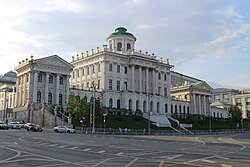
As the collection grew through further donations of icons, antiques, and Western European paintings, the Pashkov House became insufficient. This led to the construction of a second building shortly after the turn of the 20th century to accommodate the expanding art collection.
Transition to the Lenin Library
Following the October Revolution, the library experienced explosive growth in its holdings. However, financial resources were diverted to the newly finished Pushkin Museum, which began assuming the role of the Rumyantsev Museum. Consequently, in 1925, the Rumyantsev Museum was dissolved, and its art and antique collections were transferred to the Pushkin Museum.
The Pashkov House was renamed the Old Building of the Russian State Library, and the institution was renamed the V. I. Lenin State Library of the USSR (commonly known as the "Leninka").
![Main building of the library, in front is the Statue of Dostoevsky [ru]](/images/93/4f/934f8fb48c5a2e8f97bc399ca079b65281ce848bd7bf6babc3a1b9cccd010045.jpg)
Architectural Evolution
A design competition in 1927 led to the selection of a plan by architects Vladimir Shchuko and Vladimir Gelfreikh. Construction began in 1930, featuring contributions from sculptors such as Matvey Manizer. While early drafts leaned toward stern modernism, the final structure adopted a modernized neoclassicism style, mirroring the Palace of Soviets.
![A 1939 postage stamp marking the completion of the first part of the new library building;[21] it had a print run of 1600[22]](/images/63/2a/632a44edd4cba591977285088922eadc18e3f59f9ea1954ec7f7756a19822e39.jpg)
The first stage was completed in 1941, and a 250-seat reading hall opened in 1945, with further additions continuing until 1960. During this era, the library functioned as a "mass library," serving as a national repository, a research center for library science, and a tool for the development of communism in the USSR.
Operations and Preservation in the Soviet Era
The Lenin Library operated as a central hub for Soviet publications. It received three copies of every printed item in the Soviet Union, using them for distribution and international exchange. Until 1955, it was one of only two institutions permitted to engage in international book exchanges, acquiring over 40,000 science-related volumes from 60 different countries by the mid-1950s.
By 1961, the library employed 1,750 librarians and 400 technical staff to manage 22 reading rooms. The facility was a leader in preservation, utilizing a sophisticated microfilm laboratory with twelve cameras and specialized Russian-designed book cradles to preserve thousands of pages annually.
![Reading room three, the largest.[12] At the far end, a monument to Lenin. Busts along the walls.](/images/3f/11/3f1134d2e8a2c32757851a3fa1b9355f0279d030b0434298ea2a5556ea934146.jpg)
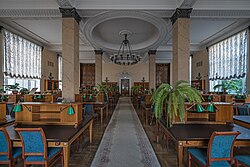
As the main building reached capacity in 1968, a new depository was constructed in Khimki to store newspapers, scientific works, and low-demand materials, with the first stage completing in 1975.
The Modern Russian State Library
In 1992, President Boris Yeltsin renamed the institution the Russian State Library. Its current legal mandate was formalized under the 1994 federal law "On Librarianship/On Library Affairs." Today, it serves as a depository for state and foreign documents and a library for the armed forces.
The library maintains a cooperation framework (established in 1996) with the National Library of Russia to manage legal deposits and avoid duplication. Modern updates include the 2007 renovation of the Pashkov House and the integration of the Russian Book Chamber's duties in 2021 to enhance digitization efforts.
Key Facts
- Founded: July 1, 1862, as the Rumyantsev Library.
- Legal Status: Designated as a legal deposit library, receiving at least one copy of every book published in the USSR (1922–1991) and continuing this practice today.
- Architecture: Designed by Vladimir Shchuko and Vladimir Gelfreikh in a modernized neoclassical style.
- Key Locations: The Pashkov House (Old Building) and the main building in Moscow, with a depository in Khimki.
- Staffing: In 1961, the library employed over 2,100 total staff members.
| Period | Name | Primary Focus/Role |
|---|---|---|
| 1862 – 1925 | Rumyantsev Library/Museum | Free public library and museum of Count Rumyantsev's collection. |
| 1925 – 1992 | V. I. Lenin State Library of the USSR | National repository, research institution, and "mass library." |
| 1992 – Present | Russian State Library | National library, state document depository, and digitization hub. |
Frequently Asked Questions
What is the "Leninka"?
The "Leninka" is the popular nickname for the V. I. Lenin State Library of the USSR, the predecessor to the current Russian State Library.
What is a legal deposit library?
A legal deposit library is an institution designated by law to receive and preserve at least one copy of every publication produced within the country.
Where is the Pashkov House located?
The Pashkov House is located at 3 Mokhovaya Street in Moscow, in close proximity to the Kremlin.
Who designed the main building of the library?
The main building was designed by architects Vladimir Shchuko and Vladimir Gelfreikh, following a competition held in 1927.
What happened to the Rumyantsev Museum's art collection?
When the Rumyantsev Museum was dissolved in 1925, its Western European art and antique collections were transferred to the Pushkin Museum.