Royal Observer Corps in the Second World War
During the Second World War, the Royal Observer Corps (ROC) served as the eyes and ears of Great Britain's air defence. While radar technology provided early warnings of approaching threats, it was the dedicated observers on the ground who tracked enemy aircraft once they crossed the coastline, providing the critical data needed to scramble fighters and warn the civilian population.
Preparation and Mobilisation
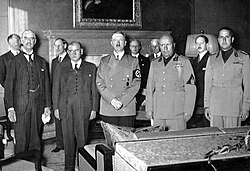
The path to wartime readiness began in September 1938. A political crisis leading to the Munich Agreement prompted a week-long mobilisation of the Observer Corps, which exposed significant technical and organisational gaps. Throughout 1939, a series of exercises were conducted to refine command and control functions.
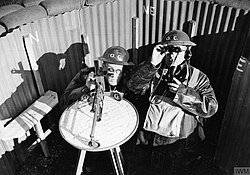
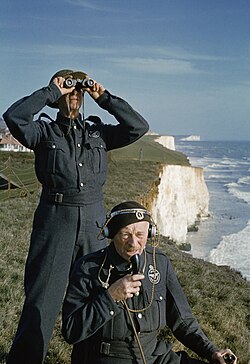
Early observation posts were rudimentary, often consisting of wooden garden sheds situated next to telegraph poles to facilitate communication with control centres via local telephone exchanges. These were eventually replaced by more durable, sandbagged brick structures. To ensure accuracy, observers were issued high-quality Royal Navy binoculars.
The Early War and the Art of Recognition
Mobilisation notices were issued on 24 August 1939, and by 3 September, posts and control centres were manned continuously—a state of readiness that would last until 12 May 1945. The initial period, known as the Phoney War, saw little enemy activity until the Battle of Dunkirk in May 1940. During Operation Dynamo, the evacuation of Allied troops, ROC posts in Kent and the Thames estuary gained vital experience plotting aircraft over southeast England.
One of the most significant challenges was aircraft recognition—the ability to distinguish between allied and enemy planes. While other services initially viewed this as nearly impossible, the Observer Corps prioritised the skill. Much of the early training material, including silhouettes and data, was developed unofficially by the Observer Corps Club before eventually receiving official recognition and being adopted across the armed forces.
The Battle of Britain and Royal Status
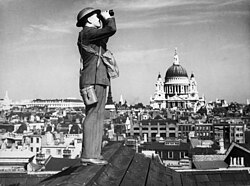
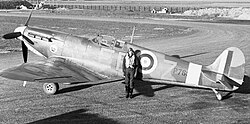
The Battle of Britain (July to October 1940) was the ROC's most critical hour. Germany sought air superiority to prepare for Operation Sea Lion, the planned invasion of Britain. While the Chain Home radar system detected aircraft approaching the coast, the ROC provided the only means of tracking them once they were inland.
Personnel operated 24/7, divided into Class A (56 hours duty per week) and Class B (up to 24 hours per week). Their plotting was essential for RAF Fighter Command to intercept raids and for issuing air-raid warnings during the Blitz, saving countless lives. In recognition of this service, King George VI granted the organization the title Royal in April 1941.
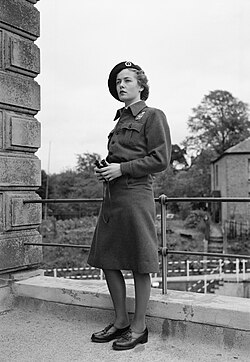
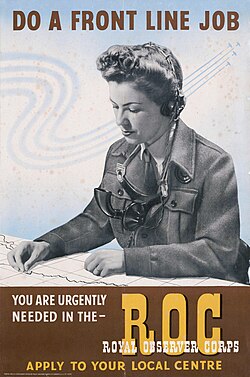
The transition to the Royal Observer Corps also brought changes in personnel and appearance. For the first time, women were recruited, initially wearing RAF overalls with a large breast badge known as the "soup plate," before transitioning to standard RAF No.2 Battledress.
Seaborne Observers and Operation Overlord
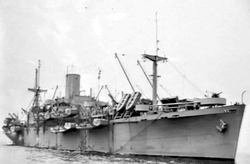
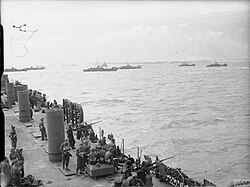
In 1944, as preparations for the invasion of France (Operation Overlord) intensified, 796 volunteers were selected as Seaborne Observers. These individuals were seconded to the Royal Navy as Petty Officers, serving on allied DEMS (Director of Merchant Shipping) and US Navy vessels.
The deployment was an unqualified success, though it came at a cost: two observers lost their lives and twenty-two survived the sinking of their ships. In recognition of their bravery, King George VI approved the permanent wearing of the "SEABORNE" shoulder flash. They remain the only ROC members entitled to wear the HM Armed Forces Veteran's Badge.
Combatting the V-1 Flying Bombs
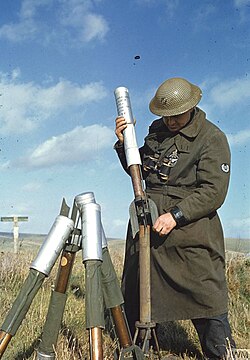
The emergence of the V-1 flying bomb led to Operation Totter. ROC posts used "Snowflake" illuminating rocket flares to alert RAF fighters to the presence of these weapons. The first V-1 was identified on 13 June 1944 by observers E. Woodward and A. Wraight at Dymchurch, Kent.
The speed of the V-1 tested the ROC's capabilities. To improve response times, RAF fighter controllers moved their equipment directly into ROC control centres at Horsham and Maidstone. This integration proved successful, allowing the new Gloster Meteor jet aircraft to be controlled entirely using ROC-derived information.
Organisation and Technical Operations
The ROC utilised a mechanical tracking system to locate aircraft. By combining a horizontal bearing and a vertical angle with the aircraft's approximate height, observers used a Post Instrument plotter to determine map coordinates.
This data was relayed to a Group control Centre, where plotters used headsets to communicate with clusters of posts. On a large map table, counters indicated the aircraft's height and number, while a colour-coded system linked to a sector clock tracked the time of observation in five-minute segments.
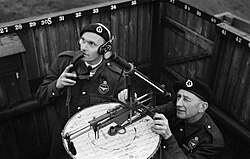
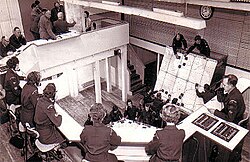
Control Centre Roles
- Plotters: Updated the plotting table and long-range boards.
- Tellers: Communicated with neighbouring ROC groups, Fighter Command, and anti-aircraft units.
- Interrogator: Liaised with Ground-controlled interception (GCI) radar units.
- Duty Controller: Supervised the plotters and observation posts.
Unique Posts and Covert Operations
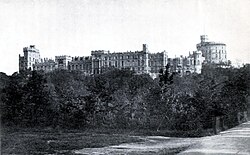
One of the most unusual posts was located atop the Brunswick Tower of Windsor Castle. Observers there frequently interacted with the Royal Family. During a V-1 attack over London, King George VI, Queen Elizabeth, and Princess Elizabeth spent over an hour on the rooftop, asking technical questions and observing the battle through binoculars.
The ROC also served as a cover for secret intelligence. Up to twenty electronic warfare units and Y-stations operated under the guise of the ROC. Personnel from MI8 wore ROC uniforms to move between military establishments without suspicion. Some "Ghost ROC" facilities, such as those at RAF Little Rissington, remained unknown to the actual ROC for years; these records remain classified until 2045.
Conclusion and Legacy
The ROC stood down on 12 May 1945. Their contribution was celebrated at a massed RAF rally at RAF North Weald, where a new ROC Ensign was dedicated. The organization's transition from a volunteer observation group to a Royal uniformed civil defence organisation proved indispensable to the Allied victory, setting the stage for their subsequent role in the Cold War.
Key Facts
- Role: Provided the only means of tracking enemy aircraft once they crossed the British coastline.
- Royal Title: Granted by King George VI in April 1941.
- Scale: By 1945, 39 centres controlled over 1,500 posts across Great Britain.
- Seaborne Observers: 796 personnel seconded to the Royal Navy for the D-Day landings.
- V-1 Defence: Used "Snowflake" flares to guide interceptors, including the Gloster Meteor jet.
- Covert Use: Provided a front for MI8 electronic warfare units and Y-stations.
| Feature | Details |
|---|---|
| Active Period | 3 September 1939 – 12 May 1945 |
| Primary Equipment | RN Binoculars, Post Instrument plotters, Sector Clocks |
| Key Operations | Battle of Britain, Operation Dynamo, Operation Overlord, Operation Totter |
| Command Structure | Administered by RAF Fighter Command |
| Personnel Types | Class A (56hrs/wk), Class B (24hrs/wk), Seaborne Observers, Women personnel |
Frequently Asked Questions
Was the Royal Observer Corps part of the Armed Forces?
No, the ROC was a uniformed civil defence organisation and its members were non-combatants. The only exceptions were full-time officers and Seaborne Observers who were seconded to the Royal Navy as Petty Officers.
How did the ROC track aircraft without radar?
Observers used a Post Instrument plotter. By taking a horizontal bearing and vertical angle and knowing the aircraft's approximate height, they could calculate the exact position on a map grid.
What were "Ghost ROC" personnel?
These were MI8 scientists, technicians, and engineers who wore ROC uniforms as a cover story to conduct secret electronic warfare and intelligence operations without attracting suspicion.
What was the significance of the "Snowflake" flares?
Under Operation Totter, these illuminating rocket flares were fired by ROC posts to visually alert RAF fighter pilots to the location of fast-moving V-1 flying bombs.
When were women first admitted to the ROC?
Women were first recruited into the organization in 1941, initially wearing RAF overalls with a distinctive breast badge.