Royal Burghs of Scotland: History, Governance, and Evolution
For centuries, the royal burgh served as a cornerstone of Scottish urban life and economic power. A royal burgh was a specific type of town founded by, or granted a charter from, the Crown. These settlements were not merely residential hubs but powerful legal and commercial entities that held a monopoly over foreign trade, distinguishing them from other types of settlements like burghs of barony.
Central to the existence of each burgh was its burgh charter. This formal document created the burgh or confirmed rights previously granted by a monarch. These charters provided the legal framework for the town's administration, allowing them to appoint bailies—officials with extensive powers in both civil and criminal justice. By 1707, Scotland had 70 royal burghs, most of which were represented in the Parliament of Scotland.
Key Facts
- Origin: Established primarily by King David I in the 12th century to create nucleated towns.
- Trade Power: Royal burghs originally held a monopoly on all foreign trade in Scotland.
- Governance: Governed by town councils, historically known as the lie doussane (the dozen).
- Legislative Reform: The Royal Burghs (Scotland) Act 1833 expanded voting rights for councillors to those eligible for parliamentary elections.
- Abolition: The legal status of royal burghs was abolished in 1975 under the Local Government (Scotland) Act 1973.
The Origins of Scottish Burghs
Before the reign of David I (1124–1153), Scotland lacked true towns. Population centers were typically limited to fortifications or areas surrounding large monasteries, such as St Andrews and Dunkeld. Most of the country consisted of scattered hamlets rather than the nucleated villages common in continental Europe.
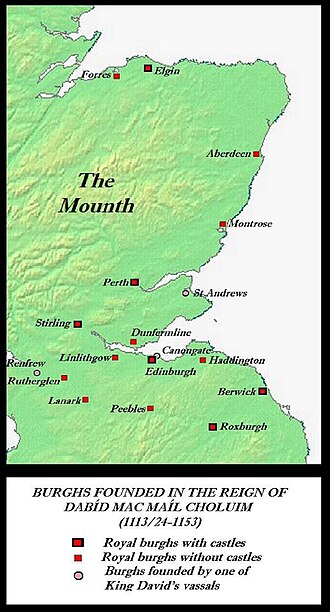
King David I transformed this landscape by establishing the first burghs. He began in the Middle-English speaking region of Lothian with Berwick and Roxburgh by 1124, before expanding into Gaelic areas with the creation of Edinburgh, Stirling, Perth, Scone, and Dunfermline by 1130. Following the conquest of Moray, burghs were also established at Elgin and Forres.
Historians suggest that these early laws, compiled in the Leges Burgorum (Laws of the Burghs), were likely modeled on the 12th-century customs of Newcastle upon Tyne. Because of Scotland's trading patterns, these burghs became melting pots of culture, populated by English, French, and Flemish settlers. This influence is still evident in the historical vocabulary of the burghs, blending Germanic terms like croft and wynd with French terms such as provost and vennel.
Expansion and Legal Evolution
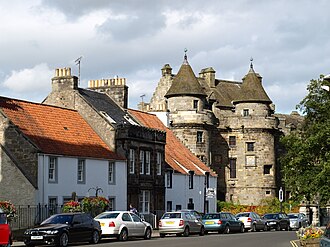
The number of burghs grew steadily through the medieval period. By 1210, there were 40 burghs in the kingdom. Subsequent monarchs continued this expansion; for example, James II created the royal burgh of Falkland in 1458.
As the centuries progressed, the governance of these towns evolved. The Royal Burghs (Scotland) Act 1833 was a pivotal piece of legislation that amended the laws for electing magistrates and councils. It aligned the eligibility for electing burgh councillors with the requirements of the Reform Act 1832, democratizing the local administration of these historic towns.
The rights of royal burghs were formally protected during the Union of 1707. Article XXI of the Treaty of Union explicitly stated that the rights and privileges of the Royal Boroughs in Scotland would remain entire after the union with England.
Summary of Royal Burgh Development
| Period/Era | Key Developments | Notable Examples |
|---|---|---|
| Early 12th Century (David I) | Introduction of nucleated towns and royal charters | Edinburgh, Berwick, Roxburgh |
| By 1214 | Expansion to 40+ burghs across the kingdom | Inverness, Ayr, Dumfries |
| 15th - 17th Century | Continued creation by James II through Charles I | Falkland, Kirkwall, Wick |
| 1833 | Reform of town council elections | All active Royal Burghs |
| 1975 | Legal abolition of royal burgh status | Former Royal Burghs |
Abolition and Modern Legacy
The legal existence of royal burghs ended on January 1, 1975, via the Local Government (Scotland) Act 1973. This act rendered the protections of the 1707 Treaty of Union redundant. While the administrative powers vanished, the historical identity remains.
Today, many towns are officially referred to as former royal burghs. While there is no statutory requirement to maintain these titles, the government has clarified that there is no ban on using historic titles for non-statutory purposes. Consequently, several community councils have incorporated "Royal Burgh" into their names, and some have rematriculated their historic armorial bearings through the Lord Lyon.
Frequently Asked Questions
What was the primary advantage of being a royal burgh?
The most significant advantage was the monopoly over foreign trade, which allowed royal burghs to control imports and exports, generating significant wealth and political influence.
Who established the first burghs in Scotland?
King David I is credited with establishing the first burghs in the early 12th century, introducing a continental style of nucleated urban settlement to Scotland.
What did the Royal Burghs (Scotland) Act 1833 change?
This Act reformed the election process for town councils, granting the right to vote for burgh councillors to those who were qualified to vote in parliamentary elections under the Reform Act 1832.
Are royal burghs still active today?
No, they were legally abolished in 1975. However, many towns continue to use the title "former royal burgh" for historical and ceremonial purposes.
What is a burgh charter?
A burgh charter was a legal document issued by the monarch that officially created a burgh or confirmed its existing rights, privileges, and administrative powers.