Royal Albion Hotel: A History of Grandeur and Adversity
The Royal Albion Hotel stands as a landmark of Brighton's architectural and social evolution. From its origins on a site associated with early medical pioneers to its status as a hub for the elite, the hotel has mirrored the fortunes of the seaside town itself, enduring periods of immense success and devastating tragedy.
The Origins of the Site
Before the hotel existed, the land was tied to the career of Richard Russell, a physician who championed the use of sea water to treat various ailments. Following Russell's death in 1759, the area known as Old Steine became the epicenter of fashionable life in Brighton. The property, then called Russell House, served as lodgings for high-profile guests, including the Duke of Cumberland, and later evolved into an entertainment hub featuring a camera obscura, a puppet theatre, and resident jugglers.
In 1823, entrepreneur John Colbatch purchased and demolished Russell House. Despite attempts by local authorities to preserve the land as an open public space, negotiations failed, paving the way for the construction of a luxury hotel.
Construction and Early Success
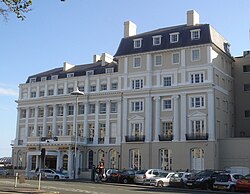
Colbatch commissioned architect Amon Henry Wilds to design the hotel starting in 1822. Wilds, an associate of Charles Busby and son of Amon Wilds, was already a prominent figure in Brighton's urban development, having worked on the Brighton Unitarian Church and King's Road. The hotel was strategically positioned where Old Steine met King's Road, with its primary façade facing Old Steine rather than the sea.
The four-storey building opened its doors on 5 August 1826. Its immediate popularity led to the addition of a stylistically similar five-storey western extension around 1847, at which point the establishment was renamed the Royal Albion Hotel.
Cultural Contributions
The hotel was more than just a place for lodging. In 1841, the Albion Rooms Literary and Scientific Institution was established in a ground-floor room. This venue served as a museum, lecture theatre, and library. When the institution eventually became unsustainable, its collections were donated to the Brighton Corporation, leading to the creation of the Brighton Library and the Brighton Museum and Art Gallery at the Royal Pavilion.
Restoration and Expansion
By the late 19th century, the hotel had fallen into disrepair and closed in 1900. It was revived in 1913 when Harry Preston, owner of the Royal York Hotel, purchased the property for £13,500 (approximately £1,347,000 in 2025). Preston oversaw a complete refurbishment, restoring the hotel's prestige and attracting a clientele of artists, entertainers, and literary figures.
During this Edwardian era, the architectural firm Clayton & Black—prolific designers of churches and public buildings in Brighton—added a sea-facing lounge to the rear. Further expansion occurred in 1963 when the Royal Albion absorbed the neighboring Adelphi Hotel (formerly the Lion Mansion Hotel), which had been built in 1856 on the site of Williams's Royal Hot and Cold Baths. This acquisition created a physical link that formed the hotel's west wing.
A Legacy of Fire and Destruction
The Royal Albion has been plagued by two major fires that significantly altered its structure.
The 1998 Kitchen Fire
On 24 November 1998, a fire erupted in the kitchen when hot fat from a pan ignited and traveled up a vent to the top floor. Strong winds accelerated the spread, forcing the evacuation of 160 people and the cancellation of a Public and Commercial Services Union conference. Approximately 160 firefighters participated in what was described as the largest firefighting operation in Brighton for nearly 30 years. While the entire building suffered smoke and water damage, the original corner section was the most severely impacted.
The 2023 Blaze and Structural Collapse
A second devastating fire occurred on 15 July 2023, starting on the fourth floor of the western side. The blaze caused a partial roof collapse at 8:30 p.m. and eventually reached the ground floor by the following afternoon. The incident led to the evacuation of 100 nearby residents and raised concerns regarding the release of asbestos.
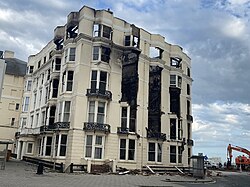
Demolition of the gutted western section began on 19 July, though it was briefly paused due to heritage concerns regarding the Grade II listed façade. An investigation by the East Sussex Fire and Rescue Service (ESFRS) concluded in October 2023 that the fire was likely caused by a discarded cigarette. Despite passing a fire safety audit in September 2022, the fire spread rapidly due to wind speed, dry timber window frames, lath and plaster walls, and hidden voids within the structure.
The hotel's instability persisted into 2025; on 21 February, parts of the A259 road were closed after engineers warned that the building and its scaffolding were at risk of "catastrophic failure."
Key Facts
- Opened: 5 August 1826.
- Architect: Amon Henry Wilds.
- Heritage Status: Grade II listed façade.
- Major Acquisitions: Absorbed the Adelphi Hotel in 1963.
- Significant Fires: Major incidents in November 1998 and July 2023.
- 2023 Cause: Likely a discarded cigarette.
| Year | Event | Significance |
|---|---|---|
| 1823 | Demolition of Russell House | Cleared site for hotel construction |
| 1826 | Hotel Opening | Established as a four-storey structure |
| 1847 | Western Extension | Renamed to Royal Albion Hotel |
| 1913 | Purchase by Harry Preston | Restored fashionable reputation |
| 1963 | Adelphi Hotel Merger | Expanded the hotel's west wing |
| 1998 | Kitchen Fire | Major structural and smoke damage |
| 2023 | Fourth Floor Fire | Led to partial collapse and demolition of west side |
Frequently Asked Questions
Who designed the Royal Albion Hotel?
The hotel was designed by architect Amon Henry Wilds, who began planning the project in 1822.
What caused the 2023 fire?
Following an investigation by the East Sussex Fire and Rescue Service, the cause was determined to likely be a discarded cigarette.
Why did the 2023 fire spread so quickly?
The rapid spread was attributed to wind direction and speed, aged and dry timber in window frames, lath and plaster wall construction, and hidden voids within the building.
What happened to the Albion Rooms Literary and Scientific Institution?
The institution became unsustainable, and its collection of books, pictures, and artefacts was given to the Brighton Corporation, helping to establish the Brighton Library and the Brighton Museum and Art Gallery.
Is the hotel still standing?
While the gutted western side was demolished following the 2023 fire, the building has faced ongoing stability issues, with reports in February 2025 indicating a risk of catastrophic failure of the remaining structure and scaffolding.