Ronald Reagan: The Presidency and Legacy of the 40th U.S. President
Ronald Reagan served as the 40th President of the United States from January 20, 1981, to January 20, 1989. A Republican leader who championed a conservative shift in American politics, Reagan's two terms were defined by a transformative approach to economics, a hardline stance against the Soviet Union, and a commitment to reducing the size of the federal government.
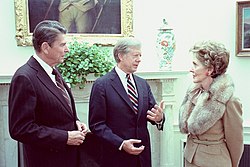
His ascent to the presidency followed a period of political volatility, culminating in the 1980 election where he defeated incumbent Jimmy Carter. With George H.W. Bush as his Vice President, Reagan sought to steer the nation away from the stagflation and geopolitical tensions of the 1970s.
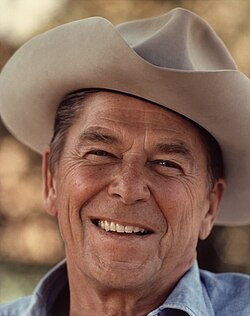
Key Facts
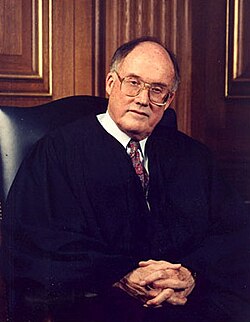
- Terms in Office: January 20, 1981 – January 20, 1989.
- Economic Policy: Implemented "Reaganomics," focusing on tax cuts and deregulation.
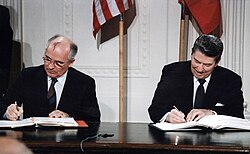
- Cold War Impact: Signed the INF Treaty with Mikhail Gorbachev, contributing to the end of the Cold War.
- Election Victory: Won one of the largest landslide victories in U.S. history in 1984.
- Judicial Legacy: Appointed William Rehnquist as Chief Justice of the Supreme Court in 1986.
The Path to the White House
![Income inequality and union participation have had a distinctly inverse relationship, with the disparity increasing since the 1980s.[98]](/images/1a/6a/1a6ae0acc2e641ae7d4ea15cbc187b5adfcb752945d160bc4a77a036f50bcb9a.webp)
The 1980 election marked a pivotal moment in U.S. history, reflecting a broader conservative shift in the electorate. Reagan's victory over Jimmy Carter set the stage for a decade of Republican influence in the executive branch.
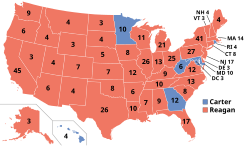
Following his victory, the transition of power took place in November 1980, signaling a new era of governance focused on limited government and a more assertive foreign policy.
Domestic Policy and "Reaganomics"
![Reagan made 24 international trips to 26 different countries during his presidency.[150]](/images/fc/6a/fc6acdea25a509189cff6191f5216f514e9ae9511911463bf17d67752752ba71.webp)
At the heart of Reagan's domestic agenda was Reaganomics, a set of economic policies based on supply-side theory. The cornerstone of this approach was the Economic Recovery Tax Act of 1981, which aimed to stimulate growth through significant tax reductions.
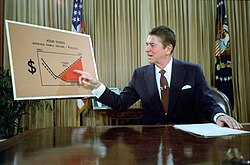
While these policies sought to curb inflation and encourage investment, they were accompanied by a complex fiscal reality. Despite efforts to reduce government spending, the national debt as a percentage of GDP rose steadily throughout his tenure, increasing from 25.2% in 1981 to 39.4% by 1989.
| Fiscal Year | Receipts (Billions) | Outlays (Billions) | Deficit (Billions) | Debt as % of GDP |
|---|---|---|---|---|
| 1981 | 599.3 | 678.2 | -79.0 | 25.2% |
| 1984 | 666.4 | 851.8 | -185.4 | 33.1% |
| 1987 | 854.3 | 1,004.0 | -149.7 | 39.6% |
| 1989 | 991.1 | 1,143.7 | -152.6 | 39.4% |
Social Policies and Controversies
Reagan's domestic legacy is also marked by his approach to social issues. His administration launched the "Just Say No" campaign against drug abuse, led largely by First Lady Nancy Reagan.
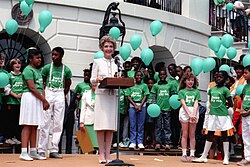
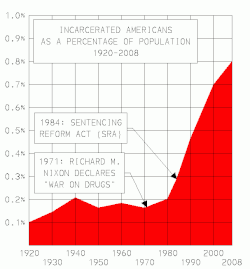
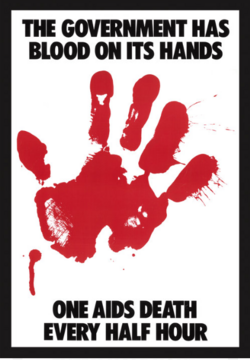
However, the administration faced significant criticism for its delayed response to the AIDS epidemic and the subsequent impact on LGBTQ rights. Additionally, the era saw a marked increase in the U.S. incarceration rate and a growing disparity in income inequality.
Foreign Affairs and the Cold War
![As the first U.S. president invited to speak before the British Parliament (June 8, 1982), Reagan predicted Marxism-Leninism would end up on the "ash heap of history"[151]](/images/83/bd/83bd614eeb201cf2611fe7d6ba8ef077863fcf0d4721082144feabe94a07fc84.jpg)
Reagan's foreign policy was characterized by an initial escalation of the Cold War, followed by a diplomatic thaw. He introduced the Strategic Defense Initiative (SDI), a proposed missile defense system, and the Reagan Doctrine, which provided aid to anti-communist movements globally.
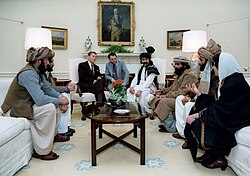
His administration was involved in several high-stakes international events, including the invasion of Grenada and the controversial Iran-Contra affair, where officials secretly facilitated arms sales to Iran to fund Contra rebels in Nicaragua.
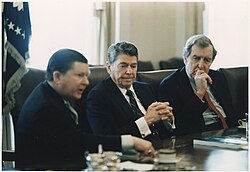
Despite these tensions, Reagan developed a productive relationship with Soviet leader Mikhail Gorbachev. This partnership led to the signing of the Intermediate-Range Nuclear Forces (INF) Treaty in 1987, a landmark agreement that helped end the Cold War.
Challenges and Transitions
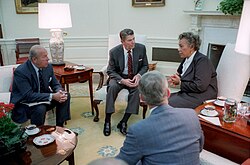
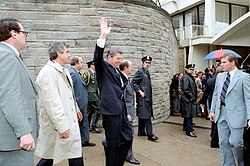
Reagan's presidency was not without personal and political crises. On March 30, 1981, he survived an assassination attempt that left him seriously wounded.
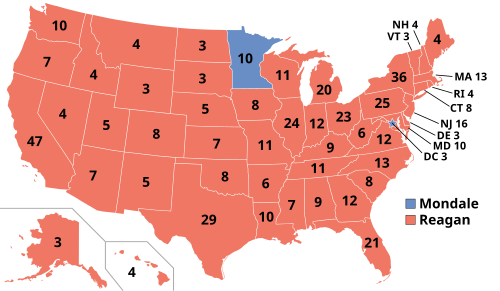
Politically, Reagan achieved a historic victory in the 1984 election, defeating Walter Mondale by winning 525 electoral votes to 13. This landslide victory cemented his influence over the American political landscape.
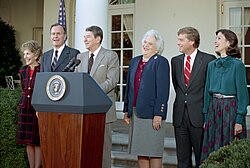
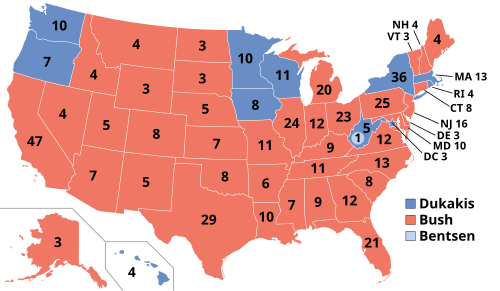
As his second term concluded, Reagan oversaw the transition to his Vice President, George H.W. Bush, who won the 1988 election against Michael Dukakis.
Frequently Asked Questions
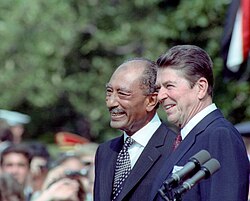
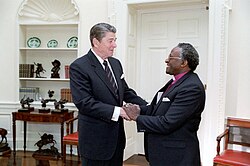
![Chadian president Hissène Habré at the White House. Habré was supported by the Reagan administration as an ally against Gaddafi's Libya[237]](/images/4b/d6/4bd64fb483f59ccd8766820c6087f70a1a9987b04a40e0903f4ecaf8717379e2.jpg)
What was "Reaganomics"?
Reaganomics refers to the economic policies of the Reagan administration, which emphasized supply-side economics. This included significant tax cuts, deregulation of industries, and a goal of reducing government spending to stimulate economic growth.
What was the Iran-Contra affair?
The Iran-Contra affair was a political scandal involving the secret sale of weapons to Iran, which was under an arms embargo, in order to secure the release of U.S. hostages and illegally fund the Contra rebels fighting the socialist government in Nicaragua.
How did Reagan contribute to the end of the Cold War?
Reagan combined a strong military buildup and a hardline rhetorical stance against the Soviet Union with a willingness to negotiate. His diplomacy with Mikhail Gorbachev resulted in the INF Treaty, which reduced nuclear arsenals and eased global tensions.
Who was the Vice President during Reagan's presidency?
George H.W. Bush served as Vice President for both of Ronald Reagan's terms from 1981 to 1989, later succeeding him as the 41st President of the United States.
What was the Strategic Defense Initiative (SDI)?
The Strategic Defense Initiative, often referred to as "Star Wars," was a proposed space-based missile defense system intended to protect the United States from nuclear missile attacks by the Soviet Union.