Ritchie Valens: The Chicano Rock Pioneer Who Changed Music
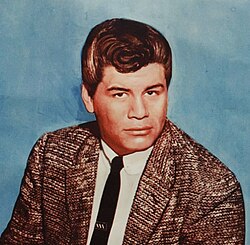
Before the global explosion of rock and roll, a teenage musician from Los Angeles bridged the gap between traditional Mexican sounds and the electric energy of the 1950s. Ritchie Valens, born Richard Steven Valenzuela, was more than just a singer; he was a forefather of the Chicano rock movement and a pioneer who proved that rock and roll could transcend ethnic and linguistic boundaries.
Though his career lasted only a few short years, Valens left an indelible mark on music history. His rise was meteoric, and his death—occurring just eight months after his breakthrough—became one of the most tragic footnotes in the history of popular music.
Key Facts
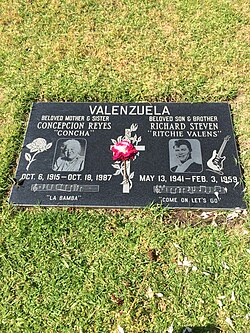
- Birth Name: Richard Steven Valenzuela (May 13, 1941 – February 3, 1959).
- Musical Legacy: Pioneer of Chicano rock and rock and roll.
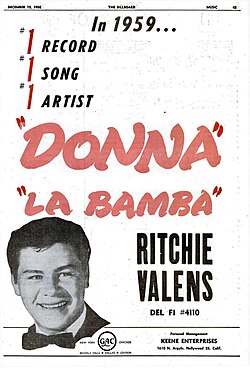
- Biggest Hits: "La Bamba" and "Donna".
- Tragic End: Died at age 17 in a plane crash known as "The Day the Music Died".
- Honors: Inducted into the Rock and Roll Hall of Fame and the Rockabilly Hall of Fame.
Early Life and Roots
Richard Steven Valenzuela was born in Pacoima, a neighborhood in the San Fernando Valley of Los Angeles. His parents were of Yaqui Native Mexican descent, having immigrated from Vícam, Sonora. Interestingly, the surname Valenzuela was often adopted by Indigenous Mexican families during the Porfiriato dictatorship to avoid forced removal from their lands.
Valens's relationship with aviation was fraught with anxiety. As a 15-year-old student at Pacoima Junior High School, he narrowly avoided the 1957 Pacoima mid-air collision because he was attending his grandfather's funeral. The disaster left him with recurring nightmares and a lifelong fear of flying.
His musical journey began on the bleachers of his junior high school, where he would play guitar for friends. At 16, he joined a local band called The Silhouettes, starting as a guitarist before stepping into the role of lead vocalist. He made his first public performance with the group on June 19, 1957.
The Rise of a Star
In May 1958, Bob Keane, president of Del-Fi Records, heard about a talented youth known as "the Little Richard of San Fernando." After witnessing a performance at a movie theater, Keane invited Valenzuela to audition in his basement studio. Impressed, Keane signed him on May 14, 1958.
To broaden the singer's appeal across different ethnic groups, Keane suggested the stage name Ritchie Valens. The transition to stardom was rapid. In a single afternoon session at Gold Star Studios in May 1958, Valens recorded "Come On, Let's Go" and "Framed." These were followed by the massive success of "Donna"—written for his high school sweetheart, Donna Ludwig—and the iconic "La Bamba." The latter double A-side sold over one million copies and earned a gold disc from the Recording Industry Association of America.
Concerts and Television Appearances
Valens quickly became a fixture on the national stage. He appeared on Dick Clark's American Bandstand on October 6, 1958, and performed at the Apollo Theater in New York City. He also participated in Alan Freed's Christmas Jubilee Show alongside legends like Chuck Berry and Bo Diddley. His only recorded live performance took place at his former school, Pacoima Junior High, in December 1958.
The Winter Dance Party and "The Day the Music Died"
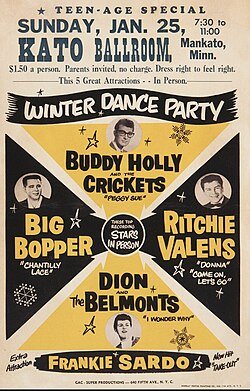
In January 1959, Valens joined the Winter Dance Party tour, a grueling trek through the Midwest alongside Buddy Holly, J. P. "The Big Bopper" Richardson, Dion and the Belmonts, and Frankie Sardo. The tour was plagued by subzero temperatures and failing equipment. The conditions were so severe that Holly's drummer, Carl Bunch, was hospitalized for frostbite, forcing Valens and other musicians to take turns on the drums.
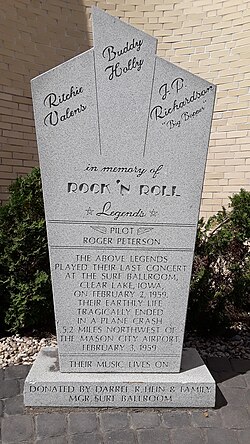
The tragedy struck on February 3, 1959. At approximately 12:55 a.m., a four-passenger Beechcraft Bonanza departed for Fargo, North Dakota. The pilot, Roger Peterson, was not qualified for the deteriorating weather conditions, and the plane crashed shortly after takeoff. Valens, Holly, Richardson, and Peterson were all killed instantly. At just 17 years old, Valens was the youngest victim of the crash.
Legacy and Tributes
Despite his short life, Valens's influence persists. He was posthumously inducted into several halls of fame, including the Rock and Roll, Rockabilly, and California Halls of Fame. His life was immortalized in the 1987 biopic La Bamba, and a new biopic is currently in development through Sony Pictures and Mucho Mas Media.
In his hometown of Pacoima, his memory is kept alive through several murals and the Ritchie Valens Park. The Los Angeles City Council officially declared May 13 as "Ritchie Valens Day," and a section of the Interstate 5 Freeway is named the Ritchie Valens Memorial Highway.
| Category | Details |
|---|---|
| Active Years | 1957–1959 |
| Primary Genres | Rock and roll, Chicano rock |
| Key Label | Del-Fi Records |
| Major Hits | "La Bamba", "Donna", "Come On, Let's Go" |
| Death Date | February 3, 1959 |
Frequently Asked Questions
Why did Ritchie Valens change his name?
His producer, Bob Keane, suggested the name "Ritchie Valens" instead of Richard Valenzuela to make him stand out from other artists named Richard and to widen his appeal across different ethnic groups.
Who was the song "Donna" written for?
The song was written for Donna Ludwig, Valens's high school sweetheart. Despite her father's objections, the two dated from 1957 until Valens's death.
What happened on "The Day the Music Died"?
This refers to February 3, 1959, when a plane crash in Iowa killed three rock and roll stars—Ritchie Valens, Buddy Holly, and J. P. "The Big Bopper" Richardson—along with their pilot.
What was the cause of the plane crash?
The crash was attributed to a loss of control by the pilot, Roger Peterson, who was not qualified to fly in the deteriorating weather conditions present at the time of takeoff.
Where is Ritchie Valens buried?
Ritchie Valens is buried at the San Fernando Mission Cemetery alongside his mother.