Residential High-Rise Developments Across Global Regions
From the dense urban cores of East Asia to the historic landscapes of Europe and the sprawling metropolises of North America, residential high-rise buildings have become a primary solution for housing growing populations. These structures range from luxury vertical cities—designed to integrate public and private spaces—to mass-produced social housing projects intended to provide affordable shelter.
Key Facts
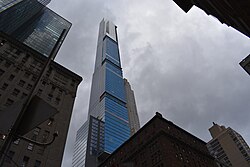
- Central Park Tower in New York City is the world's tallest residential high-rise as of December 2020.
- In Seoul, approximately 80% of residents live in apartment complexes.
- Hong Kong sees over 60% of its population residing in apartments, with 28% in public housing.
- The Khrushchyovka is a colloquial term for the blocky, socialist realist buildings common in the former Eastern Bloc.
- Samsung Tower Palace in Seoul holds the title of the tallest apartment complex in Asia.
Asia: The Rise of Vertical Communities
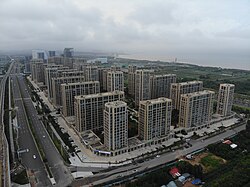
High urban densities in countries like China, India, Singapore, and South Korea have made residential towers a necessity. In land-scarce regions like Singapore and Hong Kong, high-rises are the dominant housing form. Modern architectural trends have shifted toward creating "vertical communities," where firms like WOHA and Mass Studies design buildings that offer aesthetic silhouettes and integrated public spaces, though these are typically not affordable housing options.
China and Japan
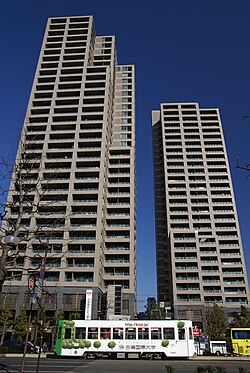
In China, innovative designs such as the Vertical Courtyard Apartments in Hangzhou utilize folded concrete floor planes to give residents the feeling of living on a second floor, complete with private courtyards. In Japan, terminology distinguishes between different types of housing: apaato refers to smaller rental apartments, while mansion describes larger, modern condominium towers.
South Korea and India
South Korea's Apartment Complexes (아파트 단지) evolved from post-war necessity to modern hubs that integrate shopping malls and parking. Seoul's metropolitan area is the densest in the OECD. Similarly, India has seen a surge in "gated societies" in cities like Mumbai, Hyderabad, and Delhi-NCR, where luxury high-rises like the Palais Royale provide extensive recreational amenities for affluent residents.
Europe: From Socialist Blocks to Modern Flats
European residential architecture is sharply divided between the legacies of the Eastern Bloc and the historic constraints of Western European city centers.
Central and Eastern Europe
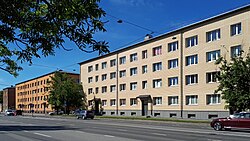
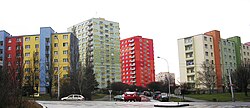
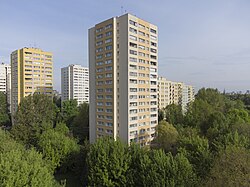
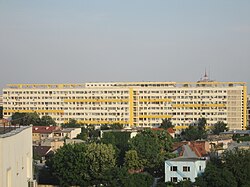
Following World War II, the USSR and its satellite states constructed massive numbers of cheap, standardized housing. These include the Khrushchyovka and the panelák (in Czechoslovakia). Romania also underwent a "systematisation" program under Nicolae Ceaușescu, which involved demolishing villages to build blocuri (blocks of flats). Today, these buildings are viewed variously as eyesores or historical relics, with many receiving EU funds for modernization.
Western Europe and the British Isles
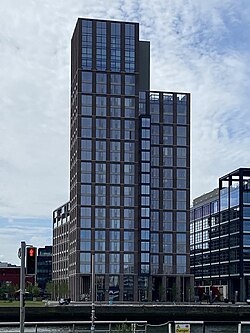
Western Europe generally has fewer high-rises due to preserved historic centers. In the United Kingdom, tower blocks were initially a solution for slum clearance but later became associated with social disorder and safety concerns, highlighted by the 1968 Ronan Point collapse and the 2017 Grenfell Tower fire. In Ireland, high-rise development was historically concentrated in Dublin (such as the now-demolished Ballymun Flats), though the "Celtic Tiger" era brought a new wave of modern apartments to cities like Cork and Galway.
Northern Ireland
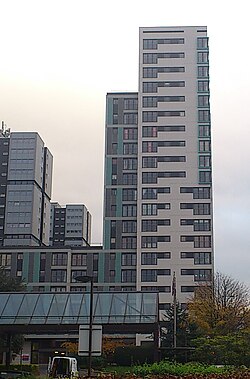
Belfast features a mix of demolished and standing high-rises. The Divis Tower remains a prominent landmark, while other complexes like the New Lodge and Rathcoole continue to dominate the local skyline. Many of these were originally built by the Northern Ireland Housing Trust as overspill housing.
North America and Oceania
In North America, high-rise development is often concentrated in downtown cores. Toronto and New York City possess the highest concentrations of these buildings on the continent.
United States
The U.S. distinguishes between midrise (buildings as tall as the street is wide to allow sunlight) and highrise. While early experiments in public housing "towers in the park" (like Pruitt-Igoe in St. Louis) often failed due to "ghettofication," commercial luxury high-rises flourish. The Central Park Tower in Manhattan currently stands as the global peak of residential height.
Australia
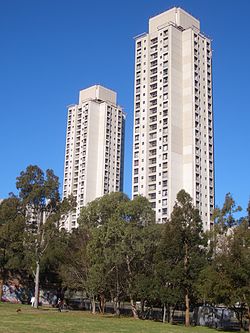
High-rise living in Australia expanded beyond the Sydney CBD in the 1960s. Some early towers were built for the Royal Australian Navy before being transitioned to low-income and immigrant housing. To avoid the stigma of "housing commission flats," developers now predominantly use the term "apartment."
Regional Housing Summary
| Region | Common Terms | Primary Driver | Notable Example/Feature |
|---|---|---|---|
| East Asia | Mansion, Apartment Complex | Extreme Urban Density | Samsung Tower Palace (Seoul) |
| Eastern Europe | Khrushchyovka, Panelák, Blocuri | Post-War Social Housing | Falowiec (Gdańsk) |
| North America | Midrise, Highrise | Land Value/Downtown Redevelopment | Central Park Tower (NYC) |
| UK/Ireland | Tower Blocks, Flats | Slum Clearance/Public Housing | Ballymun Flats (Dublin - Demolished) |
Frequently Asked Questions
What is a Khrushchyovka?
A Khrushchyovka is a colloquial term for the blocky, standardized, low-cost apartment buildings constructed across the former Eastern Bloc during the Soviet era, specifically in the 1950s, 60s, and 70s.
How does Japan distinguish between different apartment types?
Japan uses the word "apaato" for smaller, typically rental apartments and "mansion" for larger, modern, and more spacious residential towers or condominiums.
Why are there fewer high-rises in Western Europe compared to Asia?
Western European cities often have historic city centers that limit the construction of tall buildings to preserve architectural heritage.
What is the difference between midrise and highrise in the US?
In the United States, midrise buildings are generally defined as being as tall as the street is wide, a design intended to ensure that the street still receives at least five hours of sunlight.
Which is the tallest residential building in the world?
As of December 2020, the Central Park Tower in Midtown Manhattan, New York City, is the tallest residential high-rise tower in the world.