Reptiliomorpha: The Evolutionary Bridge to Amniotes
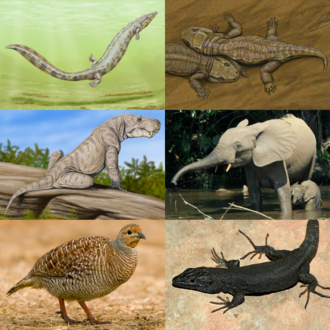
The transition from aquatic life to fully terrestrial existence is one of the most significant chapters in vertebrate history. At the center of this transition is Reptiliomorpha, a clade of tetrapods that includes all amniotes—the ancestors of modern reptiles, birds, and mammals—as well as those extinct tetrapods more closely related to amniotes than to living amphibians (lissamphibians).
Spanning from the Mississippian period (approximately 358.9 million years ago) to the present day, Reptiliomorpha represents a diverse array of "reptile-shaped" creatures. These animals bridged the gap between the primarily aquatic labyrinthodonts of the Devonian and the first true reptiles, evolving the physiological and anatomical tools necessary to conquer the land.
Key Facts
- Definition: A clade containing amniotes and tetrapods sharing a more recent common ancestor with amniotes than with lissamphibians.
- Temporal Range: From the Mississippian (358.9 Ma) to the present.
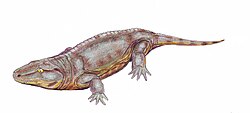
- Key Groups: Includes the crown group Amniota, as well as extinct groups like Diadectomorpha and Seymouriamorpha.
- Evolutionary Milestone: The development of the amniotic egg allowed reproduction away from water.
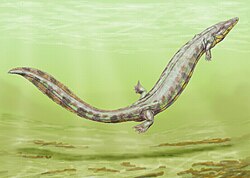
- Diversity: Ranged from aquatic forms with long bodies (embolomeres) to land-based, reptile-like forms.
Defining the Reptiliomorphs
In scientific nomenclature, Reptiliomorpha is often referred to as Pan-Amniota. The group is defined by its relationship to humans (Homo sapiens) and its exclusion of certain living amphibians, such as the tailed frog (Ascaphus truei) or the caecilian (Caecilia tentaculata).
However, the exact boundaries of this group are often debated among paleontologists. This is primarily because the origin of lissamphibians (modern amphibians) is uncertain. There are two primary hypotheses:
- The Temnospondyl Hypothesis: If modern amphibians descended from temnospondyls, then Reptiliomorpha includes diadectomorphs, seymouriamorphs, gephyrostegids, and most lepospondyls.
- The Lepospondyl Hypothesis: If modern amphibians descended from lepospondyls, the definition of Reptiliomorpha narrows significantly, potentially including only amniotes and diadectomorphs.
Anatomical and Physiological Characteristics
Reptiliomorphs exhibited a wide range of body plans depending on their environment. While groups like the gephyrostegids and diadectomorphs were land-based, the embolomeres remained aquatic, characterized by elongated bodies and short limbs.
According to paleontologist Michael J. Benton, several distinct cranial and skeletal features define the group:
- Narrow Premaxillae: The front-most bone of the upper jaw is less than half the total width of the skull.
- Tapering Vomers: The vomers (bones of the nasal septum) taper forward.
- Phalangeal Formula: A specific number of joints in the toes, typically following a 2.3.4.5.4–5 pattern.
Physiologically, these animals showed a transition in reproductive strategies. Seymouriamorphs retained amphibian-like reproduction, laying aquatic eggs that hatched into gilled larvae. In contrast, some embolomeres from the Mazon Creek fossil beds show evidence of direct development, meaning they bypassed the larval stage entirely.
The Path to Amniotes
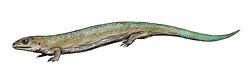
The most critical evolutionary leap within this clade was the origin of the amniotic egg. Before this, tetrapods were tied to water for reproduction. Early, small reptiliomorphs like Solenodonsaurus, Casineria, and Westlothiana may have laid eggs small enough (1 cm or less) to allow gas exchange without a complex shell, paving the way for the true amniotic egg.
Recent evidence from amniote tracks in Australia suggests that this divergence occurred almost immediately after the start of the Carboniferous, or perhaps even during the Devonian. While non-amniote reptiliomorphs coexisted with their descendants for millions of years, most terrestrial non-amniote forms vanished by the middle Permian. Only a few aquatic groups, such as the chroniosuchians, survived into the Triassic.
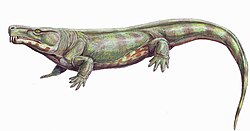
Summary of Major Reptiliomorph Groups
| Group | Environment | Key Characteristic | Status |
|---|---|---|---|
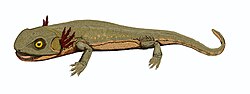
| Embolomeri | Aquatic | Long bodies, short limbs | Extinct |
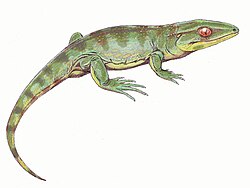
| Seymouriamorpha | Terrestrial | Amphibian-style larval stage | Extinct |
| Diadectomorpha | Terrestrial | Advanced reptile-like anatomy | Extinct |
| Amniota | Terrestrial/Diverse | Amniotic egg (water-independent) | Extant |
Frequently Asked Questions
What is the difference between a reptiliomorph and an amniote?
An amniote is a member of the crown group that possesses an amniotic egg, allowing it to reproduce on land. A non-amniote reptiliomorph is a "stem-amniote"—an animal more closely related to amniotes than to modern amphibians, but which still lacked the fully developed amniotic egg.
When did Reptiliomorpha first appear?
Fossil track evidence suggests they diverged from amphibians at the start of the Carboniferous period (approximately 358.9 million years ago), and potentially as early as the Devonian.
Were all reptiliomorphs land-dwellers?
No. While many were terrestrial, such as the seymouriamorphs and diadectomorphs, others like the embolomeres were aquatic with body plans suited for swimming.
Why is the classification of Reptiliomorpha controversial?
The controversy stems from the uncertain origin of lissamphibians (modern amphibians). Depending on whether modern amphibians descended from temnospondyls or lepospondyls, different fossil groups are either included in or excluded from the Reptiliomorpha clade.