Rennell Island: The South Pacific's Giant Upraised Atoll
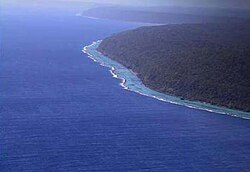
Located south of Honiara, Rennell Island is a geological marvel of the Solomon Islands. As the second largest upraised coral atoll—a coral reef that has been pushed above sea level by tectonic forces—in the world, it offers a unique landscape of towering cliffs, rolling forested hills, and the largest lake in the South Pacific.
The island's foundation dates back to the late Cretaceous and early Eocene periods, originating from volcanic activity. Over time, tectonic movements lifted the seabed, allowing coral to build. This process created a complex of coralline algal limestone that was later dolomitized (a chemical process where calcium is replaced by magnesium) and subsequently covered by younger reef limestone.
Key Facts
- Global Status: Second largest upraised coral atoll in the world.
- Major Landmark: Lake Tegano, the largest lake in the South Pacific and a World Heritage Site.
- Geography: Surrounded by cliffs ranging from 120 to 150 meters (390 to 490 feet).
- Climate: Tropical with high humidity and annual rainfall of approximately 4,000 mm.
- Biodiversity: Home to numerous endemic bird, bat, and plant species.
Geography and Infrastructure
Rennell Island is characterized by a stark contrast between its eastern and western regions. The western end is relatively flat with rolling forested hills, while the eastern end is dominated by a massive central basin. The island is largely enclosed by steep cliffs, making access challenging.
Transportation on the island is limited. The Copperhead Road is the primary artery, stretching from the Tigoa airstrip in the west to the Labagu port area in the south, with a branch extending toward the lake. For those seeking natural beauty, Kangava Bay provides white sand beaches and coral reefs ideal for snorkeling.
Lake Tegano: A World Heritage Site
Known locally as Tegano, Tungano, or "Big Water," Lake Te Nggano is the defining feature of East Rennell. Occupying 17.6% of the island's total area, the lake measures 29 kilometers (18 mi) long and 10 kilometers (6.2 mi) wide, covering 155 square kilometers (60 sq mi).
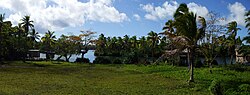
The lake is a mixture of brackish, fresh, and salt water, reaching depths of 44 meters (144 feet). Its salinity is maintained by a subterranean duct system that connects the lake to the open ocean. The lake bed consists of a hard bottom covered by several meters of suspended mud.
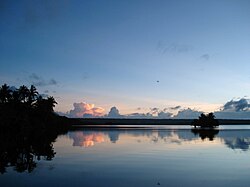
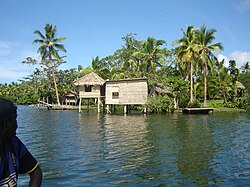
The shoreline is dotted with local dwellings, reflecting the community's close relationship with the water.
World War II History
During the Pacific War, Lake Tegano served as a strategic base for flying boats. Japanese Nakajima A6M2-N Rufe floatplanes operated here until US forces gained air and sea superiority. Following 1943, American PBY Catalinas utilized the lake as a base. A detachment of the 2nd Marines arrived on November 12, 1942, to establish a lookout post.
The lake now serves as a watery graveyard for these aircraft. Local accounts suggest nine aircraft lie at the bottom, five of which are visible from the surface. At the end of the war, US forces scuttled eight aircraft rather than transporting them home. Some planes are believed to have crashed due to the lake's coral outcrops.
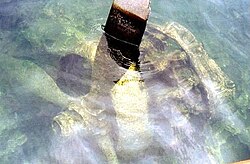
In a notable effort of local ingenuity, community members once attempted to retrieve a radial engine to use as a generator. Using only hand tools and snorkels, they cut the engine from a wing and dragged it across the coralline floor with a hand-winch. Though they brought it close to the shore, the engine's immense weight and rapid corrosion eventually forced them to abandon the project.
Climate and Environment
Rennell experiences a tropical climate with average temperatures between 23 and 28 °C (73 to 82 °F). The region is highly humid and receives significant rainfall, averaging 4,000 mm (160 inches) annually. From April to November, south-east trade winds prevail. The island is also situated in a cyclone belt; notably, Cyclone Nina struck the island in 1993.
Flora and Fauna
The biological makeup of Rennell and Bellona islands is unique, showing more similarities to Australia and New Caledonia than to other parts of the Solomon Islands. The region is a hotspot for endemic species (species found nowhere else on Earth).
Endemic Wildlife
- Birds: The Rennell starling, bare-eyed white-eye, Rennell shrikebill, and Rennell fantail. The Solomons white ibis, a dwarf subspecies of the Australian white ibis, is also endemic to these islands.
- Mammals: The Rennell flying fox is one of 11 bat species found in the area.
- Reptiles: Lake Tegano is the only known home of the endemic sea krait Laticauda crockeri, one of only two freshwater sea snake species globally. The Rennell monitor is also present.
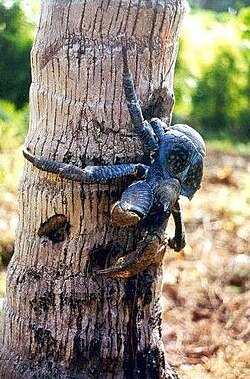
- Invertebrates: The island hosts 27 species of land snails (seven endemic), the coconut crab, and various land hermit crabs.
Botanical Diversity
The flora includes the endemic orchid Dendrobium rennellii near the lake and two endemic species of Pandanus (P. lacustris and P. rennellensis). The islands are also home to 25 species of ants and a vast array of insects, particularly moths, with 246 species identified.
Notably, Rennell is free of indigenous malaria, cane toads, vipers, and crocodiles.
Summary of Rennell Island Characteristics
| Category | Details |
|---|---|
| Geological Type | Upraised Coral Atoll |
| Lake Tegano Area | 155 km² (17.6% of island) |
| Average Temperature | 23 to 28 °C |
| Annual Rainfall | ~4,000 mm |
| Key Endemic Bird | Rennell Starling |
| Key Endemic Reptile | Sea krait (Laticauda crockeri) |
Frequently Asked Questions
What makes Rennell Island geologically unique?
Rennell is the second largest upraised coral atoll in the world, meaning its coral reef structure was pushed above sea level by tectonic activity, creating a high island with steep cliffs and a central basin.
What is the significance of Lake Tegano?
Lake Tegano is the largest lake in the South Pacific and is recognized as a World Heritage Site. It is a brackish body of water connected to the sea via subterranean ducts and is the only known habitat for the endemic sea krait Laticauda crockeri.
Which aircraft were used at Lake Tegano during WWII?
The lake served as a base for Japanese Nakajima A6M2-N Rufe floatplanes and later for American PBY Catalinas after 1943.
Are there any dangerous animals on Rennell Island?
The island is notably safe from several common regional threats, as it has no indigenous malaria, cane toads, vipers, or crocodiles.
What are some of the endemic birds found on the island?
Endemic birds include the Rennell starling, the bare-eyed white-eye, the Rennell shrikebill, the Rennell fantail, and the Solomons white ibis.