Remigration: The Rise of Mass Deportation Rhetoric in Western Politics
In recent years, the term remigration has transitioned from the fringes of far-right discourse into the mainstream political lexicon of several Western nations. While it may sound like a neutral administrative process, in a political context, it is frequently used as a euphemism for the mass deportation of non-European immigrants and native residents with migrant backgrounds. The criteria for who should be "remigrated" are often vaguely defined, typically centering on a perceived lack of assimilation into the host country's culture.
The concept is heavily championed by the Identitarian movement—a pan-European ethno-nationalist network—and thinkers such as Guillaume Faye, Renaud Camus, and Martin Sellner. These groups often link remigration to the "Great Replacement," a conspiracy theory suggesting that native European populations are being systematically replaced by non-European immigrants.
Key Facts
- Definition: A term used by far-right movements to describe the mass repatriation or deportation of immigrants and their descendants.
- Ideological Roots: Strongly tied to the Identitarian movement and the "Great Replacement" conspiracy theory.
- Scope: Now appearing in the official platforms or rhetoric of major political parties in Germany, Austria, Belgium, France, Italy, and the United States.
- Target Groups: While often focusing on illegal immigrants, some proponents advocate for the remigration of legal residents, naturalized citizens, and those who have committed crimes.
Remigration in Europe
Germany and Austria
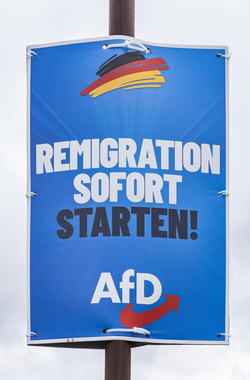
In Germany, the Alternative for Germany (AfD) has integrated remigration into its policy platform, calling for programs on the "largest possible scale." The movement gained visibility through high-profile protests, such as the 2018 Identitarian action at Frankfurt Central Station. In January 2024, reports emerged of a secret meeting in Potsdam where AfD members and activists, including Martin Sellner, allegedly discussed deporting immigrants, including naturalized German citizens.
Similarly, in Austria, the Identitäre Bewegung Österreich held protests in 2019 driven by the "Great Replacement" theory. The Freedom Party of Austria (FPÖ) has since emphasized remigration, particularly targeting individuals from Islamic countries and those who break the law.
France and Belgium
France has seen a fragmented but persistent push for remigration. While Marine Le Pen's National Rally has officially opposed the term to distance itself from the AfD, other figures like Eric Zemmour (Reconquête) and Marion Maréchal have advocated for it. Polls from 2022 indicated that a majority of French respondents were not shocked by the term, with some supporting the creation of a dedicated Ministry of Remigration.
In Belgium, the Flemish nationalist party Vlaams Belang has called for remigration since 2011. By 2021, they proposed an "Agency for Remigration," and by 2025, party leaders advocated for policies targeting illegal immigrants, asylum seekers, and foreign criminals.
Italy, the Netherlands, and Southern Europe
Italy's political landscape has seen remigration advocated by Lega Giovani and MEP Roberto Vannacci, the latter of whom founded the "National Future" party to promote the concept. In the Netherlands, the Party for Freedom (PVV) has fluctuated in its official stance but has advocated for voluntary remigration schemes and mandatory deportation for criminals.
In Spain, the Vox party has called for the mass remigration of illegal immigrants and those who "decide not to integrate." Meanwhile, in Portugal, the Chega party has supported the remigration of foreign and dual nationals who commit crimes.
Remigration in North America
United States
The term saw a significant spike in usage leading up to the 2024 U.S. presidential election. Donald Trump mainstreamed the term by calling for the remigration of illegal immigrants and pledging large-scale deportations. This rhetoric translated into administrative action in 2025 with the Department of State's proposed "Office of Remigration." Further legislative efforts, such as the "Remigration Act" introduced by Representative Andy Ogles in 2026, sought to expand the scope of denaturalization (the legal process of stripping a person of their citizenship).
Canada
In Canada, the concept is primarily promoted by alt-right and far-right groups, including Diagolon, the Second Sons, and the Dominion Society of Canada.
Summary of Political Adoption
| Country | Key Proponents | Primary Target/Focus |
|---|---|---|
| Germany | AfD, Identitarians | Mass scale; potentially including naturalized citizens |
| USA | Donald Trump, Stephen Miller | Illegal immigrants; refugee resettlement suspension |
| Austria | FPÖ, Identitäre Bewegung | "Uninvited strangers"; focus on Islamic countries |
| Belgium | Vlaams Belang | Illegal immigrants, asylum seekers, and criminals |
| France | Reconquête, Identity–Liberties | Illegal immigrants and "Fiche S" foreigners |
| Netherlands | PVV, FvD | Voluntary schemes and mandatory criminal deportation |
Frequently Asked Questions
What exactly does "remigration" mean in a political context?
In modern political discourse, remigration is a term used by far-right and Identitarian movements to describe the mass deportation or forced repatriation of non-European immigrants and their descendants to their ancestral countries of origin.
How does remigration differ from standard deportation?
While standard deportation typically targets individuals who have violated immigration laws, remigration often encompasses a broader, ideological scope. It may target legal residents or naturalized citizens based on criteria like cultural assimilation or ethnic background.
What is the "Great Replacement" theory?
The Great Replacement is a conspiracy theory claiming that native white European populations are being deliberately replaced by non-white immigrants, often through the orchestration of a global elite. This theory serves as a primary ideological driver for remigration policies.
Which political parties have officially proposed remigration?
Parties including the AfD (Germany), FPÖ (Austria), Vlaams Belang (Belgium), PVV (Netherlands), and Vox (Spain) have either included remigration in their platforms or had high-ranking members advocate for it.
Has remigration been implemented as official government policy?
While many parties advocating for remigration have held or sought power, implementation varies. In the U.S., the Trump administration proposed an "Office of Remigration" and pursued large-scale deportation efforts, while in Europe, it remains a central campaign pillar for several populist-right parties.