Remedios de Escalada: A History of Rail and Resilience
The story of Remedios de Escalada is one of transformation, evolving from a quiet residential outpost into a vital industrial and educational hub. Originally founded as a bedroom community—a residential area where inhabitants commute to a nearby city for work—the town's trajectory was forever altered by the arrival of the railway, which catalyzed its growth into a center of labor organization and cultural diversity.
The Foundations of a Rail Hub
The town was first established in 1873 by Agustín Eguren under the name Edén Argentino ("Argentine Eden"). For nearly two decades, the population remained small, numbering only in the hundreds. This changed dramatically in 1890 when the Buenos Aires Great Southern Railway opened a rail yard in the neighboring Villa Galíndez to the east.
The rail industry did more than just move trains; it fostered a new era of labor rights. In 1887, workers at the site founded La Fraternidad, which stands as one of the oldest and first trade unions in Argentina.
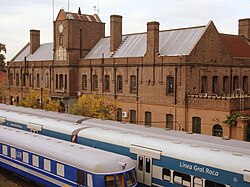
The area's importance as a rail operations hub was further solidified in 1901 through installations opened by Eliseo Ramírez and the Ramírez de Lafuente family. By 1902, the Great Southern Railway inaugurated its first commuter station, cementing the town's role in the regional transport network.
Cultural Growth and Community Development
As the infrastructure grew, so did the community's social and athletic life. In 1906, the town's first football club, Club Atlético Talleres de Remedios de Escalada, was established; the club continues to compete in the lower leagues of Argentine football today.
The early 20th century saw a significant influx of Italian Argentines, who brought entrepreneurial spirit to the region. Notable figures included Víctor Marangoni, owner of a major metalworks establishment, and Luis Máspero, who operated one of the largest hat factories in the country. To support this growing demographic, the Italian Mutual Insurance and Assistance Company was founded in 1913.
Cooperatives and Civic Institutions
The era was marked by a surge in cooperative movements and media. Key cooperatives such as El Hogar Argentino (1911) and La Internacional (1914) were established, alongside the daily newspaper La Idea in 1915. Labor dynamics also evolved with the 1921 creation of the Unión Ferroviaria, a prominent "yellow union" (a union typically aligned with management) designed to act as a counterweight to the more intransigent La Fraternidad.
The Path to Cityhood and Modern Challenges
In 1924, the Roman Catholic Parish of Nuestra Señora de los Remedios was consecrated. A pivotal administrative change occurred in 1933 when Villa Galíndez and Edén Argentino were merged to form Remedios de Escalada. The city was named in honor of María de los Remedios de Escalada, the wife of General José de San Martín, the leader of the Argentine War of Independence.
The Buenos Aires Province Legislature formally declared Remedios de Escalada a city in 1974. However, the subsequent years brought urban challenges. During the dictatorship of 1976-83, a plan to expand the General Paz Freeway from the Villa Riachuelo ward in Buenos Aires to Avellaneda was initiated. The project failed and was never completed, leaving a swath of empty lots across the city that were not adequately reurbanized.
Despite these setbacks, the city continued to evolve as an intellectual center with the establishment of the National University of Lanús in 1995, which remains one of the country's smaller national universities.
Key Facts
- Founded: 1873 as Edén Argentino by Agustín Eguren.
- Rail Influence: Became a hub via the Buenos Aires Great Southern Railway (1890) and the Ramírez family (1901).
- Labor History: Birthplace of La Fraternidad (1887), one of Argentina's oldest unions.
- City Status: Formally declared a city in 1974.
- Education: Home to the National University of Lanús since 1995.
| Year | Event | Significance |
|---|---|---|
| 1873 | Foundation of Edén Argentino | Established as a bedroom community. |
| 1887 | Foundation of La Fraternidad | One of Argentina's first trade unions. |
| 1902 | First Commuter Station | Inaugurated by the Great Southern Railway. |
| 1933 | Incorporation of the Town | Villa Galíndez and Edén Argentino merged. |
| 1974 | City Declaration | Formally recognized by the Province Legislature. |
| 1995 | University Establishment | National University of Lanús opened. |
Frequently Asked Questions
Who was Remedios de Escalada named after?
The city was named in honor of María de los Remedios de Escalada, who was the wife of General José de San Martín, the leader of the Argentine War of Independence.
What role did the railway play in the town's development?
The railway transformed the town from a small bedroom community into a prime rail operations hub, bringing infrastructure, commuter access, and the birth of significant labor unions like La Fraternidad.
What is the significance of the General Paz Freeway project?
The failed expansion project during the 1976-83 dictatorship led to widespread demolitions. Because the project was never completed, it left behind many empty lots that were not properly redeveloped.
Which educational institution is located in the city?
The National University of Lanús, established in 1995, is located in Remedios de Escalada.
What was the impact of Italian immigration on the town?
Italian Argentines contributed significantly to the local economy through industrial ventures, such as one of the country's largest hat factories and a major metalworks establishment, and founded the Italian Mutual Insurance and Assistance Company in 1913.