Realism and Naturalism in the Arts
In the world of art, realism is the pursuit of representing subject matter truthfully. It seeks to strip away artificiality, exaggeration, and supernatural elements to present the world as it is. While often used interchangeably with naturalism, these two concepts have distinct historical and philosophical roots. Naturalism focuses on the visual accuracy of objects with minimal distortion, whereas realism often refers to a specific 19th-century movement that challenged the idealized standards of academic art.
Key Facts
- Realism originated in France after the 1848 Revolution, focusing on the mundane and the commoner.
- Naturalism in visual arts is closely tied to the development of linear perspective and illusionism.
- Illusionism is the technique of creating the optical illusion of three-dimensional space on a flat surface.
- Verismo is the operatic equivalent of naturalism, featuring gritty, lower-class protagonists.
- Italian Neorealism used non-professional actors and location shooting to maintain authenticity in cinema.
The Evolution of Visual Arts
Resisting Idealization
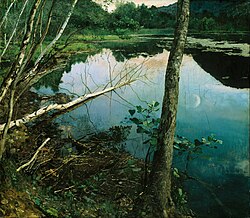
During the 19th century, naturalism emerged as a broad European movement. Unlike realism, it lacked a strong political agenda. The critic Jules-Antoine Castagnary defined the naturalist school in 1863 as the expression of life in all its phases, aiming to reproduce nature with a balance of truth and science. This scientific approach was also mirrored in the novels of Émile Zola. While Naturalist paintings often shared subject matter with Impressionism, they utilized more traditional and tighter brushwork.
The Rise of Illusionism
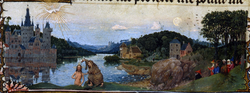
The quest for visual accuracy fluctuated throughout history. Late Antiquity rejected illusionism—the art of making a painting look like a window into a real space—in favor of expressive force. This trend reversed during the Late Medieval and Early Renaissance periods. In the 15th century, the Netherlands and Italy pioneered oil painting techniques and scientific linear perspective, allowing for precise light effects and anatomical accuracy.
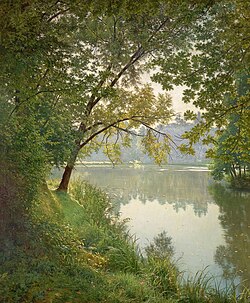
By the 17th century, the Dutch Golden Age perfected the depiction of landscapes and weather. However, portraiture often remained idealized, with artists smoothing features or using artificial poses. Even still-life paintings, while technically precise, often lacked true realism; for example, flower bouquets frequently featured blooms from different seasons that would never naturally appear together.
Depicting Ordinary Subjects
The shift toward the everyday began with Early Netherlandish painting, which brought prosperous merchants into the frame. Works like Jan van Eyck's Arnolfini Portrait provided detailed middle-class interiors, though these objects often held symbolic meanings. Later, the "Labours of the Months" cycles focused on peasants, paving the way for landscape art and the depiction of the working class.
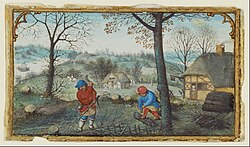
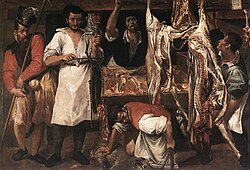
By the 16th century, scenes of food markets and kitchens became fashionable. Artists like Pieter Bruegel the Elder pioneered panoramic views of peasant life. This evolved into 17th-century genre painting across Europe, including the bodegones of Spain and the works of the Le Nain brothers in France.
The Realist Movement and Beyond
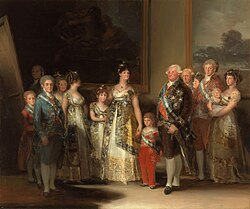
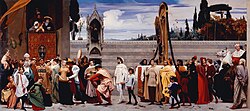
The French Realist movement, led by artists like Gustave Courbet, rejected the emotionalism of Romanticism. Motivated by leftist politics and a renewed interest in the common person, they embraced the "ugly" or sordid aspects of life. This movement spread across the West, manifesting in Russia through the Peredvizhniki (Wanderers) and in Britain through artists like Luke Fildes, who addressed pressing social issues.
Realism in Literature and Theatre
In literature, realism acted as a reaction against Romanticism. While Victorian writers adopted realist styles, the rigid conventions of "bourgeois realism" eventually sparked a revolt known as modernism around 1900. Modernists sought to criticize the 19th-century social order through anti-rationalist and anti-realist programs.
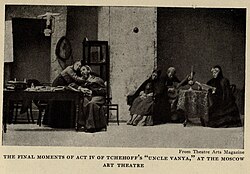
In the United States, realism in drama emerged in the late 1870s and early 1880s, championed by figures such as William Dean Howells and Henry James.
Cinema and the "Reality Effect"
Post-WWII Italy saw the rise of Italian Neorealism, led by directors like Vittorio De Sica and Roberto Rossellini. Cinema generally employs two types of realism:
- Seamless Realism: Uses narrative structures to create a "reality effect" that maintains authenticity.
- Aesthetic Realism: Promoted by Andre Bazin, this approach uses location shooting, natural light, and non-professional actors to avoid manipulating the viewer.
Realism in Opera: Verismo
Verismo was a post-Romantic operatic tradition that sought to bring the naturalism of writers like Zola and Ibsen to the stage. Composers such as Giacomo Puccini and Pietro Mascagni focused on true-to-life dramas featuring flawed, lower-class protagonists. This style peaked in the early 1900s with works like Cavalleria rusticana and Pagliacci, which explored themes of violence and infidelity.
| Feature | Naturalism | Realism |
|---|---|---|
| Primary Goal | Visual accuracy and minimal distortion | Truthful representation of life/society |
| Motivation | Scientific observation/Linear perspective | Social critique/Political awareness |
| Key Focus | Nature and biological truth | The mundane, the commoner, and the sordid |
| Origin/Peak | Renaissance (roots) / 19th Century | Post-1848 France |
Frequently Asked Questions
What is the difference between realism and naturalism?
Naturalism generally refers to the visual attempt to depict objects with the least possible distortion, often tied to scientific observation. Realism, while using naturalistic techniques, often refers to a specific 19th-century movement that focused on social truth and the lives of ordinary people, often for political reasons.
How did the French Revolution of 1848 influence art?
The aftermath of the revolution fueled the Realist movement in France. Artists began to reject the idealization of academic art and the emotionalism of Romanticism, choosing instead to focus on the commoner and the realities of the working class.
What is "aesthetic realism" in cinema?
Aesthetic realism is a filmmaking approach that avoids manipulating the viewer. It utilizes long shots, deep focus, eye-level angles, natural lighting, and non-professional actors to allow the audience to form their own interpretations of the scene.
What characterizes Verismo in opera?
Verismo is characterized by "true-to-life" drama. It moved away from romanticized plots to feature gritty, flawed protagonists from the lower classes, focusing on raw human emotions and realistic social settings.
What was the relationship between realism and modernism?
Modernism emerged around 1900 as a reaction against the limitations and conventions of 19th-century "bourgeois realism." Modernist writers and artists adopted anti-rationalist and anti-realist programs to criticize the existing social order.