Rahway Valley Railroad: A History of Ambition and Industry
The story of the Rahway Valley Railroad is a classic American tale of industrial optimism, financial struggle, and the eventual shift from rail to road. What began as a visionary project to create a manufacturing hub in New Jersey evolved through several corporate identities, serving everything from munitions plants during World War I to the prestigious Baltusrol Golf Club.
The Early Years: New York and New Orange Railroad
The railroad's origins date back to May 6, 1897, with the incorporation of the New York and New Orange Railroad (NY&NO). This venture was spearheaded by the New Orange Industrial Association, a group of businessmen from Elmira, New York, who aimed to transform land on the border of Cranford and Union into a thriving town called New Orange (known today as Kenilworth).
Construction began in July 1897, with contractor Frank H. Bailey building a two-mile stretch of track that connected with the Central Railroad of New Jersey (CNJ) at Cranford. By 1899, the line extended to N. 19th Street in New Orange and included a 0.5-mile branch connecting to the Lehigh Valley Railroad (LV) at Roselle Park. The railroad's first locomotive, No. 1 (named "New Orange"), entered service in July 1899, followed by No. 2 ("Baltusrol") in September 1900.
Despite these efforts, the town of New Orange did not grow as quickly as promoters had hoped. The NY&NO fell into default and was sold under foreclosure on February 16, 1901, to the New Orange Four Junction Railroad.
Transition to the New Orange Four Junction Railroad
Incorporated on February 4, 1901, the New Orange Four Junction Railroad (NOFJ) was an attempt by the original promoters to regain control. Under the leadership of President William W. Cole and Superintendent Horatio F. Dankel, the company surveyed potential extensions to Irvington, Millburn, and Summit, though these plans never materialized.
A brief period of prosperity arrived in 1902 when the Pennsylvania Railroad (PRR) purchased local hills for fill material to support projects like the North River Tunnels and yards in Jersey City and Newark. The NOFJ profited by hauling this material to the Roselle Park interchange. However, the New Orange Industrial Association failed in 1904, leading to the formation of the Kenilworth Realty Corporation.
This new group partnered with Louis Keller, the founder of the Social Register and the Baltusrol Golf Club, to charter the Rahway Valley Railroad and finally push the line toward Summit. On March 1, 1905, the NOFJ and the new Rahway Valley Railroad were consolidated.
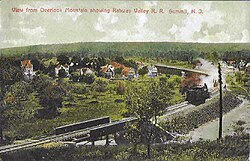
The Era of the Rahway Valley Railroad
Louis Keller's primary motivation was improving transportation to his golf club, as the dirt roads of Union County were inadequate. The consolidated Rahway Valley Railroad (RV) expanded rapidly, reaching Springfield on May 25, 1905, Baltusrol on January 1, 1906, and Summit on August 2.
The expansion was not without conflict. The Delaware, Lackawanna and Western Railroad (DL&W) fought the RV's request for a connection at Summit. This legal battle reached the United States Supreme Court, and the connection was not finally established until March 1930.
Financial Struggles and Management
High construction debts and a lack of lineside industry plagued the RV. Control shifted back to the Elmira interests via a bond call in 1909, prompting Keller to form the Rahway Valley Company to lease and operate the line. Eventually, Keller acquired the mortgage bonds, and his family maintained majority ownership until 1986.
War-Time Boom and Post-War Decline
World War I brought a surge in traffic as the RV served a munitions plant in Kenilworth and a gunpowder plant in Union. The period was marked by high activity and security concerns, including the hiring of armed guards following an explosion at the Wright plant.
The post-war era saw a decline in traffic. Management shifted to Roger A. Clark in 1920, who ended passenger service and modernized the locomotive fleet. His son, George A. Clark, took over in 1932 and led the railroad to its first profit in years by 1934.
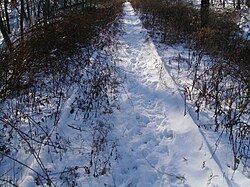
Dieselization and Late-Century Challenges
In 1951, the RV began dieselization—the process of replacing steam locomotives with diesel engines—starting with a GE 70-ton switcher (No. 16). By 1954, steam was phased out. However, the rise of improved highways and trucking began to siphon away customers.
Following the death of George Clark in 1969, his son Robert G. Clark took over, but the railroad suffered from deferred maintenance and the closure of the Maplewood line. After Robert's death in 1975, Benard Cahill became president, securing state grants to rehabilitate the tracks and establishing new offices in a repurposed Lehigh Valley passenger coach.
A brief return to passenger service occurred in 1980 for one week during the U.S. Open at Baltusrol, using coaches leased from the Cooperstown and Charlotte Valley Railroad.
Final Years and Stewardship
Delaware Otsego Ownership
The formation of Conrail in 1976 reduced the RV's interchange options. By 1986, a liability insurance crisis forced the owners to contract the Delaware Otsego Corporation (DO) to operate the line. Under DO, the RV interchanged with the Staten Island Railway via trackage rights. However, the loss of major customers like Monsanto Corp. and Jaeger Lumber by 1991 led to a terminal decline. In February 1995, DO sold the right-of-way to the state of New Jersey for $6.4 million.
Morristown and Erie Stewardship
In 2001, the state contracted the Morristown and Erie Railway (M&E) to rehabilitate and operate the southern portion of the line. While some trackage was restored between Roselle Park and the Union/Springfield border, funding struggles persisted. By May 15, 2012, the M&E removed its assets after choosing not to extend its operating agreement.
Key Facts
- Founded: Originally incorporated as the New York and New Orange Railroad on May 6, 1897.
- Key Figures: Louis Keller (founder of Baltusrol Golf Club) and the Clark family (Roger, George, and Robert).
- Major Customers: Monsanto Corp., Jaeger Lumber, and various WWI munitions plants.
- Legal Milestone: A connection battle with the DL&W that reached the U.S. Supreme Court.
- Final Sale: The right-of-way was sold to the state of New Jersey in 1995 for $6.4 million.
| Entity Name | Incorporation/Start | Primary Purpose/Outcome |
|---|---|---|
| New York and New Orange Railroad | 1897 | Serve the planned town of New Orange; ended in foreclosure. |
| New Orange Four Junction Railroad | 1901 | Assume control of NY&NO; hauled fill material for PRR. |
| Rahway Valley Railroad | 1904/1905 | Consolidated operation; extended line to Summit. |
| Delaware Otsego Corporation | 1986 (Contract) | Managed operations during insurance crisis; sold line in 1995. |
| Morristown and Erie Railway | 2001 (Contract) | State-contracted rehabilitation of the southern portion. |
Frequently Asked Questions
Why was the Rahway Valley Railroad originally created?
It was created by the New Orange Industrial Association to serve the residents and factories of a planned manufacturing town called New Orange (now Kenilworth), New Jersey.
Who was Louis Keller and what was his role?
Louis Keller was the founder of the Baltusrol Golf Club and the Social Register. He partnered with the Kenilworth Realty Corporation to charter the Rahway Valley Railroad to improve transportation to his golf club.
How did World War I affect the railroad?
The war created a boom in traffic because the railroad served critical military firms, including a gunpowder plant in Union and a munitions plant in Kenilworth.
What led to the eventual decline of the railroad?
The decline was caused by a combination of factors, including the rise of trucking and improved highways, the loss of major industrial customers like Monsanto Corp., and a liability insurance crisis in the 1980s.
Did the railroad ever run passenger trains?
Yes, it began with passenger service in 1899. Although regular service was later abolished, it ran special passenger trains for one week in 1980 for the U.S. Open at Baltusrol.