Predecessor Railroads of the West Jersey and Seashore
The development of the rail network in southern New Jersey was a complex process of chartering, construction, and strategic mergers. From the early push to connect Camden with the coast to the expansion into agricultural and industrial hubs, several key railroads laid the foundation for the region's transportation infrastructure.
Key Facts
- The Camden and Atlantic Railroad opened passenger service to Atlantic City on July 4, 1854.
- The West Jersey Railroad served as a central hub, absorbing numerous smaller lines like the Salem and Swedesboro railroads.
- The Pennsylvania Railroad (PRR) gained control of the Camden and Atlantic in 1883 via its West Jersey subsidiary.
- Many historic rights-of-way remain in use today through PATCO, NJ Transit, and Conrail.
- The West Jersey and Atlantic Railroad was a strategic PRR-directed line completed in 1880.
The Camden and Atlantic Railroad
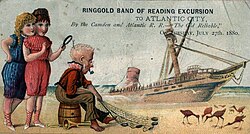
Chartered on March 19, 1852, the Camden and Atlantic (C&A) was designed to link Camden to Atlantic City via Berlin. The line was largely completed by late June 1854, though a drawbridge outside Atlantic City remained unfinished. Despite this, regular passenger service launched on July 4, 1854, transporting over 3,000 passengers on its inaugural day.
The C&A's success sparked competition, leading to the 1876 charter of the Philadelphia and Atlantic City Railway, which utilized a 3 ft 6 in (1,067 mm) gauge. Beyond transport, the C&A played a civic role; in May 1880, the railroad deployed crews to fight a massive forest fire to protect Atlantic City, an event that caused an estimated $200,000 in damages (approximately $6,672,414 in 2025).
Control of the C&A shifted on January 1, 1883, when the Pennsylvania Railroad (PRR) acquired it through the West Jersey Railroad, following controversial financial dealings involving the potential bribery of a clerk to obtain stockholder lists.
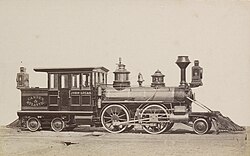
The West Jersey Railroad and Its Expansion
The West Jersey Railroad (WJ) began with a capital subscription of $250,000 on March 29, 1853, eventually reaching $450,000. Chartered on February 5, 1853, its primary goal was to connect Camden to Cape May. The line was built in stages with support from the C&A, opening the first 8.2 miles (13.2 km) on April 15, 1857, using an abandoned right-of-way from the Camden and Woodbury Railroad.
The WJ expanded to Glassboro on April 1, 1861, and to Bridgeton by July 25, 1861, completing the full line in 1863. Today, this right-of-way is known as the Vineland Secondary freight line, with the northern section planned for the Glassboro–Camden light-rail line.
Integrated Branch Lines
To solidify its network, the West Jersey Railroad merged with or leased several smaller regional lines:
- Millville and Glassboro Railroad: A 22-mile (35 km) line built by Millville businessmen. Opened in October 1860 and merged into the WJ on April 1, 1868.
- Cape May and Millville Railroad: A 41-mile (66 km) line completed in 1867. It was leased to the WJ in 1869 and fully merged on August 27, 1879.
- Salem Railroad: A 17-mile (27 km) line from Elmer to Salem, completed in 1863. It was leased in 1868 and merged on January 1, 1888.
- Swedesboro Railroad: A 10.8-mile (17.4 km) line from Woodbury to Swedesboro, completed in October 1869 and merged on January 1, 1888.
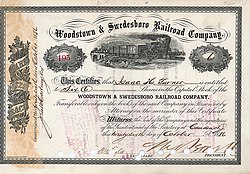
- Woodstown and Swedesboro Railroad: Opened February 23, 1873, and merged on January 1, 1888.
Specialized and Strategic Lines
The WJ also pursued specific economic interests. The Maurice River Railroad (9.76 miles) was incorporated in 1887 to tap into the Delaware Bay oyster industry and was merged into the WJ by January 1, 1888. Additionally, the WJ built a line to Riddleton Junction in February 1883 to serve agricultural interests in Woodstown, providing two distinct routes into Salem.
Secondary and Specialized Railroads
West Jersey and Atlantic Railroad
Directed by the PRR in 1879, this 34.2-mile (55.0 km) line connected Newfield to Atlantic City via Mays Landing. With a capital stock of $500,000 ($17,276,786 in 2025), it was completed on June 16, 1880, and later leased to the WJ. Much of the line was abandoned between 1958 and 1966, though a portion is now the Atlantic County Bikeway.
Philadelphia Marlton and Medford Railroad
Chartered in January 1880, this line provided service from Haddonfield to Medford by October 1881. It featured several flag stops (stations where trains stop only upon signal), including Orchard and Cropwell. Passenger service ended on September 24, 1927, and the branch was decommissioned on November 2, 1931.
Delaware River Railroad
Originally incorporated as the Delaware Shore Railroad in 1873 to link Woodbury to Penns Grove, the company faced bankruptcy in 1879 and re-emerged as the Delaware River Railroad (DRR). It was acquired by the WJ&S on April 30, 1900, and its right-of-way is currently used by Conrail's Penns Grove Secondary.
Summary of Predecessor Railroads
| Railroad Name | Primary Route/Area | Completion/Opening | Integration Date |
|---|---|---|---|
| Camden and Atlantic | Camden to Atlantic City | 1854 | 1883 (PRR Control) |
| West Jersey | Camden to Cape May | 1863 | N/A (Parent Company) |
| Millville and Glassboro | Millville to Glassboro | 1860 | 1868 (Merged) |
| Cape May and Millville | Cape May to Millville | 1867 | 1879 (Merged) |
| Salem Railroad | Elmer to Salem | 1863 | 1888 (Merged) |
| West Jersey and Atlantic | Newfield to Atlantic City | 1880 | Leased to WJ |
Frequently Asked Questions
Which modern services use the old Camden and Atlantic line?
The main line built by the C&A is still used in the 21st century for passenger services operated by PATCO and NJ Transit's Atlantic City Line.
Why was the Maurice River Railroad created?
The West Jersey Railroad built the Maurice River Railroad specifically to gain a share of the profitable Delaware Bay oyster business.
What happened to the West Jersey and Atlantic Railroad?
The line was largely abandoned between 1958 and 1966. However, a section from Egg Harbor Township to Mays Landing was converted into a rail trail as part of the Atlantic County Bikeway in 2003.
What were flag stops on the Philadelphia Marlton and Medford Railroad?
Flag stops were stations where the train would only stop if signaled by a passenger or if a passenger on board requested to get off. On the PM&M, all stops except Haddonfield, Marlton, and Medford were flag stops.
How did the Pennsylvania Railroad gain control of the Camden and Atlantic?
The PRR gained control on January 1, 1883, through its subsidiary, the West Jersey Railroad, following financial dealings that may have involved the bribery of a C&A clerk.