Radio Broadcasting: AM, FM, and Digital Transmission Systems
Radio broadcasting is a diverse field of communication that has evolved from simple signal modulations to complex digital streams. From the global reach of shortwave transmissions to the high-fidelity local coverage of FM, radio remains a vital medium for news, entertainment, and education. Today, the landscape includes a variety of operators, including commercial stations, non-commercial educational (NCE) public broadcasting, non-profit entities, community radio, student-run campus stations, and hospital radio.
According to Nielsen Audio (formerly Arbitron), a radio station is broadly defined as any government-licensed AM or FM station, HD Radio stations (primary or multicast), internet streams of licensed stations, satellite channels from Sirius or XM, or potentially unlicensed stations.
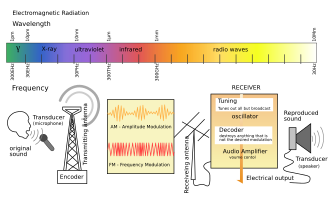
Key Facts
- AM (Amplitude Modulation) varies the signal amplitude and is susceptible to electrical interference but can travel vast distances at night.
- FM (Frequency Modulation) varies the signal frequency, offering higher fidelity and noise resistance, though it is limited to line-of-sight propagation.
- Shortwave is used for international broadcasting (e.g., BBC, VOA) and is highly sensitive to solar activity.
- Digital Radio includes systems like DAB in Europe and HD Radio in North America.
- Pirate Radio refers to unlicensed or illegal transmissions for political or entertainment purposes.
AM Radio: Amplitude Modulation
AM was the first form of broadcasting to be developed. It operates by varying the amplitude of the carrier signal to match the signal being transmitted. While the medium-wave band is used globally, Europe also utilizes the long-wave band.
Technical Characteristics and Propagation
In North America, the standard broadcast band ranges from 525 to 1,705 kHz, with channels spaced every 10 kHz (9 kHz in most other regions). One of the primary advantages of AM is its simplicity; early receivers, such as crystal radios, could operate without an external power source.
AM signals behave differently depending on the time of day due to the ionosphere (the ionized part of Earth's upper atmosphere). During the day, the D-layer of the ionosphere absorbs signals, limiting range. At night, this absorption decreases, allowing signals to reflect off the ionosphere and travel thousands of miles. This allows clear-channel stations—those with unshared frequencies—to be heard across entire continents, although they often suffer from severe signal fading.
Audio Fidelity and Limitations
AM transmitters can handle audio frequencies up to 15 kHz, though the FCC limits this to 10 kHz in the US to reduce interference. Most receivers only reproduce up to 5 kHz to keep manufacturing costs low and minimize noise. While AM stereo was introduced in North America in the late 80s and early 90s to compete with FM, it never gained widespread popularity.
FM Radio: Frequency Modulation
Invented by Edwin Howard Armstrong in the early 1930s, FM was designed to eliminate radio-frequency interference (RFI) that plagued AM. Instead of varying amplitude, FM varies the frequency of the carrier wave.
Frequency Bands and Fidelity
FM typically operates on VHF (Very High Frequency) airwaves. While most of the world uses 88 to 108 MHz, Japan uses 76 to 90 MHz, and Russia utilizes 65.9 to 74 MHz. FM offers superior fidelity because stations are spaced further apart—200 kHz in the US compared to AM's 10 kHz.
This wider bandwidth allows for a 15 kHz audio signal and a 38 kHz stereo subcarrier. Some broadcasters use the remaining capacity for auxiliary data, such as financial market information or GPS signals.
Propagation and Market Evolution
Unlike AM, FM transmissions are line-of-sight, meaning they do not reflect off the ionosphere. Consequently, the range is shorter and remains consistent regardless of the time of day. FM began as a niche medium for audio enthusiasts in the 1940s. By the 1980s, as dual AM/FM tuners became standard in radios, FM became the dominant medium in urban areas, while AM remained more prevalent in rural regions due to its longer range.
Alternative Broadcasting Methods
Pirate Radio
Pirate radio consists of illegal or unregulated transmissions. These are often used for political purposes or entertainment and have historically utilized sea vessels to avoid national jurisdictions. A broadcast may be classified as "pirate" if it is unlicensed, exceeds permitted wattage, or transmits content that is illegal in the receiving country.
Terrestrial Digital Radio
Digital broadcasting reduces noise and allows for more efficient use of the spectrum. Different regions have adopted different standards:
- DAB (Digital Audio Broadcasting): Based on the EUREKA 147 system, used primarily in the UK and South Africa.
- DAB+: Used in Germany and the Netherlands.
- L-Band: The digital radio system used in France.
- HD Radio: An in-band on-channel system used in the US and Canada, owned by the iBiquity consortium.
- DRM (Digital Radio Mondiale): A public domain system used by a small number of global broadcasters.
| Feature | AM (Amplitude Modulation) | FM (Frequency Modulation) |
|---|---|---|
| Primary Band | Medium Wave (525–1705 kHz in NA) | VHF (88–108 MHz globally) |
| Propagation | Ground wave & Ionospheric (Night) | Line-of-sight |
| Audio Fidelity | Lower (typically < 5 kHz) | Higher (up to 15 kHz + Stereo) |
| Interference | High (Lightning, EMI) | Low (Resistant to RFI) |
| Range | Long (especially at night) | Short/Local |
Frequently Asked Questions
Why can some AM stations be heard from further away at night?
During the day, the D-layer of the ionosphere absorbs AM signals. At night, this absorption disappears, allowing signals to reflect off the ionosphere and travel vast distances, a process known as ionospheric propagation.
What is the main difference between AM and FM sound quality?
FM provides higher fidelity and is more resistant to noise and interference because it uses a wider bandwidth and varies frequency rather than amplitude, allowing for stereo sound and a broader range of audio frequencies.
What is HD Radio?
HD Radio is a digital broadcasting system used in the United States and Canada. It is an "in-band on-channel" system, meaning it places digital broadcasts on frequencies adjacent to existing analog signals.
What defines a "pirate" radio station?
A pirate radio station is any transmission that is illegal or unregulated. This can be due to a lack of government licensing, exceeding power limits, or transmitting content that violates the laws of the country where the signal is received.
How does shortwave radio differ from standard AM?
While shortwave uses amplitude modulation, it operates on higher frequency bands that allow for inter-continental range depending on atmospheric conditions and solar activity, making it ideal for international broadcasting.