AM Radio: The Evolution of Amplitude Modulation Broadcasting
Amplitude Modulation (AM) is a method of broadcasting that revolutionized how information, music, and news reached the masses. Starting with experimental transmissions in the early 1900s, AM radio became the primary medium for global communication for decades. While it has since faced stiff competition from digital and FM alternatives, its legacy remains embedded in the history of modern media.
The journey of AM radio began with the work of pioneers like Reginald Fessenden, who demonstrated the potential for wireless telephony as early as 1906. Unlike earlier systems, AM allowed for the transmission of voice and music, paving the way for a new era of simultaneous distribution to thousands of listeners without the need for physical wires.
Key Facts
- Origin: Experimental transmissions began around 1901; widespread broadcasting took hold in the 1920s.
- Golden Age: AM was the dominant broadcast method from the 1920s until the 1950s.
- Core Technology: Transitioned from alternator and arc transmitters to vacuum tubes, and eventually to transistors.
- Primary Band: Medium wave (MF) is the most common AM band, typically ranging from 530 to 1700 kHz in the Americas.
- Modern Shift: Many AM stations now use FM translators or internet streams to reach younger audiences.
The Technological Evolution of AM
Early Transmitter Technologies
The earliest AM transmissions relied on alternator and arc transmitters. However, the real revolution occurred around 1915 with the advancement of vacuum tubes (known as "valves" in the UK). These devices could amplify electrical currents, solving the overheating problems associated with connecting microphones directly to antennas. Vacuum tubes provided higher quality signals and allowed for higher transmitting frequencies.
![One of the earliest radio broadcasts, French soprano Mariette Mazarin singing into Lee de Forest's arc transmitter in New York City on February 24, 1910.[3]](/images/b6/a6/b6a6bde0310362630de2bc954a61bb63a997e345cae99a178912f0fdbc6225d9.png)
The Rise of the Receiver
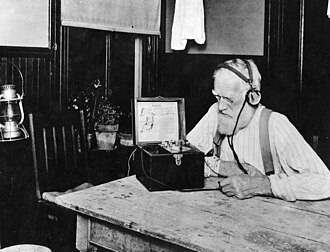
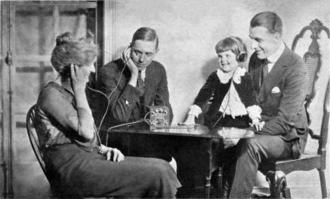
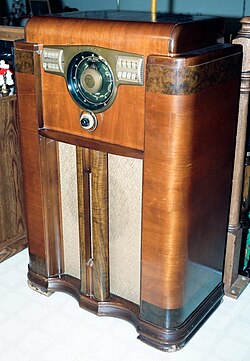
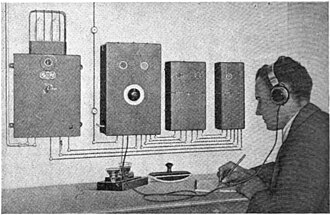
In the early days, listeners used crystal radio sets. These simple receivers lacked the power to drive loudspeakers, requiring families to huddle around earphones to hear a broadcast.
The landscape changed drastically in 1954 with the release of the Regency TR-1, the first transistor radio. Invented at Bell Labs in 1948, the transistor replaced bulky vacuum tubes with compact components. This made radios portable for the first time, turning the medium into a "companion" that people could carry in their pockets.
The History of Organized Broadcasting

Pioneering Efforts
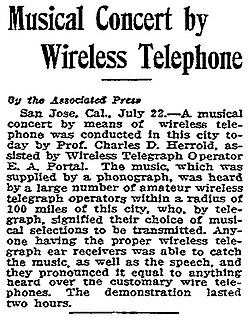
Regularly scheduled entertainment broadcasts began with Charles "Doc" Herrold in San Jose, California, in 1912. Shortly after, Lee de Forest utilized vacuum tube transmitters in New York City to broadcast news and entertainment, most notably the 1916 presidential election returns, which reached an estimated 7,000 listeners.
![Lee de Forest used an early vacuum-tube transmitter to broadcast returns for the Hughes-Wilson presidential election returns on November 7, 1916, over 2XG in New York City. Pictured is engineer Charles Logwood.[4]](/images/f9/9c/f99c2b90d2f7a5569d037337ef8ca111b99c037bcbb1cf47dfc2a6fbdd7dcab6.jpg)
Global Expansion
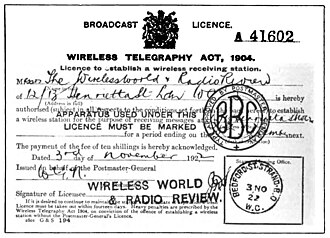
Broadcasting expanded rapidly across the Atlantic. In the UK, the Marconi factory in Chelmsford began experimental broadcasts in 1920, featuring performers like opera singer Nellie Melba. By 1922, Germany established broadcasting as a Post Office monopoly, while the British government introduced receiver licenses to fund its stations.
![Nellie Melba making a broadcast over the Marconi Chelmsford Works radio station in England on June 15, 1920.[11]](/images/4a/cc/4acc800e2391b297e7a5196ec62155006939abba12618bbbb98bae1cbc788963.jpg)
The Golden Age and Commercialization
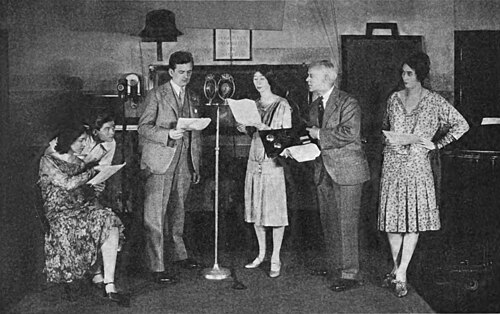
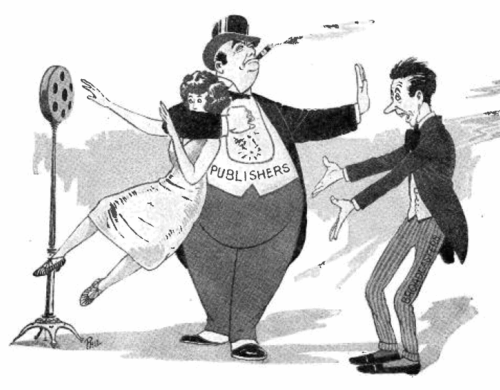
From the 1920s to the 1950s, the "Golden Age of Radio" saw the rise of massive networks and live programming. This era also saw the resolution of early copyright disputes; initially, music was played without payment, but the industry eventually agreed to pay royalties to publishers.
The Decline and Modern Adaptation
Competition from FM and Digital
The introduction of FM radio in 1941 eventually eroded AM's dominance. FM offered superior sound quality, and by 1978, FM listenership officially surpassed AM. The decline continued as digital radio, satellite radio, and internet streaming services emerged.
Revitalization Efforts
To stay competitive, the AM industry attempted several upgrades:
- AM Stereo: In 1993, the US adopted the C-QUAM system as the standard for AM stereo, though adoption remained limited as stations shifted toward talk and news formats.
- Expanded Band: The ITU extended the AM band (1610 kHz to 1700 kHz) to reduce interference, though only a small fraction of US stations migrated.
- HD Radio: The FCC has allowed stations to move toward all-digital operations to improve audio quality.
Current State of AM
Today, AM radio is primarily used for news, sports, and talk. Demographic data shows a significant age gap, with the median AM listener being 57 years old. To survive, many stations now utilize FM translators—small stations that rebroadcast the AM signal on the FM band—or simulcast via the internet.

Technical Summary
| Feature | Medium Wave (MF) - Region 2 (Americas) | Shortwave / VHF AM |
|---|---|---|
| Frequency Range | 530–1700 kHz | Various (VHF AM: 41.02–43.98 MHz) |
| Channel Spacing | 10 kHz | Variable |
| Max Audio Bandwidth | 10.2 kHz (NRSC Standard) | Variable |
| Primary Use | Local/Regional News & Talk | Long-distance / Specialized |
Frequently Asked Questions
Why did AM radio decline in popularity?
AM radio declined primarily due to the superior audio quality of FM radio, the rise of television in the 1950s, and the eventual emergence of digital streaming and podcasting.
What is the difference between a vacuum tube and a transistor radio?
Vacuum tubes were large, generated significant heat, and required more power, making early radios stationary. Transistors are tiny, efficient, and allowed radios to become portable and pocket-sized.
What are FM translators?
FM translators are low-power stations that pick up an AM signal and rebroadcast it on the FM band, allowing AM stations to reach listeners who prefer FM receivers or experience interference on AM.
What was the "Golden Age of Radio"?
The Golden Age of Radio refers to the period from the 1920s to the 1950s when radio was the dominant form of mass media and home entertainment before the widespread adoption of television.
Can AM radio be digital?
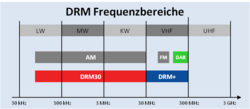
Yes. Through technologies like HD Radio and Digital Radio Mondiale (DRM), AM stations can transmit digital signals that offer better audio quality than traditional analog AM.