Quincy Media: A Comprehensive History of a Broadcasting and Publishing Powerhouse
The story of Quincy Media is a classic American tale of growth, evolving from a local newspaper merger in the early 20th century into a diversified regional media conglomerate. For nearly a century, the company expanded its footprint across the Midwest and beyond, navigating the shifts from print to radio, and eventually to television and digital media.
The Foundations of Quincy Newspapers
The corporation began its journey on June 1, 1926, as Quincy Newspapers. This entity was formed through the merger of two established local publications: the Quincy Herald (a descendant of the Illinois Bounty Land Register first published in 1835) and the Quincy Whig-Journal (descended from the Quincy Whig founded in 1838). The merger resulted in a single daily publication known as the Quincy Herald-Whig.
The ownership history of these papers involved several key figures. In 1891, Charles L. Miller, Hedley John Eaton, and Edmund Botsford purchased the Herald. Miller, who had founded the Rockford Daily Register, eventually brought his brother-in-law Aaron Burr Oakley and nephew Ray M. Oakley into the business, establishing the Oakley family's multi-generational presence in the Quincy media landscape.
Simultaneously, the Quincy Whig was purchased in 1915 by brothers Frank M. Lindsay, Sr. and Arthur O. Lindsay, Sr. By 1920, the Lindsays had consolidated the Whig with The Quincy Journal, which had been founded in 1883.

Expansion into Broadcasting
Quincy Newspapers (QNI) diversified into broadcasting in 1947 with the launch of WQDI, the first commercial FM station in Quincy. A year later, the company acquired Quincy Broadcasting Co. to operate WGEM, the city's second AM station. By 1953, WQDI was renamed WGEM-FM.
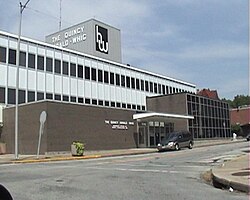
The company made a historic leap into television on September 4, 1953, launching WGEM-TV as the region's first television broadcast and an NBC affiliate. The studios were located on the ground floor of the former Tremont Hotel, a building Quincy Media later converted into the New Tremont Apartments for long-term and extended stay guests.
Strategic Growth and National Expansion
In 1969, QNI partnered with six other newspaper entities to form American Newspapers Inc., which acquired The New Jersey Herald in 1970. QNI eventually took full ownership of American Newspapers by 1986.
The 1970s and 80s marked a period of aggressive television expansion. The company acquired several stations, primarily NBC affiliates, including:
- WSJV (Elkhart, Indiana) in 1974
- KTTC (Rochester, Minnesota) in 1976
- WVVA (Bluefield, West Virginia) in 1979
- KTIV (Sioux City, Iowa) in 1989
- WREX-TV (Rockford, Illinois) in 1995
Further growth continued into the 2000s. In 2001, QNI purchased five ABC affiliates in Wisconsin from Shockley Communications (WKOW-TV, WAOW-TV, WYOW, WXOW-TV, and WQOW-TV) and acquired ProVideo of Wisconsin, Inc., a digital and non-linear online suite. Other notable acquisitions included KWWL in Waterloo, Iowa (2006) and WMOW in Crandon, Wisconsin (2009).
The Transition to Quincy Media
In January 2016, the company officially rebranded as Quincy Media. This era was characterized by complex acquisitions and regulatory navigation. Between 2014 and 2018, the company acquired several stations from Granite Broadcasting and others, including WBNG-TV (its first CBS affiliate) and stations in Peoria, Superior, and Chisholm.
To comply with FCC (Federal Communications Commission) rules regarding station ownership in a single market, Quincy Media utilized specific ratings data from "sweeps" periods to justify the acquisition of KDLH and WISE in 2018, arguing that the stations did not overlap as top-rated entities.
The company's final major expansions included the $70 million purchase of KVOA in Tucson, Arizona, and the $24.5 million acquisition of WSIL-TV and KPOB in 2018. In 2019, it briefly expanded its print portfolio by purchasing the Hannibal Courier-Post while selling The New Jersey Herald.
The Final Chapter: Acquisition by Gray Television
In early 2021, CEO Ralph Oakley confirmed that Quincy Media was for sale. On February 1, 2021, Gray Television announced an agreement to acquire all Quincy Media television properties and the WGEM radio stations for $925 million in cash.
Due to regulatory requirements from the FCC and the Department of Justice, some stations were divested. Allen Media Group purchased 10 of these stations for $380 million. The remaining newspaper assets were sold to the Phillips Media Group of Harrison, Arkansas. The entire transaction was finalized on August 2, 2021.
Key Facts
- Founded: June 1, 1926, as Quincy Newspapers.
- First TV Station: WGEM-TV, launched September 4, 1953.
- Major Rebrand: Changed name to Quincy Media in January 2016.
- Final Sale: Acquired by Gray Television in 2021 for $925 million.
- Print Legacy: Started with the merger of the Quincy Herald and Quincy Whig-Journal.
| Year | Event | Outcome |
|---|---|---|
| 1926 | Formation of Quincy Newspapers | Merger of Herald and Whig-Journal |
| 1953 | Launch of WGEM-TV | First TV broadcast in the Quincy region |
| 2016 | Corporate Rebranding | Renamed to Quincy Media |
| 2021 | Acquisition by Gray Television | Sale of TV properties for $925 million |
Frequently Asked Questions
How did Quincy Media start?
It began as Quincy Newspapers on June 1, 1926, following the merger of the Quincy Herald and the Quincy Whig-Journal into a single daily paper called the Quincy Herald-Whig.
When did the company enter the television market?
The company entered television on September 4, 1953, with the launch of WGEM-TV, which served as the NBC affiliate for the Quincy region.
What was the significance of the 2016 name change?
In January 2016, the company changed its name from Quincy Newspapers to Quincy Media to reflect its broader portfolio of television and digital assets beyond its original newspaper roots.
Who eventually acquired Quincy Media?
Gray Television acquired Quincy Media's television properties and WGEM radio stations for $925 million in a transaction completed on August 2, 2021.
What happened to the newspapers after the Gray Television deal?
The newspaper assets were not acquired by Gray Television; instead, they were sold in a separate transaction to the Phillips Media Group of Harrison, Arkansas.