Pygostyle: The Evolutionary Pillar of Bird Tails
In the world of avian anatomy, the pygostyle serves as a critical structural foundation. Derived from the Ancient Greek words pugḗ (tail or rump) and stûlos (pillar or column), the pygostyle is a skeletal condition where the final few caudal vertebrae fuse into a single, ossified structure. This "rump pillar" provides the necessary support for the tail feathers and the musculature required to control them.
The pygostyle is the primary component of the uropygium. In culinary contexts, this area is often referred to by colloquial names such as the "pope's nose," "bishop's nose," "parson's nose," or "sultan's nose." This fleshy protuberance, commonly seen on dressed chickens or turkeys, appears swollen because it houses the uropygial gland, which produces the oil birds use for preening.
Key Facts
- Definition: A fused set of final caudal vertebrae supporting tail feathers.
- Evolutionary Timeline: Likely emerged 140 to 130 million years ago during the Early Cretaceous.
- Primary Function: Provides stability and control for flight by replacing a long, mobile tail.
- Types: Categorized into "rod-type" (primitive/diverse) and "plowshare-type" (modern).
- Biological Role: Supports the rectrices (tail feathers) and the preen oil gland.
The Evolution of the Pygostyle
The transition from the long, bony tails of early ancestors—like Archaeopteryx—to the shortened pygostyle was a pivotal evolutionary step. A completely mobile tail is detrimental to flight control; therefore, the fusion of vertebrae provided a significant aerodynamic advantage. Interestingly, modern birds still exhibit longer caudal vertebrae during their embryonic stage before they fuse into the final pygostyle.
Rod-Type Pygostyles
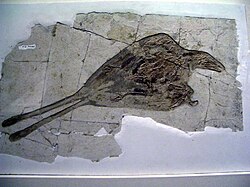
The earliest known species to possess a pygostyle were members of the Confuciusornithidae. These early birds, along with Enantiornithes and some oviraptorosaurs like Nomingia, featured a long, rod- or dagger blade-like pygostyle. These structures generally did not support a full fan of feathers; instead, they typically held downy fuzz or a few central "streamers."
While the function of the pygostyle in terrestrial animals like Nomingia remains unknown, its relative Caudipteryx lacked a pygostyle entirely, using a fan of symmetrical feathers for social display. The related Similicaudipteryx (described in 2008) possessed a rod-like pygostyle associated with a feather fan, suggesting these structures may have evolved to support ornamental displays.
Plowshare-Type Pygostyles
The more advanced plowshare-shaped pygostyle is found in Ornithurae (modern birds and their closest relatives). In almost all flying species, this shape supports an array of well-developed rectrices (tail feathers) used for precise maneuvering. While the central pair of feathers attaches directly to the pygostyle, the other rectrices are managed by bulbi rectricium (rectricial bulbs)—complex clusters of fat and muscle located on either side of the bone.
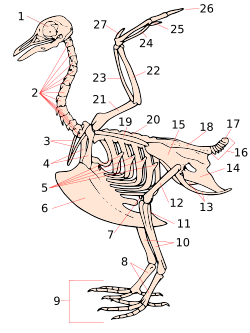
The oldest known species featuring this modern plowshare configuration is Hongshanornis longicresta. Another early example of a pygostyle similar to those in living birds is Yixianornis grabaui.
Convergent Evolution and Classification
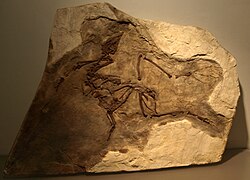
Evidence suggests that the pygostyle evolved at least twice. Rod-shaped versions likely appeared several times as a weight-saving measure associated with tail shortening. The specialized "true" pygostyles of ornithurans were later adapted from these simpler forms to enhance flight performance.
In 1996, Luis Chiappe named the clade Pygostylia to reflect this feature. In 2001, Jacques Gauthier and Kevin de Queiroz refined the definition of Pygostylia to refer specifically to the apomorphy (derived trait) of a short tail bearing an avian pygostyle.
Summary of Pygostyle Types
| Feature | Rod-Type | Plowshare-Type |
|---|---|---|
| Shape | Long, rod- or dagger-like | Plowshare-shaped |
| Associated Groups | Confuciusornithidae, Enantiornithes, some Oviraptorosaurs | Ornithurae (Modern birds) |
| Feather Type | Downy fuzz or central streamers | Well-developed rectrices (fan) |
| Primary Function | Weight reduction / Social display | Flight maneuvering and control |
The Pygostyle in Commerce and Culture
Beyond biology, the pygostyle has a presence in human culture and trade. The term "pope's nose" emerged in 18th-century Britain (around 1786), with "parson's nose" following in 1839, reflecting the religious leanings of the speaker. Variants like "bishop's nose" and "sultan's nose" appeared in the 20th century.
Economically, the "turkey tail" (the uropygium) is a significant export product. Because it is high in fat, it is often removed from turkeys in the United States and exported to markets in Ghana, Micronesia, and Samoa. In Samoa, turkey tails became popular after World War II, though they were banned from 2007 to 2013 to combat obesity before being reintroduced upon Samoa's entry into the World Trade Organization. In other regions, this cut is primarily used in pet food.
Frequently Asked Questions
What exactly is a pygostyle?
A pygostyle is a bone formed by the fusion of the final few caudal (tail) vertebrae in birds, which supports the tail feathers and the uropygial gland.
Why was the pygostyle an evolutionary advantage?
It replaced the long, heavy tails of ancestral species, which were cumbersome during flight. The shortened, fused structure allowed for better weight distribution and more precise control of tail feathers for maneuvering.
What is the difference between the two main types of pygostyles?
Rod-type pygostyles are long and thin, typically associated with primitive birds and simple streamers or downy feathers. Plowshare-type pygostyles are shaped like a plow, supporting a complex fan of rectrices used by modern birds for flight.
What is the "pope's nose"?
The "pope's nose" is a colloquial term for the uropygium, the fleshy part at the end of a bird's tail containing the pygostyle and the preen oil gland, often visible on dressed poultry.
How did the pygostyle evolve?
It evolved convergently at least twice. Early versions likely served as weight-saving measures or supports for social displays before being refined into the specialized flight-control organs seen in modern birds.