Confuciusornis: The Beaked Avialan of the Early Cretaceous
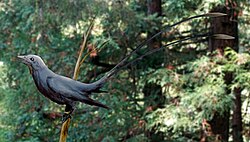
Among the most significant discoveries in the study of avian evolution is Confuciusornis, a genus of basal avialan (bird-like) theropod dinosaurs. Living during the Early Cretaceous period approximately 125 to 120 million years ago, these crow-sized creatures provide a critical window into how modern birds evolved. Named after the renowned Chinese philosopher Confucius, this genus is primarily known from the Yixian and Jiufotang Formations of China.
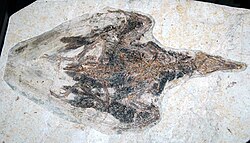
Confuciusornis is particularly notable for being one of the most abundant vertebrates in the Yixian Formation, with several hundred complete specimens recovered. Its discovery, alongside the early mammal Zhangheotherium, marked a turning point in our understanding of the Jehol Biota, a prehistoric ecosystem that has yielded the world's most important record of Mesozoic birds.
Key Facts
- Temporal Range: Early Cretaceous (125–120 Ma).
- Location: Yixian and Jiufotang Formations, China.
- Size: Roughly the size of a modern crow (50 cm length, 70 cm wingspan).
- Defining Feature: A toothless beak, which evolved convergently with modern birds.
- Diet: Likely omnivorous, with evidence of fish consumption.
- Flight: Capable of powered flight, adapted for maneuverability in dense forests.
Physical Characteristics and Anatomy
Size and Build
Confuciusornis was comparable in size to a modern crow, reaching a total length of 50 centimeters (1.6 feet) and a wingspan of up to 70 centimeters (2.3 feet). Weight estimates vary between 0.2 kg (0.44 lb) and 0.5 kg (1.1 lb). Some species, such as C. feducciai, were approximately one-third longer than the average C. sanctus specimen.

The Skull and Beak
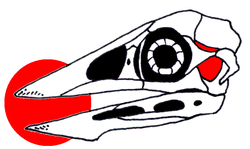
One of the most striking features of Confuciusornis is its toothless beak. While later relatives like Hesperornis and Ichthyornis retained teeth, Confuciusornis lost them independently—a process known as convergent evolution. Research indicates that beak shapes varied by species; for example, C. dui possessed an upward-curving beak, while C. sanctus had a straighter upper margin that may have hooked slightly downward.
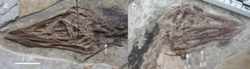
Recent studies of the skull's temporal region have led to various reconstructions, including a diapsid configuration (a skull with two temporal openings) suggested by researchers in 1999.
Skeletal Structure
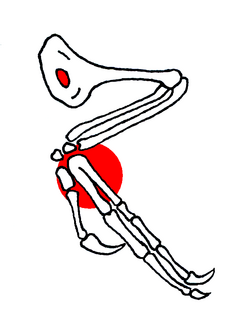
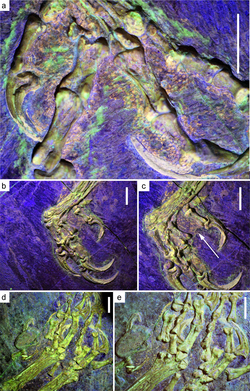
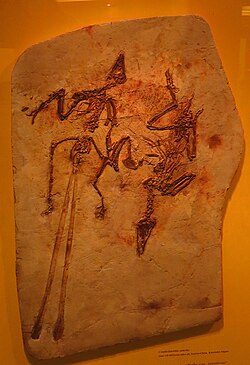
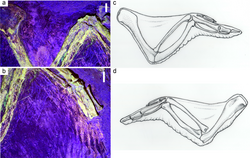
The postcranial skeleton reveals a bird adapted for its environment. Analysis of the arm bones shows a distinct hole in the humerus, while laser fluorescence of the feet has revealed the presence of scales and foot-pads.
Plumage and Coloration
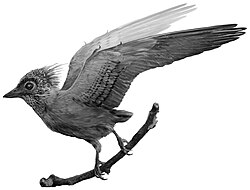
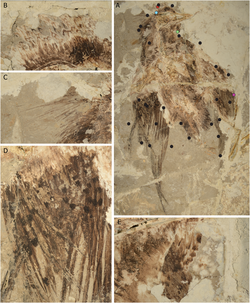
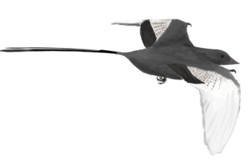
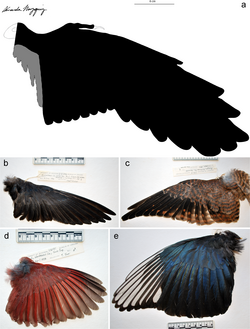
The study of melanosomes (microscopic organelles that contain pigment) has allowed scientists to hypothesize the colors of Confuciusornis. One study suggested a palette of grey, red/brown, and black, similar to a modern zebra finch. However, other research suggests a different pattern: dark body and upper wing feathers, with white or carotenoid-colored wing feathers.
The Mystery of the Tail Feathers
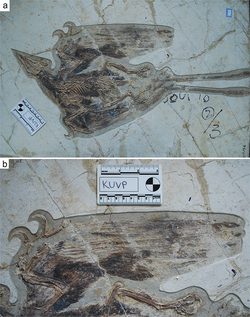
Many specimens exhibit a pair of long, streamer-like tail feathers, reminiscent of modern birds-of-paradise. Because these feathers are only found in a minority of specimens (estimated between 5% and 18%), paleontologists believe this is an example of sexual dimorphism, where the long feathers were ornamental displays used by males during courtship.
Paleobiology and Behavior
Flight Capabilities
There has been significant debate regarding whether Confuciusornis could fly. Evidence from laser fluorescence indicates that the raches (central shafts) of the feathers were robust. Combined with a substantial propatagium (the skin fold at the front of the wing) and postpatagium, researchers conclude that the bird was capable of powered flight, likely optimized for stability and maneuverability within dense forests rather than high speed.
Diet and Ecology
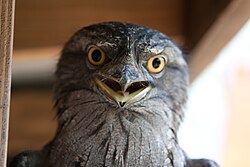
While no gastroliths (stomach stones used to grind plants) have been found, one specimen was discovered with the remains of a small fish, likely Jinanichthys, in its crop or throat. This suggests that Confuciusornis was not a herbivore but likely an omnivore, similar to modern crows.
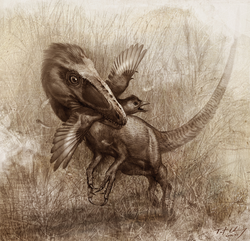
In the prehistoric food chain, Confuciusornis was prey for larger predators; stomach contents of the dinosaur Sinocalliopteryx have provided direct evidence of it preying on these birds.
Summary of Confuciusornis Species
| Species | Notable Characteristics | Status/Notes |
|---|---|---|
| C. sanctus | Type species; common in Yixian Formation | Most widely studied |
| C. dui | Upward curving, sharply tapering beak | Distinct beak morphology |
| C. feducciai | Approximately 33% longer than C. sanctus | Larger body size |
| C. jianchangensis | Early Cretaceous avialan | Identified in 2010 |
| C. shifan | Early Cretaceous avialan | Identified in 2022 |
Frequently Asked Questions
Was Confuciusornis the first bird to have a beak?
It was long thought to be the oldest beaked bird, but that title now belongs to its earlier relative, Eoconfuciusornis.
Did Confuciusornis have teeth?
No, Confuciusornis had a toothless beak. This is a case of convergent evolution, as it lost its teeth independently of the lineage that led to modern birds.
Could Confuciusornis fly?
Yes, evidence from feather robustness and wing structure suggests it was capable of powered flight, specifically adapted for maneuverability in forested environments.
Why do some specimens have long tail feathers and others do not?
This is widely interpreted as sexual dimorphism, with the long, streamer-like feathers likely belonging to males for use in courtship displays.
What did Confuciusornis eat?
It is believed to have been an omnivore. Fossil evidence showing fish remains in the crop suggests it ate small aquatic animals, and the lack of stomach stones argues against a primarily herbivorous diet.