Protoreaster lincki: The Vibrant Red Knob Sea Star of the Indian Ocean
The Protoreaster lincki, commonly known as the red knob sea star, red spine star, or African sea star, is a striking marine invertebrate native to the western Indian Ocean. Recognized for its bold colors and unique texture, this species is a fascinating example of the biodiversity found in tropical marine environments.
Key Facts
- Maximum Size: Up to 12 inches (30 cm) in diameter.
- Primary Habitat: Sandy or muddy seabeds in the western Indian Ocean.
- Diet: Carnivorous, feeding on sponges, soft corals, and other invertebrates.
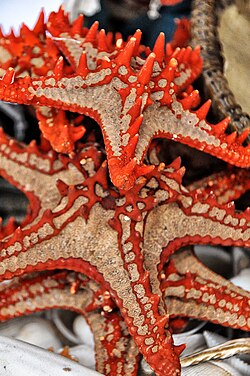
- Distinctive Feature: Bright red tubercles connected by red stripes on a gray body.
- Depth Range: From shallow tidal pools down to 100 meters (330 ft).
Physical Characteristics
The red knob sea star is visually distinct due to its coloration and structural anatomy. It typically features a gray body accented by bright red stripes that connect various tubercles—small, rounded projections—located along its five arms. This pattern gives the animal the appearance of a grid made of interconnecting wires.
Internally, the sea star's structure is supported by a skeleton composed of calcareous ossicles (small calcium carbonate plates) and spicules. These elements are embedded within a layer of connective tissue, providing the necessary support for its large central disk.
Distribution and Habitat
This species is primarily distributed across the western Indian Ocean. Its range extends along the African coast and Madagascar, reaching as far north as India and Sri Lanka. Additionally, a small, isolated population exists in Coral Bay, Western Australia.
While they are frequently spotted by observers in shallow tidal pools, P. lincki is adaptable to various depths, inhabiting waters as deep as 100 meters (330 ft). They show a strong preference for sandy or muddy seabeds, which facilitate their ability to forage for food more efficiently.
Behavior and Diet
The red knob sea star is a carnivorous predator that remains active during both the day and night. Its diet consists of a variety of sea creatures, including tube worms, clams, sponges, soft corals, and even other starfish.
Due to its striking appearance, it is a popular choice for saltwater aquariums. However, it is often considered incompatible with other invertebrates because of its predatory nature.
Conservation and Trade
The population of P. lincki faces pressure from the curios trade. The species is heavily fished to be sold as collectibles, a practice that contributes significantly to the rarefaction and decline of the species in the wild.
| Feature | Details |
|---|---|
| Scientific Name | Protoreaster lincki |
| Common Names | Red knob sea star, African red knob sea star, Red spine star |
| Max Diameter | 12 inches (30 cm) |
| Geographic Range | Western Indian Ocean (Africa, Madagascar, India, Sri Lanka, W. Australia) |
| Feeding Habit | Carnivorous |
| Max Depth | 100 meters (330 ft) |
Frequently Asked Questions
What does the red knob sea star eat?
It is a carnivore that feeds on various marine invertebrates, including soft corals, sponges, tube worms, clams, and other species of starfish.
Where can Protoreaster lincki be found in the wild?
They are found in the western Indian Ocean, primarily along the coasts of Africa and Madagascar, extending to India and Sri Lanka, with a small population in Western Australia's Coral Bay.
Can the red knob sea star be kept in an aquarium?
Yes, they are popular aquarium specimens, but they are often incompatible with other invertebrates because they may eat them.
What causes the decline of this species?
The species is heavily fished for the curios trade, which contributes to its decline in natural habitats.
What is the maximum size of a red knob sea star?
The red knob sea star can grow to a maximum diameter of 12 inches (30 cm).