Proboscis Anatomy and Function Across Animal Species
In the natural world, animals have evolved a diverse array of specialized tools to interact with their environments. One of the most versatile of these is the proboscis, an elongated appendage extending from the head. While the term is used broadly, its biological meaning shifts depending on whether the animal is a vertebrate or an invertebrate.
Etymologically, the word entered the English language in 1609 via the Latin proboscis, which is a Latinization of the Ancient Greek proboskis. This Greek root combines pro (forth, forward, before) and bosko (to feed, to nourish), perfectly describing the primary purpose of this anatomical feature.
Key Facts
- Invertebrates: The proboscis typically refers to tubular mouthparts used for sucking and feeding.
- Vertebrates: The proboscis is defined as an elongated nose or snout.
- Lepidoptera: Butterflies and moths use a coiled, two-tube system called a haustellum to drink nectar.
- Medical Inspiration: The molecular sharpness of the mosquito proboscis has informed the design of medical syringes.
- Gastropods: Some snails and slugs use hydraulic pressure to extend their proboscis for sensing or prey capture.
Proboscis in Invertebrates
For invertebrates, the proboscis is primarily a feeding organ. It is most commonly found in insects, certain worms, and gastropod molluscs.
Mosquitoes and Medical Biomimicry
Mosquitoes utilize their proboscis to extract blood, though this behavior is exclusive to females; males lack the strength to pierce human skin. However, both sexes use the organ to feed on flower nectars and fruit. Because the proboscis is exceptionally sharp at a molecular level, researchers have studied its structure to improve the design of syringes and other medical equipment.
Acanthocephala (Thorny-headed Worms)
The Acanthocephala, known as spiny-headed or thorny-headed worms, possess a specialized eversible proboscis. This organ is armed with spines, allowing the parasite to pierce and securely anchor itself to the gut wall of its host.
![Scanning electron microscopy of proboscis of an Acanthocephala[8]](/images/74/a4/74a41077296c56c0c053bd229b5a6ae1323edcd9859998a05f0cc2a4f59e3084.jpg)
Lepidoptera: Butterflies and Moths
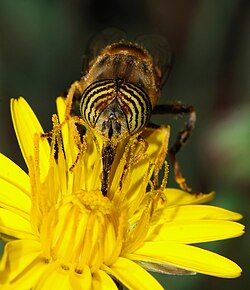
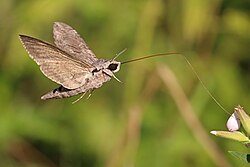
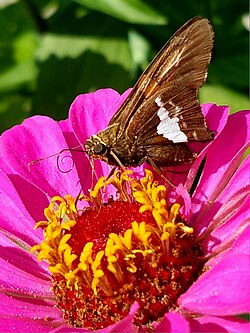
In the order Lepidoptera, the proboscis (also called the haustellum) is a sophisticated sucking mechanism. It consists of two concave tubes held together by hooks, forming a central channel for fluids. This structure is operated by internal muscles and a sac in the head that creates suction through contraction and expansion.
When at rest, the proboscis remains tightly coiled against the head. To feed, the insect unfurls the appendage to reach the center of a flower. For example, the moth Deilephila elpenor hovers in mid-air while extending its long proboscis to feed. While most Lepidoptera use this system for nectar, plant sap, or dung, some species—such as those in the family Micropterigidae—have chewing mouthparts, and others lack mouthparts entirely in their adult (imago) stage.
Gastropods
Certain evolutionary lineages of gastropods have developed a retractable proboscis, which is an elongation of the snout. These animals use the organ for sensing their environment, capturing prey, or attaching to hosts. They are categorized into three types: pleurembolic (partially retractable), acrembolic (fully retractable, common in parasites), and intraembolic (variable structure). Extension is achieved via hydraulic pressure from the head-foot musculature, while retraction is handled by specialized retractor muscles.
Proboscis in Vertebrates
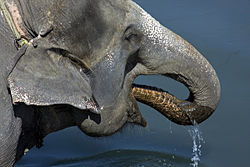
In vertebrates, the proboscis is not a sucking tube but an elongated nose or snout. The most iconic example is the elephant's trunk, but the term also applies to the elongated nose of the tapir and the snout of the male elephant seal.
Notable Vertebrates with a Proboscis
| Category | Examples |
|---|---|
| Mammals | Elephant, Tapir, Aardvark, Anteater, Proboscis monkey, Saiga antelope, Echidna, Numbat, Elephant seal, Elephant shrew, Hispaniolan solenodon |
| Extinct Mammals | Leptictidium, Macrauchenia, Moeritherium, Palorchestes |
| Fishes | Swordfish, Sailfish, Marlin, Paddlefish, Elephant fish, Spearfish |
Frequently Asked Questions
What is the difference between a proboscis in an insect and a mammal?
In insects and other invertebrates, a proboscis is typically a tubular mouthpart used for sucking fluids. In mammals and other vertebrates, it refers to an elongated nose or snout used for smelling, grasping, or sensing.
How do butterflies coil and uncoil their proboscis?
The proboscis of a butterfly consists of two tubes held together by hooks. It is operated by internal muscles and a sac in the head that creates the necessary suction for feeding; it remains coiled during rest and unfurls when the insect prepares to feed.
Do all mosquitoes use their proboscis to drink blood?
No. Only female mosquitoes use their proboscis to take blood meals. Male mosquitoes do not have a proboscis strong enough to break human skin, although both males and females use the organ to feed on flower nectars and fruit.
How do gastropods extend their proboscis?
Gastropods use hydraulic pressure generated by the wall musculature of the head-foot to protrude the proboscis, and they use specialized retractor muscles to pull it back inside the body.
Which extinct animals had a proboscis?
Several extinct mammals possessed a proboscis, including Leptictidium, Macrauchenia, Moeritherium, and Palorchestes.