Prime Minister of Mongolia: The Turbulent Tenure of Gombojavyn Zandanshatar (2025–2026)
The political landscape of Mongolia experienced a period of intense volatility between 2025 and 2026, marked by rapid leadership changes, fiscal crises, and deep internal party divisions. At the center of this storm was Gombojavyn Zandanshatar, the 32nd Prime Minister of Mongolia, whose brief administration attempted to navigate a precarious economic recovery while battling for political survival.
The transition began on June 3, 2025, when Prime Minister Luvsannamsrain Oyun-Erdene resigned following a motion of no confidence and widespread anti-government protests sparked by allegations of lavish spending by his son. On June 12, Zandanshatar was selected to replace him by a parliamentary vote of 108 to 9, officially assuming office the following day.
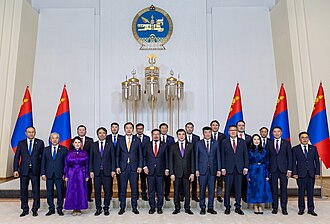
By June 18, Zandanshatar established a coalition government comprising the Mongolian People's Party (MPP), the HUN Party, and the Civil Will–Green Party. Notably, the Democratic Party—the primary opposition—was expelled from the previous coalition for violating a memorandum of understanding during the 2025 protests. Zandanshatar's cabinet consisted of 19 ministers, a reduction from the 22 ministers served under Oyun-Erdene.
Key Facts
- Appointment: Zandanshatar became the 32nd Prime Minister on June 13, 2025.
- Economic Shift: The administration focused on budget austerity, cutting ₮2.3 trillion MNT to address a fiscal deficit.
- GDP Growth: Economic growth rose from 2.4% to 5.6%, driven largely by copper exports.
- Shortest Tenure: Zandanshatar briefly became the shortest-serving PM in modern history after a contested dismissal on October 17, 2025.
- Resignation: He officially stepped down on March 27, 2026, to resolve parliamentary deadlock.
Economic Recovery and Budget Austerity
Upon taking office, Zandanshatar inherited a fiscal crisis. The 2025 budget, approved by the previous administration, was one of the most expensive in the history of the State Great Khural (Mongolia's parliament). President Khürelsükh had previously vetoed this budget in November 2024, calling for a deficit-free approach.
To stabilize the economy, Zandanshatar implemented strict austerity measures, stating that the budget needed to be reduced by $640 million. In July 2025, the government claimed to have cut ₮2.3 trillion MNT, effectively turning a looming deficit into a surplus. These measures, combined with a surge in copper exports—which made up 37.6% of total exports in the first eight months of 2025—helped push GDP growth from 2.4% to 5.6% and increased foreign exchange reserves to US$5.7 billion.
The 2025 Political Crisis
Despite economic gains, Zandanshatar's leadership was plagued by factional warfare within the MPP. The seeds of conflict were sown when former PM Oyun-Erdene advocated for a sovereign wealth fund to reduce reliance on commodities, a move opposed by powerful business interests. This divide eventually led to Oyun-Erdene's downfall and Zandanshatar's nomination by President Khürelsükh.
Tensions peaked during the MPP's eighth General Assembly in September 2025. A leadership struggle emerged between Zandanshatar and Parliamentary Speaker Dashzegviin Amarbayasgalan. When neither candidate achieved the required two-thirds majority in the first round, Zandanshatar boycotted the second round, which Amarbayasgalan won with 257 of 321 votes. Because the party charter dictated that the party chairman should be the prime minister, Zandanshatar's position became precarious.
The conflict escalated into accusations of corruption, with Zandanshatar linking Amarbayasgalan to a coal theft scandal. This led to the appointment of Battumuriin Enkhbayar as Minister of Justice and Internal Affairs to investigate the Speaker, a move that caused further party fractures and the revocation of Enkhbayar's party membership.
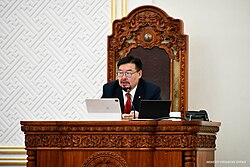
On October 17, 2025, the State Great Khural voted to dismiss Zandanshatar (71 opposing, 40 supporting). However, this dismissal was short-lived. President Khürelsükh vetoed the removal on October 20, and the Constitutional Court later ruled the motion unconstitutional on October 23. While Zandanshatar was reinstated, he withdrew from the party chairmanship race on November 11 to prioritize national stability. Nyam-Osoryn Uchral was subsequently elected party chairman on November 15.
Final Resignation and Transition
The final phase of Zandanshatar's tenure was marked by opposition pressure. In December 2025, the Democratic Party sought his dismissal following the appointment of 17 deputy ministers. By March 2026, the Democratic Party boycotted the spring session of parliament, arguing that the ruling party leader should not preside over the legislature.
Although the MPP held a majority of 68 seats, internal divisions prevented the parliament from reaching a quorum (the minimum number of members required to make proceedings valid). To end the legislative paralysis, Zandanshatar resigned on March 27, 2026.
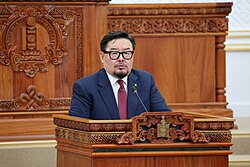
On March 30, 2026, the State Great Khural elected Nyam-Osoryn Uchral as the new Prime Minister with a vote of 88–19. Zandanshatar formally handed over the prime minister's seal at midnight.
| Metric/Event | Detail |
|---|---|
| Term Duration | June 13, 2025 – March 27, 2026 |
| GDP Growth Increase | 2.4% to 5.6% |
| Budget Cut | ₮2.3 trillion MNT |
| Foreign Exchange Reserves | US$5.7 billion |
| Key Export Driver | Copper (37.6% of total exports) |
| Successor | Nyam-Osoryn Uchral |
Frequently Asked Questions
Why did Luvsannamsrain Oyun-Erdene resign?
Oyun-Erdene resigned on June 3, 2025, due to a motion of no confidence and public protests regarding the lavish spending of his son.
How did Zandanshatar impact the Mongolian economy?
He implemented aggressive budget austerity, cutting ₮2.3 trillion MNT to eliminate a fiscal deficit, while benefiting from a surge in copper exports that raised GDP growth to 5.6%.
Why was Zandanshatar briefly dismissed in October 2025?
He was dismissed by the State Great Khural following a power struggle with Dashzegviin Amarbayasgalan; however, the Constitutional Court later ruled the dismissal unconstitutional.
What led to Zandanshatar's final resignation in 2026?
A combination of Democratic Party boycotts and internal MPP divisions prevented parliament from reaching a quorum, leading Zandanshatar to resign to avoid further government delays.
Who succeeded Gombojavyn Zandanshatar?
Nyam-Osoryn Uchral, the MPP party chairman and parliamentary speaker, was appointed Prime Minister on March 30, 2026.