President of the Republic of Türkiye
The President of the Republic of Türkiye (Turkish: Türkiye Cumhuriyeti Cumhurbaşkanı) serves as the central authority of the Turkish state, acting as both the head of state and the head of government. This dual role grants the president direction over the executive branch of the national government and the position of commander-in-chief of the Turkish military.
Established on October 29, 1923, the office has evolved from a primarily ceremonial role into a powerful executive position. Today, the president is directly elected by the people, overseeing the National Security Council and the Cabinet to steer the nation's domestic and foreign policy.

Key Facts
- Incumbent: Recep Tayyip Erdoğan (since August 28, 2014).
- First President: Mustafa Kemal Atatürk.
- Term Length: Five years, renewable once.
- Election Method: Direct popular vote.
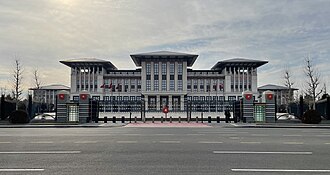
- Official Residence: Presidential Complex, Ankara.
- Core Roles: Head of State, Head of Government, and Commander-in-Chief.
Evolution of the Presidency
The presidency was founded alongside the proclamation of the Republic of Türkiye in 1923. For decades, the office was largely symbolic, with the Prime Minister wielding the actual executive authority. This balance shifted significantly following the 2017 constitutional referendum, which abolished the office of the prime minister and vested full executive powers in the presidency, effective after the 2018 general elections.
Historical Election Shifts
Historically, most presidents were elected by the Turkish Grand National Assembly. A notable exception was Kenan Evren, who was appointed in 1982 following a military coup. The system transitioned to a direct popular vote following a 2007 constitutional amendment, leading to the election of Recep Tayyip Erdoğan in 2014.
Powers and Responsibilities
The duties of the president are codified in Article 104 of the Constitution. These responsibilities span legislative, military, and diplomatic domains.
Executive and Legislative Authority
- Lawmaking: The president may promulgate laws or exercise a veto by returning laws to the Grand National Assembly for reconsideration.
- Appointments: The president appoints and dismisses the Vice President and public ministers, as well as various high-ranking judiciary and administrative officials.
- Budgetary Role: The president is responsible for delivering the budget proposal to the Grand National Assembly.
Military and Diplomatic Leadership
As the Commander-in-Chief, the president defends Turkey's territorial integrity and sovereignty. Diplomatically, the president represents the nation globally, appoints ambassadors, and negotiates and ratifies international treaties.
Selection and Incumbency
To be eligible for the presidency, a candidate must be a Turkish citizen eligible to be a deputy and at least 40 years of age. If a candidate is a current member of the Grand National Assembly, they must resign their seat to maintain the separation of powers.
Terms and Vacancies
Presidents serve a five-year term and may be re-elected once. If the office becomes vacant, the timeline for a new election depends on the proximity to the general assembly elections: if one year or less remains, elections are held together; otherwise, a presidential election occurs within 45 days.
Accountability
Following the 2017 amendments, the Grand National Assembly can initiate investigations into the president, vice president, or cabinet members. A two-thirds majority vote in the Assembly can refer the individual to the Constitutional Court for trial. Conviction by the court results in removal from office.
Presidential Administration
| Feature | Details |
|---|---|
| Formal Styles | The Honorable / His Excellency |
| Constitutional Basis | Constitution of Turkey (1982) |
| Salary (2023) | ₺ 1,428,000 (approx. US$ 75,435) |
| Key Memberships | Cabinet, National Security Council, Supreme Military Council |
| Official Website | www.tccb.tr |
Official Residences
The Presidential Complex in Ankara has served as the official residence since October 29, 2014. Prior to this, the Çankaya Mansion was the primary residence from 1923 to 2014. Other facilities, such as the Presidential State Guesthouse and the Huber Mansion, serve as secondary residences or workplaces.
Frequently Asked Questions
Who was the first president of Turkey?
Mustafa Kemal Atatürk was the founder and the first president of the Republic of Türkiye, elected unanimously on October 29, 1923.
How is the president of Turkey elected?
The president is elected through a direct popular vote by eligible Turkish citizens for a term of five years.
What happened to the office of the Prime Minister?
The office of the prime minister was abolished following constitutional amendments approved in a 2017 referendum, transferring executive authority to the president.
What are the eligibility requirements for the presidency?
A candidate must be a Turkish citizen, at least 40 years old, and eligible to serve as a deputy. Members of the Grand National Assembly must resign their seats to run.
Who serves as acting president if the office is vacant?
Under current laws, the Vice President of Turkey serves as the acting president during temporary absences or until a new president is elected following a vacancy.