Ottoman Empire: The Final Era and the Rise of Modern Turkey
The twilight of the Ottoman Empire was marked by a turbulent transition from an absolute monarchy to a fragmented state, and finally, to the birth of a modern republic. Throughout the 19th century, the rise of nationalism—the desire for ethnic groups to govern themselves—began to erode the empire's foundations. While European powers were consolidating into nation-states, the Ottomans relied on the millet system, a framework of confessional communities organized by religion rather than ethnicity. This approach, while providing some autonomy, struggled to contain the growing demands for independence in Greece, Serbia, and Bulgaria.
Key Facts
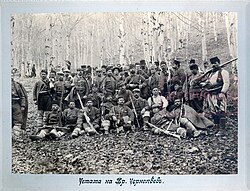
- Timeline: The final transformative period spanned from the Young Turk Revolution in 1908 to the proclamation of the Republic of Turkey in 1923.
- Economic Burden: The empire faced a massive pre-WWI debt of $716 million, largely controlled by France (60%), Germany (20%), and the UK (15%).
- Political Shift: The Committee of Union and Progress (CUP) transitioned the state from the absolute rule of Sultan Abdul Hamid II to a constitutional system.
- Territorial Loss: Major conflicts including the Balkan Wars and World War I led to the partition of the empire.
- Final Outcome: The Treaty of Lausanne (1923) replaced the Treaty of Sèvres, establishing the borders of the modern Republic of Turkey.
Economic Constraints and Foreign Influence
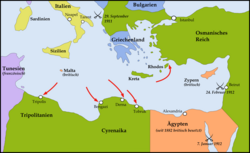
By the early 20th century, the Ottoman Empire was heavily burdened by foreign debt. This financial instability allowed European powers to exert significant control through the Ottoman Public Debt Administration. This body, along with the Imperial Ottoman Bank, managed the empire's revenues and even dictated local taxes on livestock, effectively compromising Ottoman sovereignty to serve international commercial interests.
The Young Turk Revolution and the Second Constitutional Era
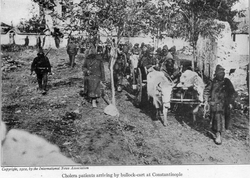
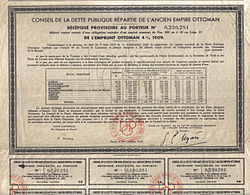
In July 1908, the Committee of Union and Progress (CUP) led a revolution against Sultan Abdul Hamid II. This movement sought to modernize the state through reforms in education, finance, and agriculture. The revolution forced the Sultan to restore the constitution of 1876, ushering in the Second Constitutional Era.
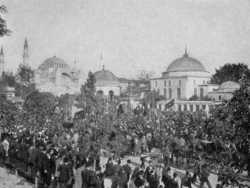
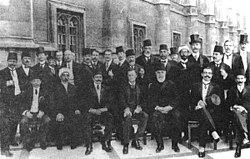
Despite the promise of equality, the CUP increasingly viewed Turks as the "dominant nation" of the empire. This period also saw the first general elections of the new era, though political participation remained limited.
Territorial Disintegration and the Balkan Wars
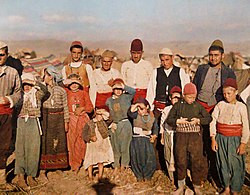
The empire's stability was further shaken by the Bosnian crisis of 1908, when Austria-Hungary annexed Bosnia and Herzegovina. Simultaneously, Bulgaria declared its independence. These events triggered a wave of nationalism across the fringes of the empire.
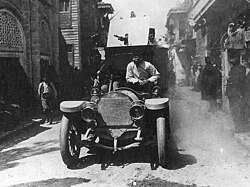
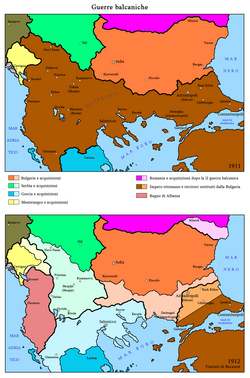
The Balkan Wars (1912–1913) were a turning point. The Balkan League—comprising Serbia, Montenegro, Greece, and Bulgaria—launched a joint attack to seize territories in Macedonia, Albania, and Thrace. The resulting defeats pushed Ottoman armies back to the gates of Constantinople and led to the independence of Albania in November 1912.
The Rise of the Three Pashas
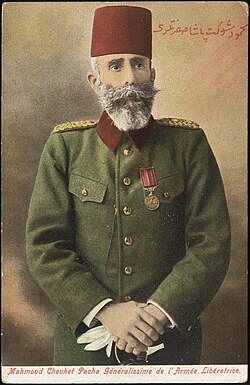
The humiliation of the Balkan Wars allowed the CUP to seize tighter control of the government. Following the 1914 elections, a military regime emerged under the Three Pashas: Enver Pasha (Minister of War), Ahmet Cemal (Minister of the Navy), and Talaat Pasha (Minister of the Interior). This triumvirate maintained de facto control of the empire as a personal dictatorship during World War I.
Internal Conflicts and Regional Politics
Armenian and Kurdish Relations
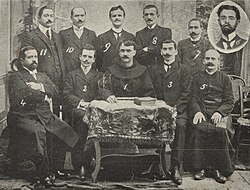
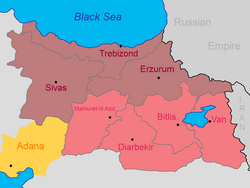
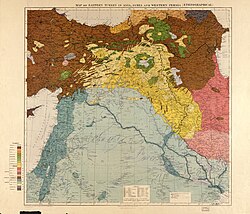
Relations with the Armenian population were volatile. While the Armenian Revolutionary Federation (ARF) initially sought reconciliation in 1908, the 1909 Adana Massacre severely damaged trust. By 1914, tensions peaked as the CUP attempted to use Armenian populations to incite rebellion against Russia in the Caucasus.
Yemeni Resistance
In the south, the Zaidis in Yemen rebelled against Ottoman rule. By 1911, the empire was forced to grant significant concessions to Imam Yahya, recognizing him as the spiritual and temporal head of the Zaidis and restoring sharia law in those regions.
World War I and the Fall of the Empire
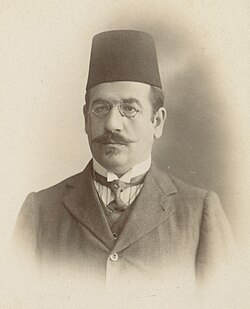
The Ottoman Empire entered World War I on October 29, 1914, attacking Russia's Black Sea coast. The empire fought across multiple theaters, including Gallipoli, Mesopotamia, and the Caucasus. Despite early victories at Gallipoli and the Siege of Kut, the empire was exhausted by 1918, leading to the signing of the Armistice of Mudros.
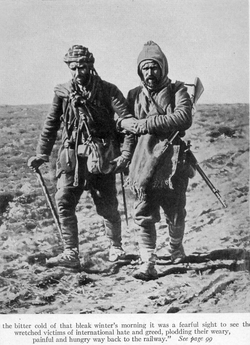
Following the armistice, Constantinople was occupied by Allied forces. The subsequent Treaty of Sèvres (1920) proposed a harsh partitioning of the empire, which sparked the Turkish War of Independence led by Mustafa Kemal Atatürk.
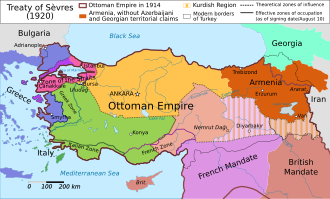
The Birth of the Republic of Turkey
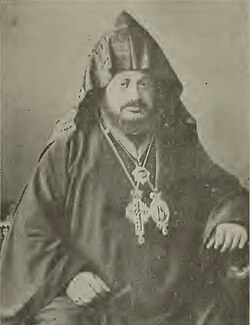
The Turkish nationalists successfully resisted the terms of Sèvres. On November 1, 1922, the Ottoman Sultanate was formally abolished, and Sultan Mehmed VI went into exile. The Treaty of Lausanne (1923) finally secured international recognition for the new Turkish state's borders. On October 29, 1923, the Republic of Turkey was officially declared.
| Period/Event | Key Driver | Primary Outcome |
|---|---|---|
| Young Turk Revolution (1908) | CUP Rebellion | Restoration of 1876 Constitution |
| Balkan Wars (1912-1913) | Balkan League Nationalism | Loss of Macedonia, Albania, and Thrace |
| World War I (1914-1918) | Alliance with Central Powers | Armistice of Mudros and Occupation |
| Treaty of Lausanne (1923) | War of Independence | Establishment of Republic of Turkey |
Frequently Asked Questions
What was the millet system?
The millet system was the Ottoman method of governing diverse populations by organizing them into confessional communities based on religion, allowing each community a degree of autonomy in their own legal and cultural affairs.
Who were the Three Pashas?
The Three Pashas—Enver, Talaat, and Cemal—were the leading members of the Committee of Union and Progress who exercised near-absolute control over the Ottoman Empire as a military regime during World War I.
Why was the Treaty of Sèvres replaced?
The Treaty of Sèvres was seen as too punitive and was never ratified. It was replaced by the Treaty of Lausanne after the Turkish nationalists, led by Mustafa Kemal Atatürk, won the Turkish War of Independence.
How did the Ottoman Empire's debt affect its sovereignty?
The empire's massive debt led to the creation of the Ottoman Public Debt Administration, which allowed European powers to control key imperial revenues and influence internal financial policies.
What triggered the Balkan Wars?
The wars were triggered by the nationalist ambitions of the Balkan League (Serbia, Greece, Bulgaria, and Montenegro), who sought to partition the remaining Ottoman territories in Europe.