President of the Republic of Latvia
The President of the Republic of Latvia serves as the head of state, representing the nation both domestically and internationally. Established under the Satversme (the Constitution of Latvia) in 1922, the office has evolved through periods of democratic governance, authoritarianism, and foreign occupation to become a cornerstone of the modern Latvian state.
Currently, the office is held by Edgars Rinkēvičs, who assumed office on July 8, 2023. A former foreign minister, Rinkēvičs is the first openly gay head of state in any European Union member state.
Key Facts
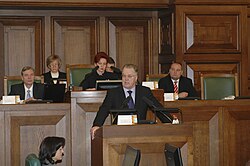
- Incumbent: Edgars Rinkēvičs (since July 8, 2023).
- Term Length: Four years, renewable once consecutively.
- Appointed By: The Saeima (the Latvian Parliament).
- Official Residence: Riga Castle.
- Annual Salary: €54,732.
- Role: Head of State and Commander-in-Chief of the National Armed Forces.
History and Development
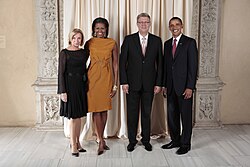
The presidency was formally established by the Satversme on February 15, 1922. Before this, the duties of the head of state were performed by the Chairperson of the Parliament. Jānis Čakste, who had served as the head of state under provisional constitutions since 1918, became the first officially elected president on November 14, 1922.
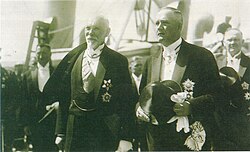
The early years of the presidency saw a transition from democratic stability to authoritarianism. Following the 1934 coup d'état, President Alberts Kviesis remained in office but did not interfere with the shift toward an authoritarian system. By 1936, the roles of president and prime minister were merged under Kārlis Ulmanis, who held both positions until the Soviet occupation in June 1940.
During the Soviet occupation (1940–1991), the Republic of Latvia continued to exist legally in the eyes of international law. The Foreign Service represented the state in exile, and various figures, including Pauls Kalniņš and Bishop Jāzeps Rancāns, served as acting presidents to maintain legal continuity.
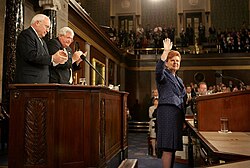
Following the restoration of independence in 1990, the office was reinstated in 1993. Guntis Ulmanis became the first president of the restored republic, followed by Vaira Vīķe-Freiberga, who made history as the first female president of Latvia.
Duties and Constitutional Powers
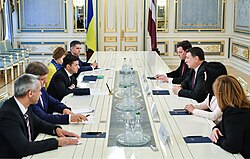
The President of Latvia holds significant responsibilities across military, legislative, and diplomatic spheres, though many actions require the joint signature of the prime minister or a relevant minister to assume political responsibility.
Military and Security Authority
As the Commander-in-Chief of the National Armed Forces, the president is central to national security. Key powers include:
- Declaring war based on a decision by the Saeima.
- Appointing a Supreme Commander during wartime.
- Chairing the National Security Council.
- Recommending the appointment or dismissal of the Commander of the National Armed Forces to the Saeima.
Legislative and Administrative Roles
The president possesses the right to initiate legislation and present draft amendments to the Constitution or laws submitted by at least one-tenth of the electorate to the Saeima. Additionally, the president can convene and preside over extraordinary meetings of the Cabinet of Ministers.
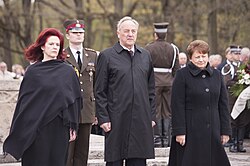
Diplomatic and Ceremonial Functions
The president appoints and dismisses extraordinary and plenipotentiary ambassadors based on recommendations from the Foreign Minister and the Saeima's Commission of Foreign Affairs. The president also administers the oath of office to judges and awards state honors.
Presidential Residences
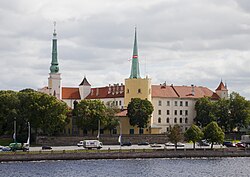
The primary official residence is Riga Castle, which has served the office since 1922. The castle features the iconic Three Stars Tower and houses various diplomatic gifts in its museum halls.
The president also has access to a retreat in Jūrmala, a three-story residence built in 1971. While it offers a park and a private beach, some presidents, such as Andris Bērziņš, declined to use it due to its history as a Soviet-era guest house.
Summary of Presidential Terms
| President | Term Start | Term End | Political Affiliation |
|---|---|---|---|
| Jānis Čakste | 1922 | 1927 | Democratic Centre |
| Gustavs Zemgals | 1927 | 1930 | Democratic Centre |
| Alberts Kviesis | 1930 | 1936 | Farmers' Union / Independent |
| Kārlis Ulmanis | 1936 | 1940 | Independent |
| Guntis Ulmanis | 1993 | 1999 | Farmers' Union |
| Vaira Vīķe-Freiberga | 1999 | 2007 | Independent |
| Valdis Zatlers | 2007 | 2011 | Independent |
| Andris Bērziņš | 2011 | 2015 | Union of Greens and Farmers |
| Raimonds Vējonis | 2015 | 2019 | Green Party |
| Egils Levits | 2019 | 2023 | Independent |
| Edgars Rinkēvičs | 2023 | Incumbent | Unity |
Frequently Asked Questions
How is the President of Latvia elected?
The president is elected by the Saeima (Parliament) for a term of four years. The process may involve multiple rounds of voting to reach a decision.
What are the term limits for the presidency?
A president can be elected for any number of terms, but they cannot hold the office for more than two consecutive terms (a maximum of eight consecutive years).
Who takes over if the presidency becomes vacant?
In the event of a vacancy, the Speaker of the Saeima assumes the duties of the president until a new president is elected.
Does the president have direct political responsibility?
No, the president does not bear political responsibility for the fulfillment of their duties. Most presidential orders must be joint-signed by the prime minister or a minister, who then assumes full responsibility.
What is the significance of the Satversme?
The Satversme is the Constitution of the Republic of Latvia, adopted in 1922. It is the founding legal document that defines the powers, duties, and election process of the president.