President of the Republic of Estonia
The President of the Republic of Estonia serves as the formal head of state for the nation. Unlike many other republics, Estonia operates as a parliamentary system where the president is primarily a ceremonial figurehead. This design ensures that executive power remains vested in the Government, preventing the concentration of authority in a single individual.
The current incumbent is Alar Karis, who assumed office on October 11, 2021. To maintain impartiality and independence, the president is required to suspend membership in any political party for the duration of their term. Additionally, any other elected or appointed offices held by the individual terminate automatically upon taking office.
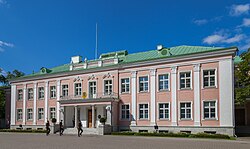
Key Facts
- Current President: Alar Karis (since October 11, 2021).
- Term Length: Five years, renewable once consecutively.
- Residence: Presidential Palace, Tallinn.
- Monthly Salary: €10,240.
- Election Method: Elected by the Riigikogu (Parliament) or a special Electoral College.
- Constitutional Basis: Constitution of Estonia (1992).
The Election Process
The process for electing the Estonian president is designed to ensure broad consensus. The Riigikogu (the Estonian Parliament) first attempts to elect a candidate; for a candidate to win, they must secure a two-thirds supermajority.
If no candidate achieves this majority after three rounds of balloting, the process moves to a special electoral body. This body consists of all Riigikogu members and elected representatives from every municipality (ranging from one to ten representatives per municipality based on population). This assembly then chooses between the two candidates who received the highest percentage of votes in the parliamentary rounds.
Historical Evolution
Estonia's approach to its head of state has shifted significantly over the last century. Following early experiences with the abuse of power by Russian emperors, the first Estonian constitution created an ultra-parliamentary system. Until 1934, the nominal head of state was the State Elder (riigivanem), who served as the chairman of the cabinet but remained entirely dependent on the Parliament.
A shift toward a stronger presidency occurred with the 1933 and 1938 constitutions. In 1938, the title was officially changed to "President of the Republic," and Konstantin Päts became the inaugural holder of the office. However, this era ended abruptly in 1940 during the Soviet military occupation, when Päts was forced to appoint a puppet government and was eventually deported to Russia.
During the period of Soviet occupation (1940–1991), the presidency was abolished. However, a legal continuity was maintained through acting presidents elected by the Electoral Council in secret, including Jüri Uluots, August Rei, Aleksander Warma, Tõnis Kint, and Heinrich Mark. This continuity culminated in 1992 when Lennart Meri was elected as the president of the restored republic.
Constitutional Role and Responsibilities
While the president lacks nominal executive powers, the role carries significant diplomatic and constitutional duties. The president acts as the highest representative of the state in international affairs and signs international treaties previously approved by the Government.
Legislative and Judicial Influence
The president promulgates laws but possesses the power to refuse a bill within 14 days if it is deemed contrary to the Constitution. If the Riigikogu passes the bill a second time without changes, the president may refer the matter to the Riigikohus (the Supreme Court) for a final ruling on its constitutionality.
Appointments and Nominations
- Prime Minister: The president nominates a candidate for Prime Minister after consulting parliamentary factions.
- Government: Formally appoints and dismisses ministers based on the Prime Minister's binding proposal.
- High Officials: Nominates the chairperson of the Supreme Court, the auditor general, the Chancellor of Justice, and the chairperson of the board of the Bank of Estonia.
Defense and Emergency Powers
The president is the Supreme Commander of the National Defence Forces, though this is largely ceremonial as the Ministry of Defence manages actual operations. The president also heads the State Defence Council and can declare martial law in the event of an attack on Estonia.
Presidential Summary
| Feature | Details |
|---|---|
| Type of State | Parliamentary Republic |
| Executive Power | Vested in the Government |
| Term Limit | Max 2 consecutive terms |
| Key Duty | International representation & Constitutional oversight |
| Deputy | Speaker of the Riigikogu |
List of Presidents of the Restored Republic
Since the adoption of the 1992 Constitution, Estonia has had six presidents:
- Lennart Meri (1992–2001)
- Arnold Rüütel (2001–2006)
- Toomas Hendrik Ilves (2006–2016)
- Kersti Kaljulaid (2016–2021)
- Alar Karis (2021–Present)
Frequently Asked Questions
Does the President of Estonia have executive power?
No. The Constitution explicitly vests executive power in the Government. The president is a ceremonial figurehead without nominal executive powers.
How is the President of Estonia elected?
The president is elected by the Riigikogu. If a two-thirds supermajority is not reached after three rounds, a special Electoral College consisting of parliament members and municipal representatives is convened to decide between the top two candidates.
Can the President veto a law?
The president can refuse to promulgate a bill and return it to the Riigikogu. If the parliament passes it again, the president must either sign it or ask the Supreme Court (Riigikohus) to rule on its constitutionality.
What happens to a president's political party membership?
The president is obliged to suspend their membership in any political party for the duration of their term to ensure independence and impartiality.
Who takes over if the president is incapacitated?
Historically, the Prime Minister has assumed duties as the "Prime Minister in duties of the President," and the Speaker of the Riigikogu currently serves as the deputy.