President of the Italian Republic
The President of the Italian Republic (Italian: Presidente della Repubblica Italiana) serves as the head of state of Italy. Established under the Constitution of Italy in 1948, the office was designed to replace the King of Italy, transitioning the nation into a republic. The president acts as a symbol of national unity and serves as the primary guardian of the Constitution, ensuring that the country's political actions remain within legal bounds.
The current incumbent is Sergio Mattarella, a former constitutional judge who first took office on February 3, 2015, and was re-elected on January 29, 2022.
Key Facts
- Term Length: Seven years, renewable.
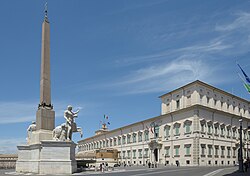
- Residence: Quirinal Palace, Rome.
- Primary Role: Head of state and Commander-in-chief of the Armed Forces.
- Eligibility: Italian citizens aged 50 or older with full civil and political rights.
- Annual Salary: €230,000.
- Succession: The President of the Senate serves as the acting president during vacancies or absences.
Qualifications and Term of Office
The framers of the 1948 Constitution envisioned the president as an elder statesman. Consequently, Article 84 mandates that any candidate must be at least 50 years old on election day. To ensure impartiality, the presidency is incompatible with any other office; the president-elect must resign from all other positions before being sworn in.
While the term is set at seven years, there are no formal term limits. Historically, presidents did not seek second terms until 2013, when Giorgio Napolitano was re-elected to resolve a parliamentary deadlock, though he resigned before completing his second term in January 2015.
The Election Process
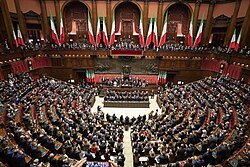
The president is elected by an electoral college, which consists of members of both houses of the Italian Parliament and 58 special electors appointed by regional councils. The voting takes place via secret ballot at the Palazzo Montecitorio.
| Electoral Body | Member Type | Number of Members | Notes |
|---|---|---|---|
| Chamber of Deputies | Elected Deputies | 400 | Reduced following 2020 referendum |
| Senate of the Republic | Elected Senators | 200 | Standard elected members |
| Senate of the Republic | Appointed Senators | Up to 5 | Appointed by the President |
| Senate of the Republic | Former Presidents | Unlimited | Serve ex officio unless resigned |
| Regions | Special Electors | 58 | 3 per region (Aosta Valley appoints 1) |
To be elected in the first three rounds, a candidate requires a two-thirds majority. If no one is elected by the fourth round, a simple majority suffices. Because there are no formal personal candidacies—only proposals from groups—voters sometimes cast ballots for non-political figures or fictitious characters as a strategic move to express discontent or test the political waters.
Presidential Powers and Mandate
The president's authority is divided across several domains, though most acts require a countersignature from the prime minister or a minister to be valid, as political responsibility lies with the government.
Foreign and Parliamentary Affairs
The president accredits diplomatic functionaries, ratifies international treaties (with Parliamentary authorization), and declares a state of war as decided by Parliament. Domestically, the president can dissolve the Chambers of Parliament, call for extraordinary sessions, and appoint up to five senators for life.
Legislative and Executive Duties
The president promulgates laws approved by Parliament but possesses the power to send a bill back for reconsideration once. In executive matters, the president appoints the prime minister and Cabinet ministers based on the prime minister's advice. They also preside over the Consiglio Supremo di Difesa (Supreme Defence Council) as commander-in-chief of the armed forces.
Judicial Authority
The president chairs the Consiglio Superiore della Magistratura (Superior Judicial Council) and appoints one-third of the members of the Constitutional Court of Italy. They also hold the autonomous power to grant pardons and commutations.
While often viewed as ceremonial, the role becomes critical during political instability. The president has significant latitude in appointing prime ministers when no clear parliamentary majority exists, as seen in the appointments of Mario Monti and Enrico Letta. President Mattarella further demonstrated this authority in 2018 by blocking the appointment of Paolo Savona to the Ministry of Economy and Finance to protect Italy's relationship with the European Union.
![Standard of former presidents of Italy.[7]](/images/46/31/46315cb5533704f2b863904f06f524e987a61423fd4b2b68eb2e7e32f34b8612.webp)

Residence and Protocol
The president's primary residence is the Quirinal Palace in Rome. Additional holdings include the Castelporziano estate near Rome and Villa Rosebery in Naples. The Quirinal Palace is guarded by the Corazzieri, an elite cuirassier honor guard of the Carabinieri.
Frequently Asked Questions
Who is the current President of Italy?
The current president is Sergio Mattarella, who has served since February 3, 2015, and was re-elected in 2022.
How long is the term of the Italian President?
The president serves a seven-year term, which is renewable.
What happens if the president cannot perform their duties?
In the event of travel, illness, or vacancy, the President of the Senate of the Republic performs the presidential functions as the acting president.
Can the president veto laws?
The president cannot permanently veto a law, but they can send a bill back to Parliament once for reconsideration. If Parliament passes the bill a second time, the president must promulgate it.
Who elects the President of the Republic?
The president is elected by an electoral college consisting of the Italian Parliament (Deputies and Senators) and 58 regional representatives.