Presidency Armies of British India
The Presidency Armies were the primary military forces of the East India Company (EIC) and, subsequently, the British Crown in India. Operating from 1774 to 1895, these forces were composed largely of Indian sepoys (Indian soldiers serving under British officers) and were divided into three distinct regional commands: the Bengal Army, the Madras Army, and the Bombay Army.
These armies played a pivotal role in expanding British territorial control, stretching from Peshawar in the north to Sind in the west and Rangoon in the east. Their operational reach extended beyond the subcontinent, involving the forces in conflicts as far as Abyssinia and China.
Key Facts
- Active Period: 1774–1895.
- Structure: Three separate armies based in the presidencies of Bengal, Madras, and Bombay.
- Composition: Primarily Indian sepoys commanded by European officers.
- Transition: Transferred from East India Company control to the British Crown after the Indian Rebellion of 1857.
- Unification: The three separate armies were merged into a single Indian Army in 1895.
- Father of the Indian Army: Major-General Stringer Lawrence.
Origins and Early Development
The roots of the British Indian Army lie in the early security needs of the East India Company. Initially, the Company employed local watchmen to protect its trading stations. In 1748, these disparate groups were placed under the command of Major-General Stringer Lawrence, who is recognized as the "Father of the Indian Army."
By the mid-eighteenth century, the Company established formal armies at its three main stations: Calcutta (Bengal), Madras, and Bombay. Each army operated independently with its own regiments and European officer cadre. These forces consisted of European regiments (both officers and men) and "Native" regiments, where European officers led Indian soldiers. These units were categorized into Artillery, Cavalry, and Infantry (often called "Native Infantry" or N.I.).
To bolster these forces, the British Crown frequently dispatched regular British Army regiments, known as "H.M.'s Regiments" or "Royal regiments," to reinforce the Company's positions.
Regimental Organization and Recruitment
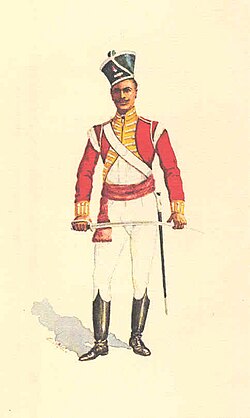
In 1757, Robert Clive introduced the concept of sepoy battalions for the Bengal Presidency. These soldiers were trained, dressed, and armed identically to the British "red coats." This model was adopted by Madras in 1759 and Bombay in 1867. Recruitment was localized, often drawing soldiers from specific families, villages, or single castes.
Cavalry and Specialized Units
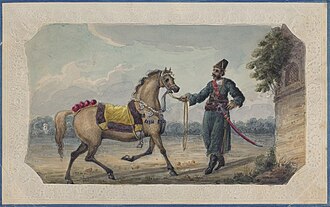
Regular cavalry regiments were established in 1784, though only three survived the 1857 rebellion. The Company also utilized irregular cavalry raised via the silladar system. Under this arrangement, the soldier provided his own horse, weapons, and attire in exchange for a lump sum and periodic maintenance grants. These irregular units had very few British officers.
Additionally, the armies maintained native artillery and pioneers, the latter of whom were eventually known as Sappers and Miners.
Structural Shifts
Between 1796 and 1804, a two-battalion regimental system was implemented. However, this system lacked cohesion and gave regimental commanders excessive control, which proved frustrating for the battalions. The system was abolished in 1824, returning the army to single-battalion regiments numbered by their seniority of raising.
The Impact of the 1857 Rebellion
The Indian Rebellion of 1857 marked a turning point in the administration of the forces. The British Crown took direct control of India from the East India Company. While European regiments were amalgamated into the British Army in 1860, the "Native" regiments remained separate, and their officers continued to be listed under their respective Presidency Armies.
Two major changes followed the rebellion: recruitment shifted toward the Martial Race system, and the operation of artillery was restricted exclusively to the British Army. By 1895, the three separate entities were finally abolished and merged into a unified Indian Army.
Operational History
The Presidency Armies were engaged in numerous conflicts to secure and expand British influence. Their history is defined by a series of regional wars and overseas expeditions.
| Conflict Category | Key Wars/Engagements |
|---|---|
| Indian Subcontinent | Battle of Plassey, Battle of Buxar, Carnatic Wars, Anglo-Mysore Wars, Anglo-Maratha Wars, Anglo-Sikh Wars, Anglo-Nepalese War |
| Regional Borders | Anglo-Burmese Wars, First Anglo-Afghan War, Anglo-Persian War |
| International/Overseas | First and Second Opium Wars, Expedition to Abyssinia |
| Internal Conflict | Vellore Mutiny, Indian Rebellion of 1857 |
Frequently Asked Questions
What were the three Presidency Armies?
The three Presidency Armies were the Bengal Army, the Madras Army, and the Bombay Army, each based in the respective administrative presidencies of the East India Company in India.
Who were the sepoys?
Sepoys were Indian soldiers who served in the Native regiments of the Presidency Armies, trained and equipped in the European style and commanded by British officers.
What was the silladar system?
The silladar system was used for irregular cavalry, where the soldier provided his own horse and equipment in exchange for a lump sum grant and maintenance payments from the state.
How did the 1857 Rebellion change the army?
Following the rebellion, the British Crown took over the armies from the East India Company, artillery was restricted to British troops only, and recruitment shifted to the Martial Race system.
When did the Presidency Armies become a single entity?
The separate Presidency Armies were abolished and merged into a fully unified Indian Army in 1895.