Prehistoric Scotland: From Geological Origins to the Iron Age
Long before the Romans brought the region into the scope of recorded history, the land now known as Scotland was shaped by violent tectonic shifts and inhabited by a succession of complex human cultures. Because much of the countryside escaped intensive farming and the land provided an abundance of stone over timber, Scotland remains a treasure trove of accessible archaeological sites that offer a window into the deep past.
The Geological Foundation of Scotland
Geologically, Scotland is an outlier in Europe. It began as a sliver of Laurentia, an ancient continent that later formed the bulk of North America. During the Cambrian period, this region sat south of the equator, separated from the continent of Baltica (modern-day Scandinavia and the Baltic region) by the Iapetus Ocean.
Over millions of years, these landmasses collided. During the Silurian period, tectonic folding pushed the first Scottish land above water, and by the Devonian period, the Laurentian plate smashed into Avalonia (containing most of present-day England and Wales). This collision created a massive mountain chain, comparable in height to the Alps, and formed the granitic West Highland and Grampian chains.
Later, during the Tertiary period, a constructive plate boundary—where tectonic plates move apart—separated Scotland from Laurentia, opening the Atlantic Ocean. This process triggered renewed volcanism on the west coast, creating the mountains of Skye, Jura, Mull, Rùm, and Arran. Finally, repeated glaciations in the Neogene and Quaternary periods carved the landscape, creating U-shaped river valleys, glacial corries, and pyramidal peaks.
Early Human Habitation
Before the arrival of modern humans, Neanderthals were prominent in Europe during mild spells around 130,000–70,000 BC and again around 40,000 BC. While Neanderthal sites exist in southern England, no such traces have been found in Scotland, likely because repeated glaciations destroyed evidence of early habitation.
Scotland only became habitable again approximately 15,000 years ago as the ice retreated. The earliest evidence of human presence is found at Howburn Farm near Elsrickle, where flint artefacts date back to around 12,000 BC, placing these inhabitants in the Upper Paleolithic period.
The Mesolithic Hunter-Gatherers
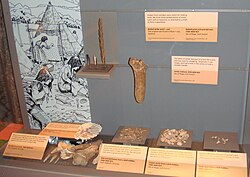
By 8500 BC, hunter-gatherer encampments were established, such as the one at Cramond near Edinburgh. Evidence from this site, including microlith stone tools and carbonised hazelnut shells, suggests these people used cooking methods similar to those found at other Mesolithic sites like Star Carr. While often highly mobile—using boats for fishing and transporting stone tools—some evidence suggests that hunter-gatherers may have established permanent residences.
On the west coast, sites like Sand at Applecross reveal a diet of shellfish, fish, and deer. These early inhabitants used "pot boiler" stones for cooking and created beads from seashells and purple dyes from shellfish.
The Neolithic Revolution and Monument Building
The transition to farming brought permanent settlements. Around 3600 BC, massive timber-framed buildings were constructed at Balbridie in Aberdeenshire and Claish near Stirling. In the Northern and Western Isles, a lack of timber led to the use of local stone, resulting in exceptionally well-preserved ruins.
The Orkney Islands provide the most vivid example of this era. The Knap of Howar (3500–3100 BC) features stone furniture and evidence of cattle, sheep, pig farming, and the cultivation of barley and wheat. Similarly, the village of Skara Brae (3000–2500 BC) consists of stone houses linked by low passageways.
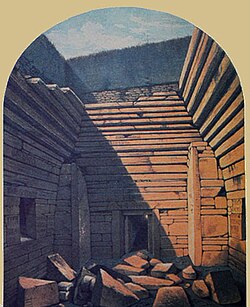
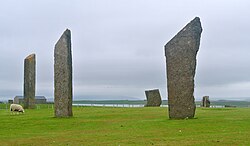
Orkney is also home to a dense cluster of ritual monuments, including the Standing Stones of Stenness, the Ring of Brodgar, and Maeshowe, a sophisticated passage grave. These sites are part of a broader European Megalithic culture, which also produced Stonehenge in England and the stone rows of Carnac in Brittany.
The Bronze and Iron Ages
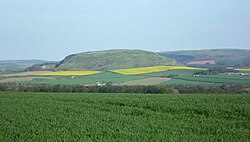
The Bronze Age saw a shift toward individual tombs, such as the Clava cairns near Inverness, which exhibit complex astronomical alignments. This period also saw the introduction of hill forts, such as Eildon Hill (c. 1000 BC), and the appearance of mummies at Cladh Hallan on South Uist between 1600 and 1300 BC.
By 700 BC, Scotland entered the Iron Age, characterized by defended farmsteads and the spread of Brythonic Celtic culture. This era is defined by various fortified structures:
- Brochs: Massive stone towers, such as the nearly complete Mousa Broch.
- Duns and Hill Forts: Fortified settlements like Traprain Law, which grew to the size of a town.
- Crannogs: Island settlements linked to land by causeways, primarily used for defense.
- Souterrains: Underground passageways of obscure purpose.
![Broch of Mousa, c. 300 BC[11]](/images/f7/5d/f75db5bd912e3e6cd1cf75eb59aa8f4208ffece0608274efef37d92d08499852.jpg)
Key Facts
- Geological Origin: Scotland was originally part of the continent Laurentia before colliding with Baltica and Avalonia.
- Earliest Humans: The first evidence of human habitation dates to approximately 12,000 BC at Howburn Farm.
- Neolithic Architecture: Orkney contains some of the best-preserved Neolithic villages (Skara Brae) and tombs (Maeshowe) in Europe.
- Iron Age Defense: The period is marked by the construction of brochs, crannogs, and hill forts.
- Megalithic Links: Scotland's standing stones are part of a wider European cultural movement that included Stonehenge.
| Period | Approx. Date | Key Characteristics | Notable Sites/Structures |
|---|---|---|---|
| Upper Paleolithic/Mesolithic | 12,000 – 4,000 BC | Hunter-gatherers, mobile lifestyles, flint tools | Howburn Farm, Cramond |
| Neolithic | 4,000 – 2,500 BC | Farming, permanent stone villages, megaliths | Skara Brae, Maeshowe, Ring of Brodgar |
| Bronze Age | 2,500 – 700 BC | Individual tombs, hill forts, metalworking | Clava Cairns, Eildon Hill |
| Iron Age | 700 BC – Roman Era | Defended farmsteads, Celtic culture, brochs | Mousa Broch, Traprain Law |
Frequently Asked Questions
Why are Neolithic sites so well-preserved in Orkney?
The preservation is primarily due to the abundance of local stone, which was often found on the shore already split into convenient building slabs, and a lack of timber that forced builders to use stone for almost all structures.
What is a broch?
A broch is a spectacular type of drystone hollow-walled tower found in Iron Age Scotland, with the Mousa Broch in Shetland being one of the most complete examples.
How did Scotland's geology affect its landscape?
The collision of ancient continents created massive mountain chains, while later volcanic activity and repeated glaciations carved the land into U-shaped valleys and dramatic peaks.
What were crannogs used for?
Crannogs were island settlements constructed in lochs and linked to the shore by causeways; they are generally believed to have served a defensive function.
Who were the first humans to inhabit Scotland?
The earliest evidence points to Upper Paleolithic humans around 12,000 BC, followed by Mesolithic hunter-gatherers who moved into the region as the climate warmed after the last ice age.