Postcolonial African Urban Planning: Evolution and Regional Approaches
The process of decolonization fundamentally reshaped the nation-states of Africa, leaving a lasting imprint on how their cities are designed and managed. While many countries inherited colonial frameworks, the trajectory of their urban planning has diverged based on local political shifts, economic ambitions, and the struggle to reclaim spatial autonomy.
Key Facts
- Ghana shifted toward decentralized planning between 1988 and 1989 to move power from federal to local levels.
- Nigeria maintains strict professional certification for town planners through TOPREC and NITP.
- Rwanda aims for middle-income status via "Vision 2020" and the redevelopment of Kigali by 2040.
- South Africa's urban form was heavily dictated by apartheid-era policies and the British New Town model.
- Tanzania is transitioning from colonial-era land use laws toward more participatory planning for its citizens.
Ghana: The Shift Toward Decentralization
For decades, urban development in Ghana was governed by the 1945 Town and Country Planning Act, a piece of legislation based on British Law. To distance the nation from this colonial legacy, the Provisional National Defence Council launched a decentralization campaign from 1988 to 1989. This initiative aimed to transfer planning authority from the federal level to local constituents.
While these decentralized units have grown in influence and allowed for more nuanced local planning, they face systemic hurdles. Because these offices are funded nationally, there is often a lack of clarity regarding which ministries govern specific planning departments across various regions and municipalities, leading to organizational and participation challenges.
Nigeria: Professionalizing Urban Planning
In Nigeria, the focus of urban planning is centered on professional standardization and education. Two primary bodies lead this effort: the Nigerian Institute of Town Planners (NITP) and the Town Planners Registration Council (TOPREC).
The path to becoming a registered town planner is rigorous. Candidates must either complete a four-year comprehensive degree or a degree in Urban and Regional Planning followed by an accredited master's degree. After graduation, aspiring planners must undergo two years of work-based training to achieve full membership in the NITP and subsequently pass the TOPREC professional examination.
Rwanda: Ambitious Visions for Kigali
Under President Paul Kagame, Rwanda has pursued aggressive development goals. The Vision 2020 plan was designed to elevate Rwanda to a middle-income country (as defined by the World Bank). A parallel initiative, Kigali 2040, focuses on the redevelopment of the capital city.
This strategy emphasizes growth and urban renewal, similar to early twentieth-century American models. A primary goal is the elimination of informal settlements—unplanned residential areas—to make way for more ordered development. This growth has been supported by a significant increase in official aid from foreign governments, which grew by over 45% between 2006 and 2009. However, the plan faces challenges such as suburbanization, and as of 2017, nearly three-fourths of the population remained rural.
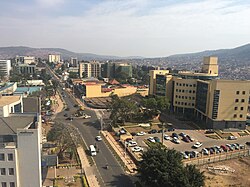
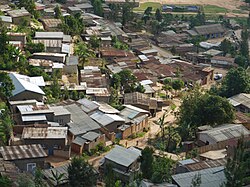
The drive for modernization in Kigali often involves replacing existing social structures with planned housing.
South Africa: The Legacy of Apartheid
Urban planning in South Africa was profoundly shaped by apartheid, a system of institutionalized racial segregation. Planning standards established in the 1950s dominated policy for forty years, utilizing the British New Town model. This model mandated specific lot sizes for free-standing houses in townships such as Soweto, KwaMashu, Botshabello, and Madadeni.
These mandates dictated the density and atmosphere of South African cities. By the mid-1970s, the spatial divide was further reinforced by the emergence of unplanned informal settlements outside the designated "white areas," cementing a racialized power differential in the urban landscape.
Tanzania: Moving Toward Participatory Planning
Tanzania's land use system was originally based on the 1947 Town and Country Planning Act, adopted in 1956. For years, these regulations remained disconnected from the daily realities of Tanzanians, as colonial laws typically favored officials over individuals.
Over the last twenty years, Tanzania has moved toward participatory planning—an approach that involves the community in the decision-making process. This shift has been supported by several legislative acts, including the 1982 Local Government (Urban Authorities) Act, the 1995 National Land Policy, and the 1999 Land Act. Despite these legal strides, limited resources mean these benefits are mostly felt in major centers like Dar es Salaam, Mwanza, Arusha, Dodoma, and Mbeya. As of 2017, about one-third of the population lived in urban areas, with more than 10% of that urban population residing in Dar es Salaam.
Regional Planning Summary
| Country | Primary Influence/Driver | Key Planning Goal/Mechanism | Major Challenge |
|---|---|---|---|
| Ghana | British Law / Decentralization | Localizing planning power | Funding and administrative clarity |
| Nigeria | Professional Certification | Standardized education (TOPREC/NITP) | Rigorous certification requirements |
| Rwanda | Vision 2020 / Kigali 2040 | Middle-income status & urban renewal | Suburbanization & informal settlements |
| South Africa | Apartheid / British New Town | Racialized spatial organization | Legacy of segregation and density |
| Tanzania | Participatory Legislation | Redistributing power to citizens | Resource gaps in smaller urban areas |
Frequently Asked Questions
How did the British New Town model affect South Africa?
The British New Town model mandated specific lot sizes for free-standing houses in townships like Soweto and KwaMashu, which determined the density and overall atmosphere of South African cities during the apartheid era.
What is the goal of Rwanda's Vision 2020?
Vision 2020 is an ambitious plan to transform Rwanda into a middle-income country, as defined by the World Bank, while simultaneously redeveloping the capital, Kigali, by 2040.
How has Ghana attempted to remove colonial influence from its planning?
Between 1988 and 1989, Ghana launched a decentralization campaign to shift planning power from the federal level to local units, allowing constituents to regain control from the colonial-era regime.
What are the requirements to become a registered town planner in Nigeria?
A candidate must have a degree in Urban and Regional Planning (or a relevant field) and either a TOPREC-accredited master's degree or a comprehensive four-year degree. They must then complete two years of work-based training for NITP membership and pass the TOPREC professional examination.
What is participatory planning in the context of Tanzania?
Participatory planning is a shift toward redistributing power from government officials to regular citizens, supported by legislation such as the 1999 Land Act and the 1995 National Land Policy.