Post-Rock: The Evolution of Instrumental Texture and Sound
Post-rock is a genre that challenges the very foundations of rock music. Rather than relying on the traditional energy of riffs and power chords, it treats rock instrumentation as a tool for creating atmosphere, timbre, and texture. Emerging from the underground scenes of the late 20th century, post-rock shifted the focus from the song-based structure of pop and rock toward expansive, often cinematic soundscapes.
The genre is defined by its willingness to borrow from a vast array of influences, ranging from the repetitive rhythms of 1970s German experimental music to the precision of contemporary classical compositions. By blending traditional guitars and drums with electronic production and digital textures, post-rock artists create music that is often more about the journey of sound than a catchy chorus.
Key Facts
- Definition: Using rock instrumentation for non-rock purposes.
- Origin: Emerged in the early 1990s across the UK, Canada, and the United States.
- Key Pioneers: Talk Talk, Slint, and Bark Psychosis.
- Core Philosophy: Prioritizing timbre and texture over traditional riffs and song structures.
- Evolution: Transitioned from experimental, left-field explorations (First Wave) to dramatic, crescendo-driven instrumentals (Second Wave).
The Etymology and Definition of Post-Rock
The term was coined by English music journalist Simon Reynolds in late 1993. He popularized the phrase in a 1994 review of the album Hex by Bark Psychosis. Reynolds described the movement as music that used "rock instrumentation for non-rock purposes," specifically using guitars to facilitate textures rather than standard rock tropes.
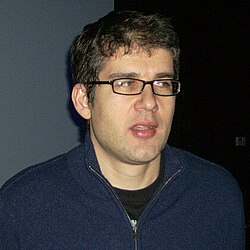
While Reynolds is credited with popularizing the term, he later noted that the phrase had been floating around the music scene for over a decade prior. For example, a 1967 Time article used the term to describe the studio innovations of the Beatles and George Martin. However, the modern meaning of post-rock became firmly established in the 1990s.
Stylistic Origins and Influences
Post-rock did not emerge in a vacuum; it is a synthesis of various experimental styles. One of the most significant influences was krautrock—the 1970s German experimental scene featuring bands like Can, Neu!, and Faust. Post-rock adopted the motorik beat (a steady, driving 4/4 rhythm) and a minimalist approach to melody.
Other foundational influences include:
- The Velvet Underground: Their use of "dronology" in the 1960s paved the way for the space rock revival.
- Post-Punk: Bands like Wire, particularly on their album 154, are often cited as "godfathers" of the genre.
- Ambient and Electronica: The integration of digital production and atmospheric textures.
- Avant-Garde Jazz and Minimalism: Influencing the complex structures and improvisational feel of later works.
The First Wave: Experimentalism and Texture
The first wave of post-rock in the early 1990s was characterized by a "left-field" approach. Bands like Stereolab, Disco Inferno, and Seefeel blended psychedelia, hip hop, and free improvisation. This era was less about "epic" sounds and more about the gradual abandonment of the traditional song format in favor of space and effects processing.
During this period, the album Spiderland by Slint became a cornerstone of the movement, influencing how musicians approached tension and dynamics.
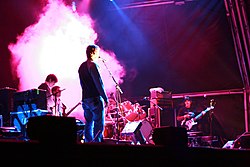
By 1996, the release of Tortoise's Millions Now Living Will Never Die helped solidify post-rock as a recognized term in music journalism. Meanwhile, in Bristol, England, a lo-fi scene emerged involving artists like Movietone and Flying Saucer Attack, who were influenced by the city's burgeoning trip-hop scene.
The Second Wave: Crescendos and Cinema
In the late 1990s and 2000s, post-rock evolved into a more dramatic, atmospheric style. This "second wave" moved away from the quirky experimentalism of the first wave toward sweeping, emotional compositions often characterized by a slow build-up to a massive sonic peak (the crescendo).
Montreal, Canada, became a major hub for this sound, centered around Constellation Records and the band Godspeed You! Black Emperor. Their work incorporated elements of chamber music, free jazz, and musique concrète (a type of composition that uses recorded sounds as raw material).
Other prominent acts of this era include:
- Mogwai: Known for their dynamic shifts between quiet intimacy and wall-of-sound intensity.
- Sigur Rós: Famous for using "Hopelandic" (a constructed gibberish language) to treat the voice as another instrument.
- Explosions in the Sky: Contributing to the genre's popularity through cinematic, melodic instrumentals.
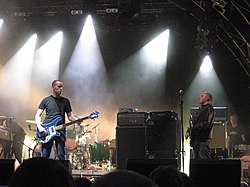
This era also saw mainstream breakthroughs. Radiohead's Kid A and Amnesiac are cited as pivotal moments where post-rock influences—such as krautrock and electronica—entered the global pop consciousness.
Summary of Post-Rock Evolution
| Feature | First Wave (Early 1990s) | Second Wave (2000s–Present) |
|---|---|---|
| Primary Focus | Texture, timbre, and experimentation | Drama, atmosphere, and crescendos |
| Key Influences | Krautrock, Post-punk, Electronica | Chamber music, Free jazz, Musique concrète |
| Notable Hubs | UK (Bristol), USA (Chicago) | Canada (Montreal), Iceland |
| Representative Acts | Bark Psychosis, Tortoise, Slint | Mogwai, Sigur Rós, Godspeed You! Black Emperor |
Frequently Asked Questions
What does "post-rock" actually mean?
Post-rock refers to music that uses traditional rock instruments (like electric guitars, bass, and drums) but avoids traditional rock structures. Instead of focusing on riffs, hooks, or standard song formats, it emphasizes texture, atmosphere, and timbre.
Who coined the term post-rock?
The term was coined and popularized by music journalist Simon Reynolds in the early 1990s, most notably in his reviews for Melody Maker and Mojo.
Is post-rock always instrumental?
While the second wave of post-rock is predominantly instrumental, the first wave included more vocals. Some bands, like Sigur Rós, use vocals as an instrument rather than for delivering lyrical meaning, often using invented languages.
How is post-rock different from progressive rock?
While both are experimental, post-rock generally focuses more on timbre, space, and atmospheric textures, whereas progressive rock often emphasizes technical virtuosity and complex time signatures.
What is the "motorik" beat?
The motorik beat is a steady, repetitive 4/4 rhythm originating from 1970s German krautrock. It provides a hypnotic, driving foundation that many post-rock bands adopted to create a sense of forward motion without traditional song changes.