Portuguese Colonization of the Americas
During the 15th century, Portugal emerged as a global leader in European exploration, driven by a desire to expand trade and territory. This ambition culminated in the Treaty of Tordesillas in 1494, a landmark agreement that divided the non-European world into two exclusive hemispheres: one for Castile (Spain) and one for Portugal. While Portugal is most famously associated with the vast territories of South America, its colonial ambitions initially stretched from the frozen coasts of Canada to the tropical shores of Brazil.
Key Facts
- Treaty of Tordesillas (1494): Divided the Earth outside Europe between Spain and Portugal.
- North American Presence: Early Portuguese exploration and fishing outposts existed in Newfoundland and Labrador.
- Discovery of Brazil: Pedro Álvares Cabral officially landed in Brazil on April 22, 1500.
- Administrative Evolution: Brazil transitioned from private Captaincy Colonies to a centralized Governorate General in 1549.
- Economic Drivers: Early trade focused on brazilwood, later shifting to a massive sugar cane industry.
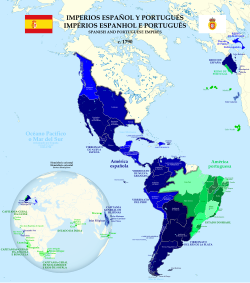
- Territorial Unity: Unlike Spanish America, Portuguese America remained a single unified colony by 1775.
Portuguese Settlements in North America
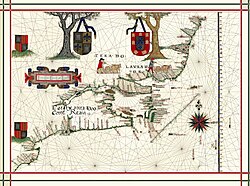
Based on the Treaty of Tordesillas, the Portuguese Crown claimed rights to regions in the North Atlantic. Between 1499 and 1500, mariner João Fernandes Lavrador visited Greenland and the northeast Atlantic coast, giving his name to the region of Labrador. Shortly after, the Corte-Real brothers charted Newfoundland and Labrador, claiming them for the Portuguese Empire.
Some historians point to fragmentary evidence of an even earlier expedition in 1473 by João Vaz Corte-Real to Terra Nova do Bacalhau (New Land of the Codfish). While these pre-Columbian voyages remain a subject of scholarly debate, the Portuguese presence in the region was solidified by the cod fisheries. In 1506, King Manuel I established taxes on these fisheries, and by 1521, João Álvares Fagundes and Pero de Barcelos had established fishing outposts in Newfoundland and Nova Scotia.
Eventually, these North American outposts were abandoned as Portugal shifted its focus toward South America. However, the cultural legacy persists in eastern Canada through towns such as St. John's, Conception Bay, and Portugal Cove-St. Philip's.
The Colonization of Brazil
Arrival and Early Exploration
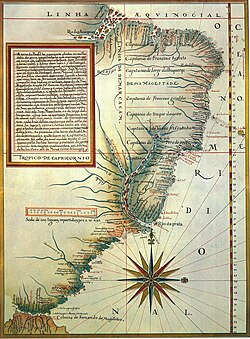
On April 21, 1500, Pedro Álvares Cabral encountered the Brazilian coast while performing a volta do mar (a wide sailing arc used to avoid calm winds in the Gulf of Guinea). He landed at Porto Seguro on April 22, initially naming the land Ilha de Vera Cruz (Island of the True Cross), believing it to be an island. This voyage was historic, as it connected four continents for the first time.
Subsequent expeditions between 1501 and 1502, including one with the Florentine observer Amerigo Vespucci, explored further south toward Patagonia. Vespucci's accounts were pivotal; he proposed that these lands were not the Indies, but a Mundus novus (New World), a hypothesis that became widely popular across Europe.
Administrative Growth and Governance
Permanent settlement began in 1532 with the founding of São Vicente by Martim Afonso de Sousa. This settlement is symbolically viewed as the birthplace of democracy in the Americas due to its municipal prerogatives and the election of its first City Council (Câmara) on August 22, 1532.
Between 1534 and 1536, the Crown established 15 Captaincy Colonies—autonomous, mostly private territories run by Captain-majors. Due to limited success, these were reorganized in 1549 into the Governorate General of Brazil, with its capital at São Salvador. This centralization allowed for more efficient management and a steadier income for the Portuguese Empire.
The economy evolved from the collection of brazilwood (used for dye) to a labor-intensive sugar cane industry, which relied heavily on Native and later African enslaved labor.
Conflict and Consolidation
Portuguese control faced challenges from other European powers. Between 1630 and 1654, the Netherlands controlled parts of the Northeast region, centering their power in Recife. However, following the Second Battle of Guararapes in 1649, the Portuguese regained full control by 1654.
Over the next two centuries, the administration shifted through various states, including the State of Maranhão and the State of Grão-Pará. By 1775, all these territories were reunited under the State of Brazil. This unification prevented the fragmentation into multiple smaller countries that occurred in neighboring Spanish colonies.
Other American Interests
Beyond Brazil, Portuguese influence extended to other regions. In Uruguay, the Portuguese founded the city of Colónia do Sacramento. Additionally, Portuguese merchants were active in the West Indies (Caribbean). During the union with Castile, Portuguese traders gained further access to the Gulf of Mexico and Peru.
Summary of Portuguese Colonial Evolution
| Period/Year | Administrative Structure | Key Characteristic |
|---|---|---|
| 1500–1532 | Trading Posts | Temporary settlements focused on brazilwood extraction. |
| 1534–1548 | Captaincy Colonies | 15 autonomous, private colonies run by Captain-majors. |
| 1549–1621 | Governorate General | Centralized government based in São Salvador. |
| 1621–1775 | Divided States | Split into separate states (e.g., Maranhão, Grão-Pará). |
| 1775–End of Colony | Unified State of Brazil | All territories reunited under a single colonial administration. |
Frequently Asked Questions
Did Portugal colonize North America?
Yes, although these attempts were largely unsuccessful in the long term. Portugal established fishing outposts in Newfoundland and Nova Scotia and explored Greenland and Labrador in the late 15th and early 16th centuries.
What was the purpose of the Treaty of Tordesillas?
The treaty was designed to prevent conflict between Spain and Portugal by dividing the newly discovered lands outside Europe into two exclusive zones of conquest and colonization.
Who was the first Portuguese explorer to reach Brazil?
Pedro Álvares Cabral is credited with the official discovery, landing at Porto Seguro on April 22, 1500, though some historians suggest others may have encountered the coast earlier.
Why did Brazil remain one large country while Spanish America split?
A primary reason was the administrative unification of all Portuguese territories into a single colony (the State of Brazil) by 1775, which maintained territorial integrity.
What was the primary economic driver of colonial Brazil?
While the early economy relied on brazilwood, the colony later transitioned to a massive sugar cane industry, which drove the demand for enslaved labor from Africa and Native populations.