Port of Beirut: History, Operations, and the 2020 Catastrophe
The Port of Beirut is the primary maritime gateway for Lebanon, situated on the eastern edge of Saint George Bay along the northern Mediterranean coast. As one of the largest and most active ports in the Eastern Mediterranean, it serves as a critical hub for the nation's trade and logistics, located just west of the Beirut River.
For decades, the port has been central to Lebanon's economy, handling the vast majority of the country's imports. However, its history is marked by a complex blend of strategic importance, political turmoil, and a devastating industrial disaster that reshaped the city of Beirut.
Key Facts
- Location: Beirut, Lebanon (33°54′10″N 35°31′30″E).
- Opened: 1887.
- Ownership: Government of Lebanon.
- Operator: Gestion et Exploitation du Port de Beyrouth (GEPB).
- Capacity: 16 berths and a container terminal expanded to 1,100 meters.
- Economic Impact: Handled approximately 60% of Lebanon's imports prior to 2020.
- 2019 Volume: 1,229,081 TEU (Twenty-foot Equivalent Units).
Historical Evolution
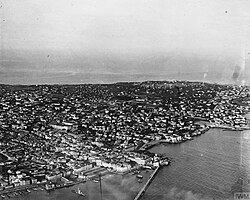
The port's modern origins date back to 1887 during Ottoman rule, when it was granted to a French company, the Compagnie du Port, des Quais et des Entrepôts de Beyrouth. This arrangement provided the port with significant autonomy and growth. Following the establishment of the French Mandate for Syria and the Lebanon in 1920, the port benefited from increased French funding and trade networks.
The facility's trajectory was severely disrupted by the Lebanese Civil War. During this period, various armed militias vied for control of the docks. In 1976, shipping ceased entirely for nine months due to clashes, leaving warehouses and equipment in ruins. Control shifted multiple times between various factions, including the Lebanese Forces, until the Lebanese Army consolidated power in the early 1990s.
By 1990, the Government of Lebanon assumed direct ownership of the port after the original company's charter expired, though the Gestion et Exploitation du Port de Beyrouth (GEPB) continued its management.
Infrastructure and Management
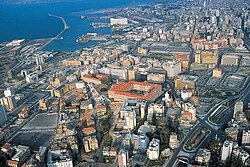
The Port of Beirut is an artificial harbor covering approximately 1.2 square kilometers. Since December 2004, the container terminal operations have been subcontracted to the private Beirut Container Terminal Consortium (BCTC). This terminal is equipped with 16 post-panamax ship-to-shore gantry cranes and handles significant transshipments in addition to national imports and exports.
Despite its economic utility, the port has faced severe criticism regarding its governance. It earned the nickname "Cave of Ali Baba and the 40 Thieves" due to systemic reports of corruption, bribery schemes, and tax evasion. In the early 2010s, estimates suggested that annual tax evasion at the port exceeded $1.5 billion.
The 2020 Explosion and Aftermath
On 4 August 2020, a catastrophic series of explosions occurred at the port, resulting in at least 218 deaths and more than 7,000 injuries. The blast rendered approximately 300,000 people homeless and caused billions of dollars in damages across Beirut.
The disaster was triggered by the improper storage of 2,750 tons of ammonium nitrate, a highly explosive chemical. The material had arrived in September 2013 on the MV Rhosus, a Russian-owned, Moldovan-flagged ship that was abandoned by its crew. Despite six warnings from customs officials over three years, the chemical remained stored in Hangar 12.
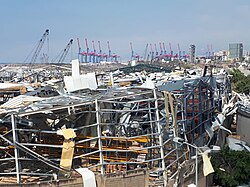
The explosion destroyed the port's warehouses and grain elevators, which held most of Lebanon's grain reserves. While the container port remained largely intact and resumed operations by mid-August, the overall damage forced cargo to be redirected to smaller ports in Tripoli and Tyre. In April 2022, the government ordered the demolition of the remaining grain silos, which were deemed at risk of collapse.
Subsequent Incidents
On 10 September 2020, just weeks after the main blast, a large fire broke out in a cooking oil warehouse and food parcels belonging to the International Committee of the Red Cross (ICRC). The fire spread to a stock of rubber tires in the duty-free zone, causing panic among residents who feared another explosion. The fire was eventually extinguished by ground personnel and Lebanese Air Force helicopters.
Port Statistics Summary
| Metric | Value | Year/Reference |
|---|---|---|
| Vessel Arrivals | 2,395 | 2009 |
| Annual Cargo Tonnage | 5.8 million tonnes | 2009 |
| Annual Container Volume | 1,229,081 TEU | 2019 |
| Annual Revenue | $163,486,146 | 2009 |
| Passenger Traffic | 6,699 | 2009 |
Frequently Asked Questions
What caused the 2020 Beirut port explosion?
The explosion was caused by the ignition of 2,750 tons of ammonium nitrate that had been improperly stored in Hangar 12 for six years after being abandoned by the crew of the MV Rhosus in 2013.
Who currently owns and operates the port?
The port is owned by the Government of Lebanon and is operated by the Gestion et Exploitation du Port de Beyrouth (GEPB), with container terminal operations subcontracted to the Beirut Container Terminal Consortium (BCTC).
How did the 2020 blast affect Lebanon's food security?
The explosion destroyed most of Beirut's grain reserves, which were stored in the port's silos, leaving the country with less than a month's worth of grain reserves immediately following the disaster.
What is the significance of the "Cave of Ali Baba" nickname?
This nickname refers to long-standing allegations of pervasive corruption, bribery, and massive tax evasion within the port's management and customs operations.
When will the investigation into the explosion resume?
It was announced that the investigation into the 2020 explosion would resume on January 16, 2025.