Politikon Coinage of the Byzantine Empire
In the middle of the 14th century, the Byzantine Empire produced a distinctive series of billon coins—an alloy consisting primarily of copper with a small amount of silver—known as the politikon. These coins are easily identified by the Greek inscription +ΠΟΛΙΤΙΚΟΝ, which translates to "of the city" or "civic." Unlike traditional Byzantine currency, the politikon series reflects a fascinating intersection of Eastern and Western influences during a period of significant political instability.
Key Facts
- Inscription: Marked with +ΠΟΛΙΤΙΚΟΝ ("of the city, civic").
- Composition: Primarily billon, with silver content typically between 0.200 and 0.250.
- Weight: Standard weight ranges from 0.6 to 0.8 grams.
- Origin: Generally believed to have been minted in Constantinople.
- Timeline: Struck from the 1330s through the 1350s.
- Design: Heavily influenced by Western European models, often featuring a large cross or the Virgin Mary.
Design and Physical Characteristics
The politikon coins were modeled after the widespread tornese (known in Greek as tournesion), a common currency type of the era. Most examples measure approximately 17 mm in diameter. While early issues were concave in shape, later versions were struck flat.
Visually, these coins departed from traditional Byzantine iconography. Instead of the usual imperial portraits, many feature a large cross or a bust of the Virgin Mary, mirroring Western European styles. Interestingly, many of these coins are anonymous, failing to identify the specific emperor under whose authority they were minted.
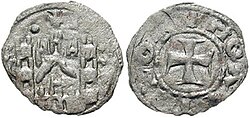
Variations in Weight and Metal
While the majority of politikon coins followed the standard tornese specifications, numismatists have identified a few anomalies. One specimen held in the Cabinet des Médailles in Paris weighs 1.4 grams with a silver content of 0.785. While this is significantly higher than a standard tornese, it remains lower than the basilikon, the primary Byzantine silver coin. Additionally, some large, thick copper versions weighing around 2 grams exist, though their specific function remains unclear.
Chronology and Imperial Association
The politikon series is viewed as a continuation of the tornese issues introduced by Emperor Andronikos II Palaiologos (r. 1282–1328). It is believed that these coins were rated at 96 to the gold hyperpyron.
The timeline of the series can be traced through the few coins that do name their emperors:
- 1330s: Issues bearing the name of Andronikos III Palaiologos (r. 1328–1341).
- 1340s: An anonymous series produced during a period of destructive civil war.
- 1350s: Final issues featuring John V Palaiologos (r. 1341–1376 and 1379–1391), after which the type was discontinued.
The Debate Over Origin and Purpose
The meaning of the +ΠΟΛΙΤΙΚΟΝ inscription has been a subject of scholarly debate. Early researchers, such as Gustave Schlumberger, suggested these were not currency but tickets used for the bread dole. However, modern consensus views them as legitimate coinage. The inscription likely indicates that the coins were struck to meet a specific public or civic need, similar to contemporary French coins marked BVRGENSIS.
Regarding their origin, the "Western" appearance of the coins led some to suggest they were minted in provincial mints near the Frankish states of southern Greece. However, because these coins are absent from local archaeological finds in those regions, historians now consider their origin in Constantinople to be secure.
Summary of Politikon Specifications
| Feature | Standard Specification | Notable Exceptions |
|---|---|---|
| Weight | 0.6–0.8 grams | 1.4g (Paris specimen); ~2g (copper types) |
| Diameter | 17 mm | Varies for heavy copper types |
| Silver Content | 0.200–0.250 | 0.785 (Paris specimen) |
| Shape | Initially concave, later flat | N/A |
Frequently Asked Questions
What does the word "politikon" mean on these coins?
The Greek inscription +ΠΟΛΙΤΙΚΟΝ translates to "of the city" or "civic," suggesting the coins were minted to fulfill a specific public or civic requirement.
Where were the politikon coins minted?
Although their design resembles Western European styles, the lack of local finds in southern Greece suggests they were minted in Constantinople.
Which emperors are associated with this coinage?
The series is linked to the tornese issues of Andronikos II Palaiologos, with specific coins naming Andronikos III Palaiologos and John V Palaiologos.
Were these coins used as bread tickets?
While earlier scholars like Gustave Schlumberger proposed they were tickets for the bread dole, they are now recognized by historians as actual coinage.
How did the politikon differ from traditional Byzantine coins?
They differed primarily in their iconography, which followed Western European models (such as the Virgin Mary or a large cross) rather than traditional Byzantine imperial styles, and many lacked the emperor's name.